1 Department of Epidemiology Erasmus MC University Medical Center Rotterdam the Netherlands.
2 Department of Radiology and Nuclear Medicine Erasmus MC University Medical Center Rotterdam the Netherlands.
J Am Heart Assoc. 2019 Apr 2;8(7):e011565. doi: 10.1161/JAHA.118.011565.
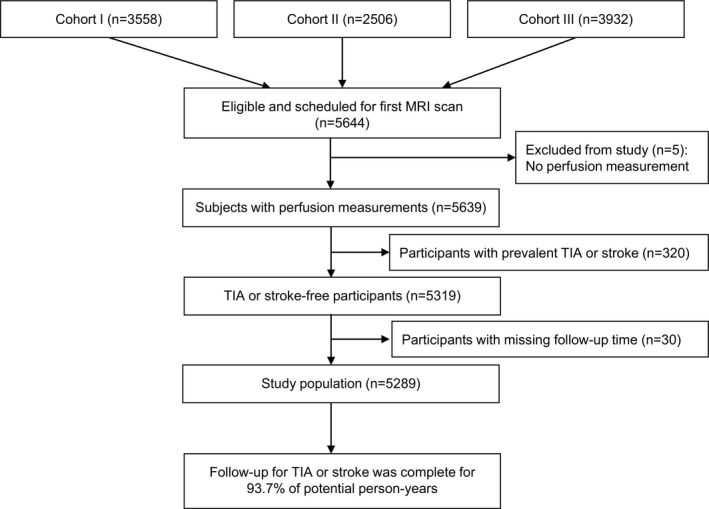
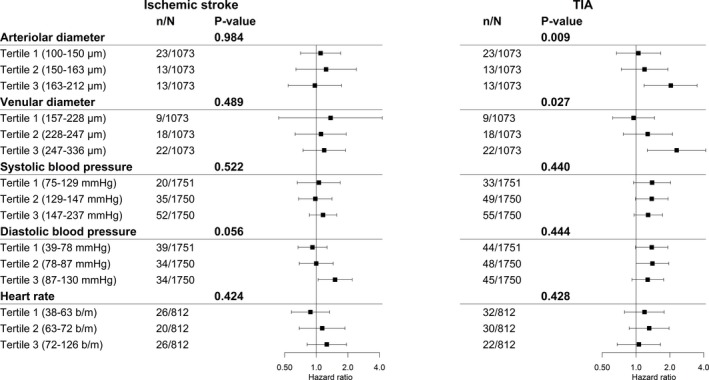
Background The role of subtle disturbances of brain perfusion in the risk of transient ischemic attack ( TIA) or ischemic stroke remains unknown. We examined the association between global brain perfusion and risk of TIA and ischemic stroke in the general population. Methods and Results Between 2005 and 2015, 5289 stroke-free participants (mean age, 64.3 years; 55.6% women) from the Rotterdam Study underwent phase-contrast brain magnetic resonance imaging at baseline to assess global brain perfusion. These participants were followed for incident TIA or ischemic stroke until January 1, 2016. We investigated associations between global brain perfusion (mL of blood flow/100 mL of brain/min) and risk of TIA and ischemic stroke using Cox regression models with adjustment for age, sex, and cardiovascular risk factors. Additionally, we investigated whether associations were modified by retinal vessel calibers, small and large vessel disease, blood pressure, and heart rate. During a median follow-up of 7.2 years (36 103 person-years), 137 participants suffered a TIA and another 108 an ischemic stroke. We found that lower global brain perfusion was associated with a higher risk of TIA , but not with the risk of ischemic stroke (adjusted hazard ratio, 95% CI, per standard deviation decrease of global brain perfusion: 1.29, 1.07-1.55 for TIA and adjusted hazard ratio of 1.06, 0.87-1.30 for ischemic stroke). Across strata of wider arteriolar retinal calibers, lower brain perfusion was more prominently associated with TIA , but not with ischemic stroke. Conclusions In a community-dwelling population, impaired global brain perfusion increased the risk of TIA , but not of ischemic stroke.
大脑灌注细微紊乱在短暂性脑缺血发作(TIA)或缺血性卒中风险中的作用仍不清楚。我们研究了全脑灌注与普通人群 TIA 和缺血性卒中风险之间的关系。
在 2005 年至 2015 年间,来自鹿特丹研究的 5289 名无卒中参与者(平均年龄 64.3 岁;55.6%为女性)在基线时接受了相位对比脑磁共振成像,以评估全脑灌注。这些参与者在随访期间发生 TIA 或缺血性卒中,直至 2016 年 1 月 1 日。我们使用 Cox 回归模型,在校正年龄、性别和心血管危险因素后,研究了全脑灌注(每 100 毫升脑血流的毫升数/分钟)与 TIA 和缺血性卒中风险之间的关系。此外,我们还研究了这些关联是否受到视网膜血管直径、小血管和大血管疾病、血压和心率的影响。在中位随访 7.2 年(36103 人年)期间,137 名参与者发生 TIA,108 名参与者发生缺血性卒中。我们发现,较低的全脑灌注与 TIA 风险升高相关,但与缺血性卒中风险无关(每标准偏差降低全脑灌注的调整后的危险比,95%CI:1.29,1.07-1.55 用于 TIA;调整后的危险比为 1.06,0.87-1.30 用于缺血性卒中)。在更宽的视网膜小动脉直径分层中,较低的脑灌注与 TIA 的关系更为明显,而与缺血性卒中无关。
在社区居住人群中,全脑灌注受损增加了 TIA 的风险,但不会增加缺血性卒中的风险。