Cycoń Mariusz, Mrozik Agnieszka, Piotrowska-Seget Zofia
Department of Microbiology and Virology, School of Pharmacy with the Division of Laboratory Medicine, Medical University of Silesia, Sosnowiec, Poland.
Department of Biochemistry, Faculty of Biology and Environmental Protection, University of Silesia, Katowice, Poland.
Front Microbiol. 2019 Mar 8;10:338. doi: 10.3389/fmicb.2019.00338. eCollection 2019.
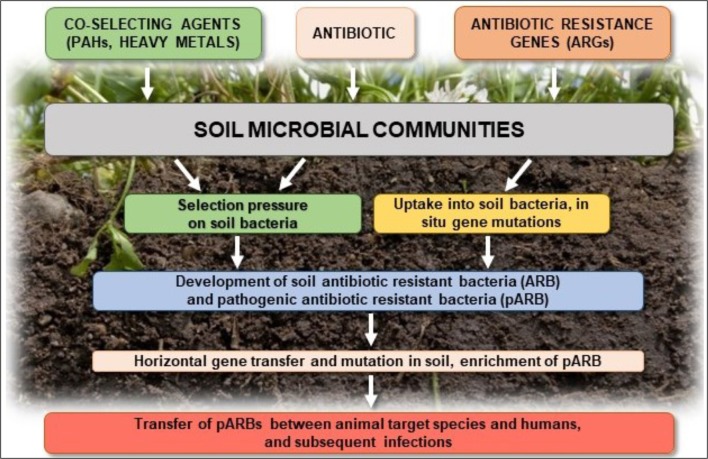
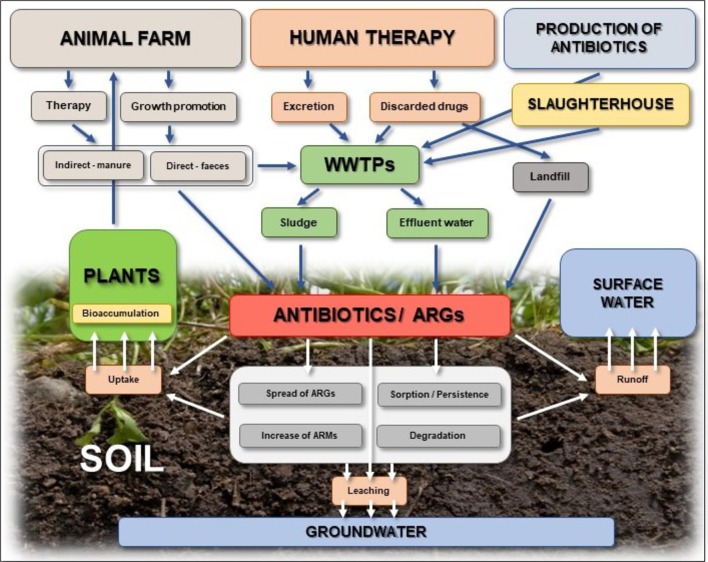
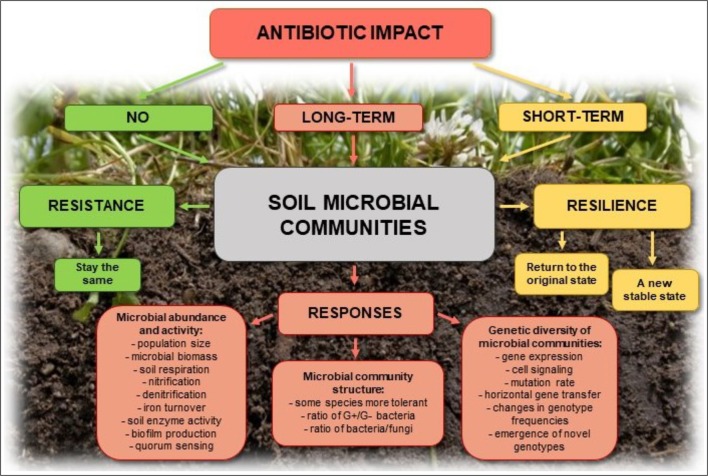
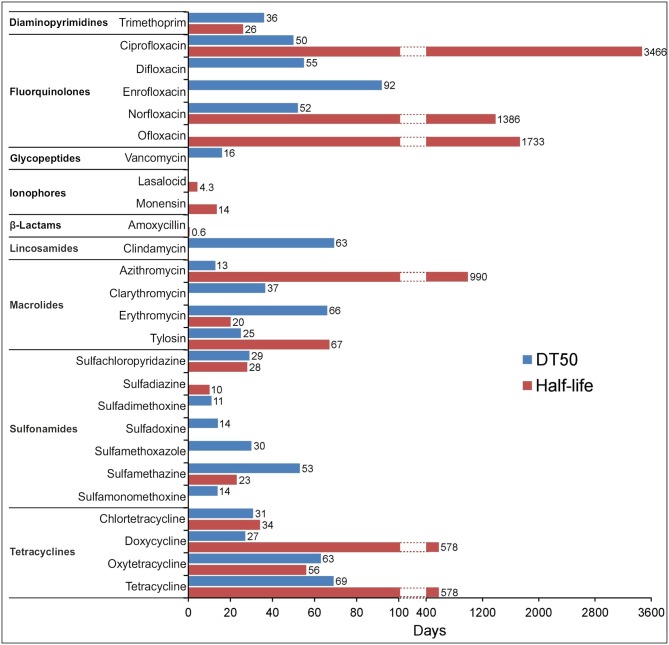
Antibiotics play a key role in the management of infectious diseases in humans, animals, livestock, and aquacultures all over the world. The release of increasing amount of antibiotics into waters and soils creates a potential threat to all microorganisms in these environments. This review addresses issues related to the fate and degradation of antibiotics in soils and the impact of antibiotics on the structural, genetic and functional diversity of microbial communities. Due to the emergence of bacterial resistance to antibiotics, which is considered a worldwide public health problem, the abundance and diversity of antibiotic resistance genes (ARGs) in soils are also discussed. When antibiotic residues enter the soil, the main processes determining their persistence are sorption to organic particles and degradation/transformation. The wide range of DT50 values for antibiotic residues in soils shows that the processes governing persistence depend on a number of different factors, e.g., physico-chemical properties of the residue, characteristics of the soil, and climatic factors (temperature, rainfall, and humidity). The results presented in this review show that antibiotics affect soil microorganisms by changing their enzyme activity and ability to metabolize different carbon sources, as well as by altering the overall microbial biomass and the relative abundance of different groups (i.e., Gram-negative bacteria, Gram-positive bacteria, and fungi) in microbial communities. Studies using methods based on analyses of nucleic acids prove that antibiotics alter the biodiversity of microbial communities and the presence of many types of ARGs in soil are affected by agricultural and human activities. It is worth emphasizing that studies on ARGs in soil have resulted in the discovery of new genes and enzymes responsible for bacterial resistance to antibiotics. However, many ambiguous results indicate that precise estimation of the impact of antibiotics on the activity and diversity of soil microbial communities is a great challenge.
抗生素在全球人类、动物、家畜和水产养殖的传染病管理中发挥着关键作用。越来越多的抗生素释放到水体和土壤中,对这些环境中的所有微生物构成了潜在威胁。本综述探讨了与抗生素在土壤中的归宿和降解以及抗生素对微生物群落结构、遗传和功能多样性的影响相关的问题。由于细菌对抗生素的耐药性出现,这被认为是一个全球性的公共卫生问题,因此还讨论了土壤中抗生素抗性基因(ARGs)的丰度和多样性。当抗生素残留进入土壤时,决定其持久性的主要过程是对有机颗粒的吸附以及降解/转化。土壤中抗生素残留的DT50值范围很广,这表明控制持久性的过程取决于许多不同因素,例如残留的物理化学性质、土壤特性和气候因素(温度、降雨和湿度)。本综述给出的结果表明,抗生素通过改变土壤微生物的酶活性和代谢不同碳源的能力,以及改变微生物群落中的总微生物生物量和不同群体(即革兰氏阴性菌、革兰氏阳性菌和真菌)的相对丰度来影响土壤微生物。使用基于核酸分析方法的研究证明,抗生素会改变微生物群落的生物多样性,并且土壤中多种类型ARGs的存在受农业和人类活动的影响。值得强调的是,对土壤中ARGs的研究发现了负责细菌抗生素抗性的新基因和酶。然而,许多模棱两可的结果表明,精确估计抗生素对土壤微生物群落活性和多样性的影响是一项巨大挑战。