Department of Pathology, Stanford University School of Medicine, Palo Alto, CA, USA.
Department of Veterans Affairs Medical Center, Center for Imaging of Neurodegenerative Diseases, San Francisco, CA, USA.
J Alzheimers Dis. 2019;68(3):1029-1038. doi: 10.3233/JAD-181009.
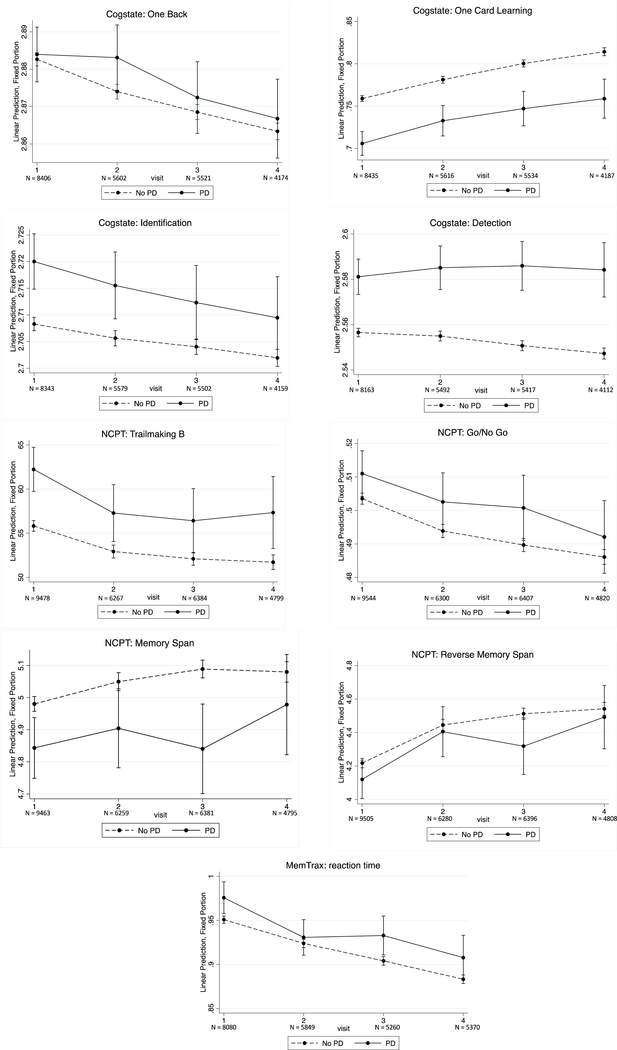
The study of cognition in Parkinson's disease (PD) traditionally requires exhaustive recruitment strategies. The current study examines data collected by the Brain Health Registry (BHR) to determine whether ongoing efforts to improve the recruitment base for therapeutic trials in Alzheimer's disease may be similarly effective for PD research, and whether online cognitive measurements can discriminate between participants who do and do not report a PD diagnosis. Participants enrolled in the BHR (age ≥50) with self-reported PD data and online cognitive testing available were included (n = 11,813). Associations between baseline cognitive variables and diagnostic group were analyzed using logistic regression. Linear mixed effects models were used to analyze longitudinal data. A total of 634 participants reported PD diagnosis at baseline with no self-reported cognitive impairment and completed cognitive testing. Measures of visual learning and memory, processing speed, attention, and working memory discriminated between self-reported PD and non-PD participants after correcting for multiple comparisons (p values < 0.006). Scores on all cognitive tests improved over time in PD and controls with the exception of processing speed, which remained stable in participants with PD while improving in those without. We demonstrate that a novel online approach to recruitment and longitudinal follow-up of study participants is effective for those with self-reported PD, and that significant differences exist between those with and without a reported diagnosis of PD on computerized cognitive measures. These results have important implications for recruitment of participants with PD into targeted therapeutic trials or large-scale genetic and cognitive studies.
帕金森病(PD)认知研究传统上需要详尽的招募策略。本研究通过脑健康注册中心(BHR)的数据来确定,针对阿尔茨海默病治疗试验的不断改进的招募基础是否也可能对 PD 研究有效,以及在线认知测量是否可以区分报告 PD 诊断和未报告 PD 诊断的参与者。研究纳入了 BHR 中(年龄≥50 岁)有自我报告 PD 数据和在线认知测试的参与者(n=11813)。使用逻辑回归分析了基线认知变量与诊断组之间的相关性。使用线性混合效应模型分析了纵向数据。共有 634 名参与者在基线时报告 PD 诊断且无自我报告认知障碍,并完成了认知测试。在进行多次比较校正(p 值<0.006)后,视觉学习和记忆、处理速度、注意力和工作记忆的测量值可以区分自我报告 PD 和非 PD 参与者。PD 和对照组的所有认知测试分数都随时间推移而提高,除了处理速度,PD 患者的处理速度保持稳定,而无 PD 的患者的处理速度则有所提高。我们证明了一种新颖的在线方法,用于招募和对有自我报告 PD 的参与者进行纵向随访是有效的,并且在报告的 PD 诊断存在与否的计算机化认知测量方面存在显著差异。这些结果对招募 PD 患者参加靶向治疗试验或大规模遗传和认知研究具有重要意义。