Department of Clinical, Neuro- and Developmental Psychology, Amsterdam Public Health Research Institute, Vrije Universiteit Amsterdam, Van der Boechorststraat 7, 1081BT Amsterdam, The Netherlands.
Department of Psychiatry, Rutgers-Robert Wood Johnson Medical School, Piscataway, 671 Hoes Lane, Piscataway, NJ 08854, USA.
Int J Environ Res Public Health. 2019 Mar 23;16(6):1051. doi: 10.3390/ijerph16061051.
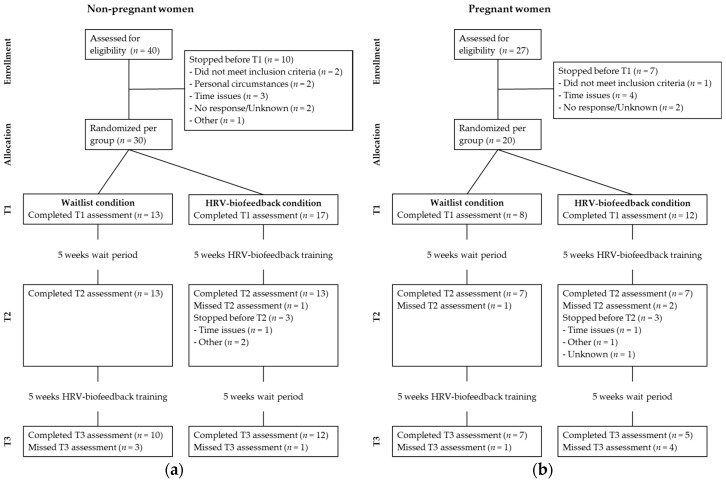
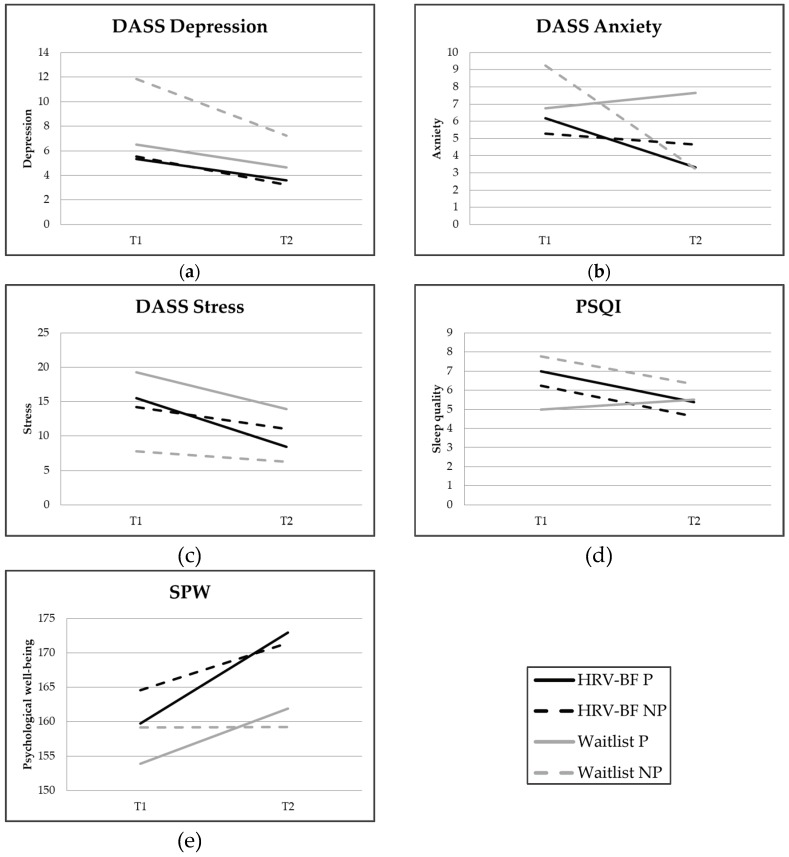
In this study, we examined the efficacy of heart rate variability (HRV)-biofeedback on stress and stress-related mental health problems in women. Furthermore, we examined whether the efficacy differed between pregnant and non-pregnant women. Fifty women (20 pregnant, 30 non-pregnant; mean age 31.6, = 5.9) were randomized into an intervention ( = 29) or a waitlist condition ( = 21). All participants completed questionnaires on stress, anxiety, depressive symptoms, sleep, and psychological well-being on three occasions with 6-week intervals. Women in the intervention condition received HRV-biofeedback training between assessment 1 and 2, and women in the waitlist condition received the intervention between assessment 2 and 3. The intervention consisted of a 5-week HRV-biofeedback training program with weekly 60⁻90 min. sessions and daily exercises at home. Results indicated a statistically significant beneficial effect of HRV-biofeedback on psychological well-being for all women, and an additional statistically significant beneficial effect on anxiety complaints for pregnant women. No significant effect was found for the other stress-related complaints. These findings support the use of HRV-biofeedback as a stress-reducing technique among women reporting stress and related complaints in clinical practice to improve their well-being. Furthermore, it supports the use of this technique for reducing anxiety during pregnancy.
在这项研究中,我们考察了心率变异性(HRV)生物反馈对女性压力和与压力相关的心理健康问题的疗效。此外,我们还考察了这种疗效在孕妇和非孕妇之间是否存在差异。五十名女性(20 名孕妇,30 名非孕妇;平均年龄 31.6, = 5.9)被随机分配到干预组( = 29)或等待名单组( = 21)。所有参与者在 6 周的间隔内分三次完成了关于压力、焦虑、抑郁症状、睡眠和心理幸福感的问卷。干预组在评估 1 和 2 之间接受 HRV 生物反馈训练,等待名单组在评估 2 和 3 之间接受干预。干预包括一个为期 5 周的 HRV 生物反馈训练计划,每周 60-90 分钟,在家中进行每日练习。结果表明,HRV 生物反馈对所有女性的心理幸福感都有统计学上显著的有益效果,对孕妇的焦虑症状也有额外的统计学上显著的有益效果。其他与压力相关的抱怨则没有显著效果。这些发现支持在临床实践中,将 HRV 生物反馈作为一种减轻压力的技术,用于报告压力和相关抱怨的女性,以提高她们的幸福感。此外,它还支持在怀孕期间使用这种技术来减轻焦虑。