Institute for Physical Activity, Fukuoka University, 8-19-1 Nanakuma, Jonan-ku, Fukuoka 814-0180, Japan.
Department of Nutrition and Metabolism, National Institute of Health and Nutrition, National Institutes of Biomedical Innovation, Health, and Nutrition, 1-23-1 Toyama, Shinjuku-ku, Tokyo 162-8636, Japan.
Nutrients. 2019 Mar 23;11(3):690. doi: 10.3390/nu11030690.
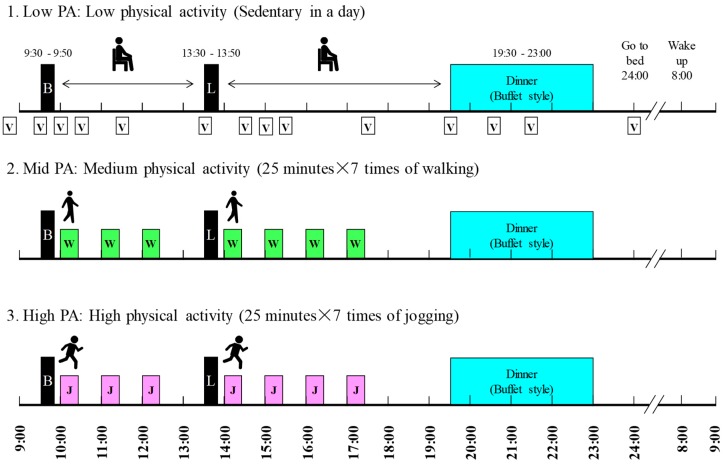
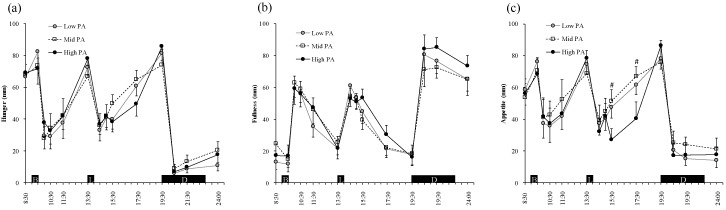
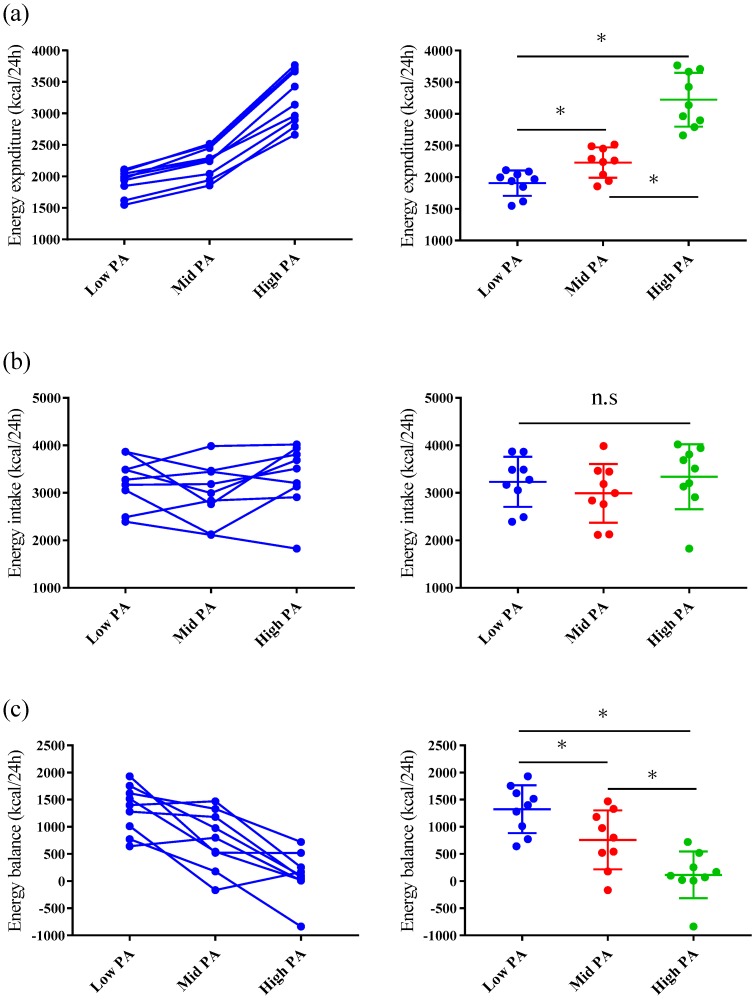
We aimed to investigate the effects of a wide range of daily physical activity (PA) levels on energy balance (EB), energy intake (EI), and appetite. Nine young men completed three different PA levels in a metabolic chamber in a random order: (1) no exercise (Low-PA); (2) 25 min walking seven times (Mid-PA); and (3) 25 min running seven times (High-PA) within a 24 h period. Interval exercise (25 min exercise and 35 min rest) was performed three times in the morning and four times in the afternoon. The exercise intensities were 21.6% and 53.7% V ˙ O₂ peak for the Mid-PA and High-PA days, respectively. Participants were served three standardized meals and a buffet for dinner. The 24 h EB was calculated as 24 h energy expenditure (EE) minus 24 h EI. The 24 h EEs for the Low-PA, Mid-PA, and High-PA days were 1907 ± 200, 2232 ± 240, and 3224 ± 426 kcal, respectively, with significant differences observed among the three conditions ( < 0.01 for Low-PA vs. Mid-PA, Low-PA vs. High-PA, and Mid-PA vs. High-PA, respectively). The 24 h EIs for the Low-PA, Mid-PA, and High-PA days were 3232 ± 528, 2991 ± 617, and 3337 ± 684 kcal, and were unaffected by PA levels ( = 0.115). The 24 h EBs were 1324 ± 441 kcal (Low-PA), 759 ± 543 kcal (Mid-PA), and 113 ± 430 kcal (High-PA), with significant differences observed between Low-PA vs. Mid-PA ( = 0.0496), Low-PA vs. High-PA ( ≤ 0.01), and Mid-PA vs. High-PA ( = 0.017) conditions. The EB in the Low-PA group was the highest of the three conditions. Appetite perception did not differ among the study days, however there was an interaction trend ( = 0.078, time × condition). Thus, significantly different daily PA did not affect 24 h EI, however markedly affected 24 h EB, implying that EB is not automatically matched during a single day.
我们旨在研究广泛的日常体力活动(PA)水平对能量平衡(EB)、能量摄入(EI)和食欲的影响。9 名年轻男性在代谢室内以随机顺序完成三种不同的 PA 水平:(1)不运动(低 PA);(2)25 分钟内步行 7 次(中 PA);和(3)25 分钟内跑步 7 次(高 PA),持续 24 小时。上午进行三次,下午进行四次间隔运动(25 分钟运动和 35 分钟休息)。中 PA 和高 PA 日的运动强度分别为 21.6%和 53.7%V˙O₂峰值。参与者被提供三份标准化餐食和一份自助晚餐。24 小时 EB 计算为 24 小时能量消耗(EE)减去 24 小时 EI。低 PA、中 PA 和高 PA 日的 24 小时 EE 分别为 1907 ± 200、2232 ± 240 和 3224 ± 426 kcal,三种条件之间存在显著差异(低 PA 与中 PA、低 PA 与高 PA、中 PA 与高 PA 相比,分别为 <0.01)。低 PA、中 PA 和高 PA 日的 24 小时 EI 分别为 3232 ± 528、2991 ± 617 和 3337 ± 684 kcal,不受 PA 水平的影响(=0.115)。24 小时 EB 分别为 1324 ± 441 kcal(低 PA)、759 ± 543 kcal(中 PA)和 113 ± 430 kcal(高 PA),低 PA 与中 PA 之间存在显著差异(=0.0496),低 PA 与高 PA(≤0.01)之间存在显著差异,中 PA 与高 PA 之间存在显著差异(=0.017)。低 PA 组的 EB 是三种条件中最高的。研究日期间,食欲感知没有差异,但存在交互趋势(=0.078,时间×条件)。因此,明显不同的日常 PA 不会影响 24 小时 EI,但明显影响 24 小时 EB,这意味着 EB 在一天内不会自动匹配。