Askew Deborah A, Guy Jillian, Lyall Vivian, Egert Sonya, Rogers Lynne, Pokino Leigh-Anne, Manton-Williams Peggy, Schluter Philip J
School of Clinical Medicine, Primary Care Clinical Unit, The University of Queensland, Royal Brisbane & Women's Hospital, Level 8 Health Sciences Building, Building 16/910, Brisbane, QLD, 4029, Australia.
Southern Queensland Centre of Excellence in Aboriginal and Torres Strait Islander Primary Health Care, Queensland Health, PO Box 52, Inala, QLD, 4077, Australia.
BMC Public Health. 2019 Mar 25;19(1):343. doi: 10.1186/s12889-019-6660-1.
Pregnancy can be a time of joy and a time of significant stress. For many Aboriginal and Torres Strait Islander (hereafter, respectfully, Indigenous) women, cigarette smoking, even during pregnancy, is a socially sanctioned behavioural response to stress. Indigenous women smoke during pregnancy at higher rates than their non-Indigenous counterparts.
A mixed methods, exploratory study, undertaken in an urban, Indigenous primary health care service, tested the impact and acceptability of a smoking cessation intervention for women pregnant with an Indigenous baby, their significant other (SO), and their primary health care service. The intervention included case management, incentivised smoking cessation support and culturally-based art activities.
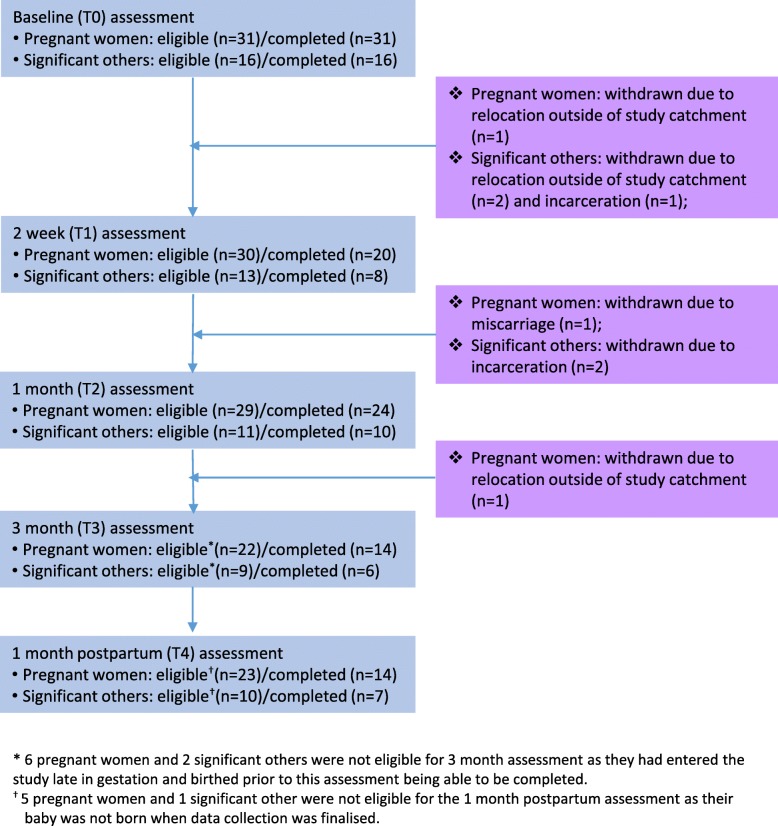
Thirty-one pregnant women and 16 SOs participated. Nearly half attempted to quit at least once during the study, 36% (4/11) of pregnant women had quit at the 3 month assessment and two remained smoke free 1 month postpartum. Most participants self-reported a reduction in tobacco smoking. Exhaled CO confirmed this for SOs (mean reduction - 2.2 ppm/assessment wave, 95% CI: -4.0, - 0.4 ppm/assessment wave, p = 0.015) but not for pregnant women. Many participants experienced social and economic vulnerabilities, including housing and financial insecurity and physical safety concerns.
Tobacco smoking is normalised and socially sanctioned in Indigenous communities and smoking is frequently a response to the multitude of stressors and challenges that Indigenous people experience on a daily basis. Smoking cessation interventions for pregnant Indigenous women must be cognisant of the realities of their private lives where the smoking occurs, in addition to the impact of the broader societal context. Narrow definitions of success focussing only on smoking cessation ignore the psychological benefit of empowering women and facilitating positive changes in smoking behaviours. Our smoking cessation intervention supported pregnant women and their SOs to manage these stressors and challenges, thereby enabling them to develop a solid foundation from which they could address their smoking. A broad definition of success in this space is required: one that celebrates positive smoking behaviour changes in addition to cessation.
怀孕可能是一段充满喜悦的时光,也可能是压力巨大的时期。对于许多原住民和托雷斯海峡岛民(以下简称“原住民”)女性来说,吸烟,即使是在孕期吸烟,也是一种社会认可的应对压力的行为方式。原住民女性孕期吸烟率高于非原住民女性。
在一家城市原住民初级卫生保健服务机构开展了一项混合方法的探索性研究,测试了一项戒烟干预措施对怀有原住民宝宝的孕妇、其重要他人(SO)以及她们的初级卫生保健服务机构的影响和可接受性。该干预措施包括病例管理、激励性戒烟支持以及基于文化的艺术活动。
31名孕妇和16名重要他人参与了研究。近一半人在研究期间至少尝试戒烟一次,36%(4/11)的孕妇在3个月评估时已戒烟,两人在产后1个月仍保持不吸烟状态。大多数参与者自我报告吸烟量减少。呼出一氧化碳检测结果证实重要他人的吸烟量减少了(平均减少-2.2 ppm/评估周期,95%置信区间:-4.0,-0.4 ppm/评估周期,p = 0.015),但孕妇的情况未得到证实。许多参与者面临社会和经济方面的脆弱性,包括住房和经济不安全以及人身安全问题。
在原住民社区,吸烟被视为正常现象且得到社会认可,吸烟常常是对原住民每天所经历的众多压力源和挑战的一种应对方式。针对怀孕原住民女性的戒烟干预措施,除了要考虑更广泛社会背景的影响外,还必须认识到她们吸烟时私人生活的实际情况。仅关注戒烟的狭义成功定义忽略了赋予女性权力以及促进吸烟行为积极改变所带来的心理益处。我们的戒烟干预措施支持孕妇及其重要他人应对这些压力源和挑战,从而使她们能够奠定一个坚实基础来解决吸烟问题。在这个领域需要一个广义的成功定义:一个除了庆祝戒烟外还认可吸烟行为积极改变的定义。