• 文献检索
  • 文档翻译
  • 深度研究
  • 学术资讯
  • Suppr Zotero 插件Zotero 插件
  • 邀请有礼
  • 套餐&价格
  • 历史记录
应用&插件
Suppr Zotero 插件Zotero 插件浏览器插件Mac 客户端Windows 客户端微信小程序
定价
高级版会员购买积分包购买API积分包
服务
文献检索文档翻译深度研究API 文档MCP 服务
关于我们
关于 Suppr公司介绍联系我们用户协议隐私条款
关注我们

Suppr 超能文献

核心技术专利:CN118964589B侵权必究
粤ICP备2023148730 号-1Suppr @ 2026

文献检索

告别复杂PubMed语法,用中文像聊天一样搜索,搜遍4000万医学文献。AI智能推荐,让科研检索更轻松。

立即免费搜索

文件翻译

保留排版,准确专业,支持PDF/Word/PPT等文件格式,支持 12+语言互译。

免费翻译文档

深度研究

AI帮你快速写综述,25分钟生成高质量综述,智能提取关键信息,辅助科研写作。

立即免费体验

家是甜蜜的:沙蝇在巴西东北部偏远的土著村落找到了避难所,那里是利什曼病的流行地区。

Home sweet home: sand flies find a refuge in remote indigenous villages in north-eastern Brazil, where leishmaniasis is endemic.

机构信息

Department of Immunology, Aggeu Magalhães Institute, Oswaldo Cruz Foundation (Fiocruz), Recife, Brazil.

State Secretary of Health of Pernambuco, Recife, Brazil.

出版信息

Parasit Vectors. 2019 Mar 26;12(1):118. doi: 10.1186/s13071-019-3383-1.

DOI:10.1186/s13071-019-3383-1
PMID:30909958
原文链接:https://pmc.ncbi.nlm.nih.gov/articles/PMC6434633/
Abstract

BACKGROUND

From 2012 to 2013, an outbreak of cutaneous leishmaniasis by Leishmania braziliensis was detected in indigenous villages located in a remote rural area of Pernambuco state, north-eastern Brazil. Considering that the principal activities of this indigenous community are farming and crop plantation, and also that the outbreak involved many children, we investigated the presence of sand fly vectors inside human houses and also the exposure of dogs to leishmanial parasites. Our general objective was to gather epidemiological data that could indicate the occurrence of a peri-domestic/domestic transmission cycle of L. braziliensis in these indigenous villages.

METHODS

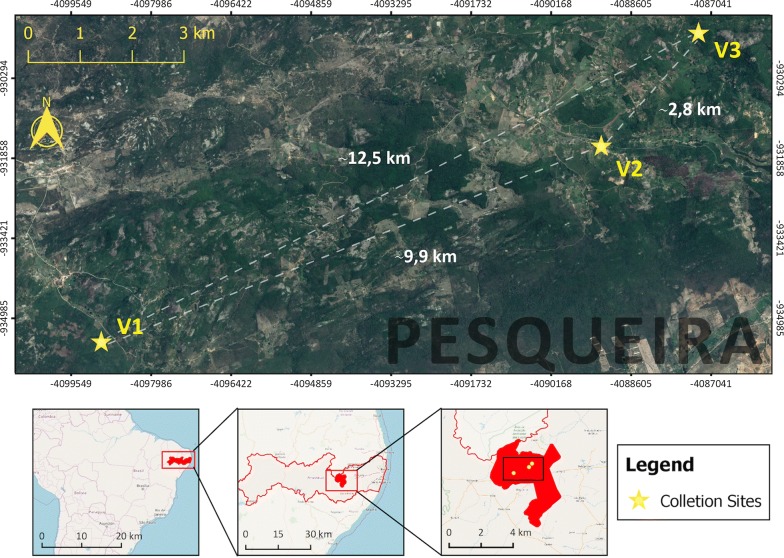
From March 2015 to March 2016, sand flies were collected using light traps in the indoor and immediate outdoor environments in the three indigenous villages that reported the most cutaneous leishmaniasis cases during the 2012-2013 outbreak. Moreover, samples obtained from 300 dogs living in the outbreak villages and two nearby villages were tested by a rapid immunochromatographic test and by a real-time PCR for detecting anti-Leishmania antibodies and Leishmania DNA, respectively.

RESULTS

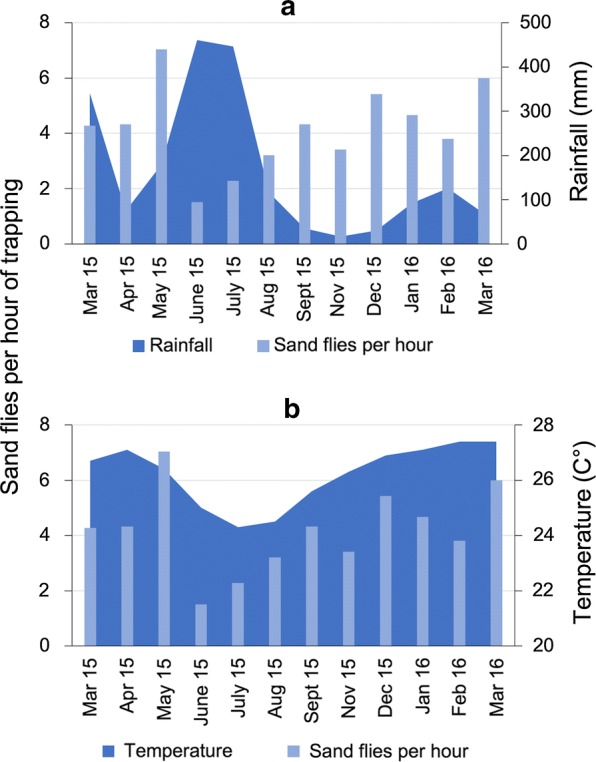
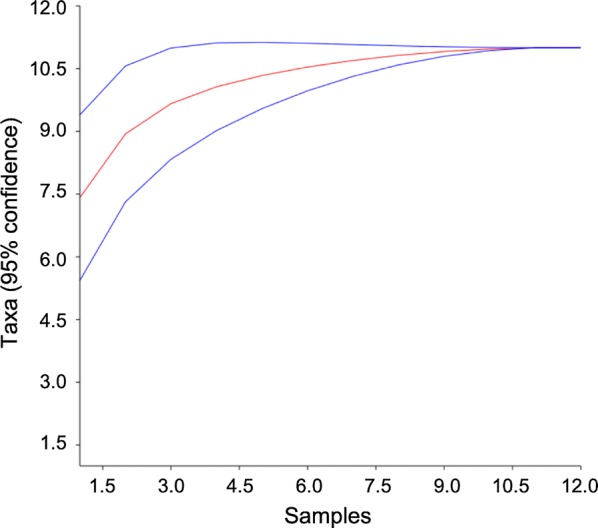
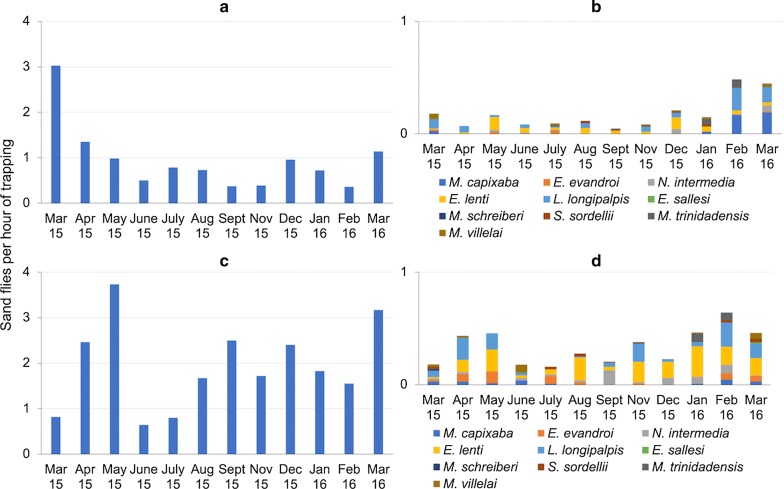
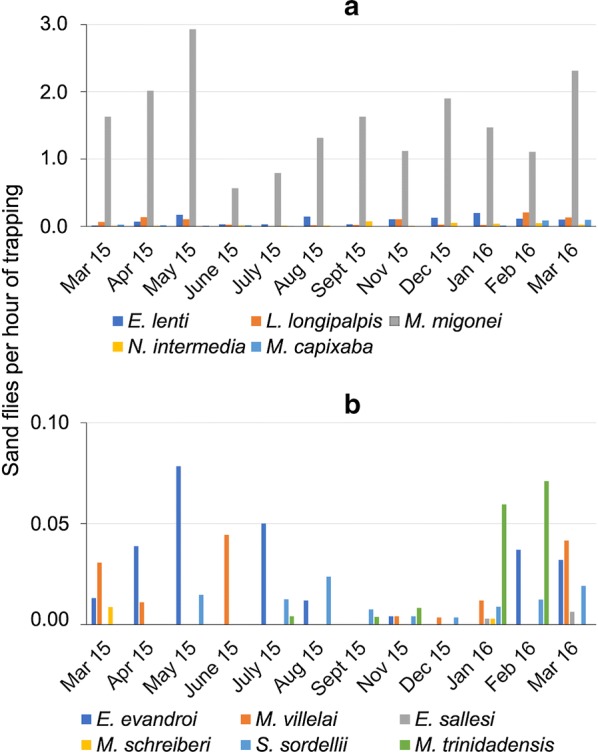
In total, 5640 sand flies belonging to 11 species were identified. Males (n = 3540) predominated over females (n = 2100). Migonemyia migonei (84.3%) was the most abundant species, followed by Evandromyia lenti (5.5%), Lutzomyia longipalpis (4.1%), Nyssomyia intermedia (1.6%) and Micropygomyia capixaba (1.4%), representing together ~97% of the sand flies collected. Nine out of the 11 species identified in this study were found indoors, including M. migonei, L. longipalpis and N. intermedia, which are proven vectors of Leishmania spp. Out of 300 dogs tested, 26 (8.7%) presented anti-Leishmania antibodies and six (2%) were Leishmania DNA-positive. The level of exposure in dogs living in the indigenous villages where the 2012-2013 outbreak of human CL was detected was almost 2-fold higher than in the two nearby villages (11.0 vs 6.2% for serology and 2.6 vs 1.4% for real-time PCR).

CONCLUSIONS

The results suggest that different sand fly vectors may be adapted to human dwellings, thus increasing the risk of transmission in the indoor and immediate outdoor environments. The adaptation of sand flies to the indoor environment in the studied indigenous villages may be partly explained by the poor housing conditions and the proximity of the houses to crop plantations and forest fragments.

摘要

背景

2012 年至 2013 年,巴西东北部伯南布哥州偏远农村的土著村落爆发了巴西利什曼原虫引起的皮肤利什曼病。考虑到该土著社区的主要活动是农业和作物种植,而且疫情涉及许多儿童,我们调查了屋内和附近环境中沙蝇媒介的存在情况,以及狗对利什曼原虫寄生虫的暴露情况。我们的总体目标是收集流行病学数据,以表明在这些土著村落中存在巴西利什曼原虫的家庭/家庭内传播周期。

方法

2015 年 3 月至 2016 年 3 月,在 2012-2013 年疫情期间报告皮肤利什曼病病例最多的三个土著村落,使用诱捕器在室内和室外环境中收集沙蝇。此外,对居住在疫情村和两个附近村庄的 300 只狗的样本进行了快速免疫层析试验和实时 PCR 检测,以检测抗利什曼原虫抗体和利什曼原虫 DNA。

结果

共鉴定出 5640 只沙蝇,属于 11 种。雄性(n=3540)多于雌性(n=2100)。米戈尼米亚·米戈内(Migonemyia migonei)(84.3%)是最丰富的物种,其次是埃文达米亚·伦蒂(Evandromyia lenti)(5.5%)、鲁氏利什曼原虫(Lutzomyia longipalpis)(4.1%)、尼西米亚·因特梅迪亚(Nyssomyia intermedia)(1.6%)和米克洛皮加米亚·卡皮萨巴(Micropygomyia capixaba)(1.4%),这 11 种沙蝇占采集沙蝇的 97%左右。本研究鉴定的 11 种中有 9 种在室内发现,包括米戈内米亚·米戈内(Migonemyia migonei)、鲁氏利什曼原虫(Lutzomyia longipalpis)和尼西米亚·因特梅迪亚(Nyssomyia intermedia),它们是利什曼原虫属的已知媒介。在 300 只接受检测的狗中,有 26 只(8.7%)呈抗利什曼原虫抗体阳性,6 只(2%)呈利什曼原虫 DNA 阳性。在检测到 2012-2013 年人类 CL 疫情的土著村落中,生活的狗的暴露水平几乎是两个附近村庄的两倍(血清学为 11.0%对 6.2%,实时 PCR 为 2.6%对 1.4%)。

结论

结果表明,不同的沙蝇媒介可能适应人类居住环境,从而增加了室内和室外环境中的传播风险。在研究的土著村落中,沙蝇适应室内环境的部分原因可能是住房条件差,房屋靠近种植园和森林碎片。
https://cdn.ncbi.nlm.nih.gov/pmc/blobs/958a/6434633/89af0c89be0b/13071_2019_3383_Fig5_HTML.jpg
https://cdn.ncbi.nlm.nih.gov/pmc/blobs/958a/6434633/248f97f93cf1/13071_2019_3383_Fig1_HTML.jpg
https://cdn.ncbi.nlm.nih.gov/pmc/blobs/958a/6434633/ff906d8d4334/13071_2019_3383_Fig2_HTML.jpg
https://cdn.ncbi.nlm.nih.gov/pmc/blobs/958a/6434633/16b68ee98a96/13071_2019_3383_Fig3_HTML.jpg
https://cdn.ncbi.nlm.nih.gov/pmc/blobs/958a/6434633/f034a7fb8040/13071_2019_3383_Fig4_HTML.jpg
https://cdn.ncbi.nlm.nih.gov/pmc/blobs/958a/6434633/89af0c89be0b/13071_2019_3383_Fig5_HTML.jpg
https://cdn.ncbi.nlm.nih.gov/pmc/blobs/958a/6434633/248f97f93cf1/13071_2019_3383_Fig1_HTML.jpg
https://cdn.ncbi.nlm.nih.gov/pmc/blobs/958a/6434633/ff906d8d4334/13071_2019_3383_Fig2_HTML.jpg
https://cdn.ncbi.nlm.nih.gov/pmc/blobs/958a/6434633/16b68ee98a96/13071_2019_3383_Fig3_HTML.jpg
https://cdn.ncbi.nlm.nih.gov/pmc/blobs/958a/6434633/f034a7fb8040/13071_2019_3383_Fig4_HTML.jpg
https://cdn.ncbi.nlm.nih.gov/pmc/blobs/958a/6434633/89af0c89be0b/13071_2019_3383_Fig5_HTML.jpg

相似文献

1
Home sweet home: sand flies find a refuge in remote indigenous villages in north-eastern Brazil, where leishmaniasis is endemic.家是甜蜜的:沙蝇在巴西东北部偏远的土著村落找到了避难所,那里是利什曼病的流行地区。
Parasit Vectors. 2019 Mar 26;12(1):118. doi: 10.1186/s13071-019-3383-1.
2
Epidemiological aspects of vector, parasite, and domestic reservoir in areas of recent transmission and no reported human cases of visceral leishmaniasis in Brazil.巴西近期有内脏利什曼病传播但无人类病例报告地区的病媒、寄生虫和家庭宿主的流行病学情况。
Acta Trop. 2015 Aug;148:128-36. doi: 10.1016/j.actatropica.2015.04.002. Epub 2015 Apr 14.
3
Ecology, feeding and natural infection by Leishmania spp. of phlebotomine sand flies in an area of high incidence of American tegumentary leishmaniasis in the municipality of Rio Branco, Acre, Brazil.巴西阿克里州里布朗库市一个皮肤利什曼病高发地区的白蛉科吸血昆虫的生态学、摄食习性和利什曼原虫的自然感染情况。
Parasit Vectors. 2018 Jan 26;11(1):64. doi: 10.1186/s13071-018-2641-y.
4
The sand fly fauna (Psychodidae: Phlebotominae) in the region of Saquarema, State of Rio de Janeiro, Brazil, an endemic area of cutaneous leishmaniasis transmission.巴西里约热内卢州萨夸雷马地区的白蛉种群(蛾蠓科:白蛉亚科),该地区是皮肤利什曼病传播的流行区。
J Vector Ecol. 2011 Mar;36 Suppl 1:S95-8. doi: 10.1111/j.1948-7134.2011.00117.x.
5
Composition of sand fly fauna (Diptera: Psychodidae) and detection of Leishmania DNA (Kinetoplastida: Trypanosomatidae) in different ecotopes from a rural settlement in the central Amazon, Brazil.沙蝇区系组成(双翅目:长角亚目)和巴西亚马逊中部一个农村定居点不同生态区莱什曼原虫 DNA(动基体目:锥虫科)的检测。
Parasit Vectors. 2018 Mar 13;11(1):180. doi: 10.1186/s13071-018-2743-6.
6
Molecular detection of Leishmania in phlebotomine sand flies (Diptera: Psychodidae) from a cutaneous leishmaniasis focus atXakriabá Indigenous Reserve, Brazil.在巴西沙克里亚巴印第安人保护区一个皮肤利什曼病疫源地的白蛉(双翅目:毛蠓科)中利什曼原虫的分子检测
PLoS One. 2015 Apr 8;10(4):e0122038. doi: 10.1371/journal.pone.0122038. eCollection 2015.
7
Leishmania infantum detection in Nyssomyia neivai and dogs in Southern Brazil.在巴西南部的内氏按蚊和犬中检测利什曼原虫。
Parasit Vectors. 2024 Jun 25;17(1):269. doi: 10.1186/s13071-024-06336-z.
8
Ecological Aspects of Phlebotomine Sand Flies (Diptera, Psychodidae, Phlebotominae) in Areas of American Cutaneous Leishmaniasis, in the Municipality of Paraty, Rio de Janeiro, Brazil. I-Index of Abundance by Location and Type of Capture.巴西里约热内卢州帕拉蒂市美洲皮肤利什曼病流行区白蛉(双翅目,蛾蠓科,白蛉亚科)的生态学研究。I - 按地点和捕获类型划分的丰度指数
J Med Entomol. 2015 Sep;52(5):886-95. doi: 10.1093/jme/tjv105. Epub 2015 Jul 25.
9
Ecology of sand flies in a low-density residential rural area, with mixed forest/agricultural exploitation, in north-eastern Brazil.巴西东北部一个低密度农村居民区的白蛉生态,该地区森林与农业混合开发。
Acta Trop. 2015 Jun;146:89-94. doi: 10.1016/j.actatropica.2015.03.011. Epub 2015 Mar 16.
10
Molecular Detection of Leishmania in Sand Flies (Diptera: Psychodidae: Phlebotominae) Collected in the Caititu Indigenous Reserve of the Municipality of Lábrea, State of Amazonas, Brazil.在巴西亚马孙州拉布雷阿市凯蒂图印第安保护区采集的白蛉(双翅目:毛蠓科:白蛉亚科)中利什曼原虫的分子检测
J Med Entomol. 2014 Nov 1;51(6):1276-82. doi: 10.1603/ME14025.

引用本文的文献

1
Juvenile Canine Leishmaniosis: A Systematic Literature Review and an Atypical Clinical Case.幼年犬利什曼病:系统文献综述及一例非典型临床病例
Vet Sci. 2025 Jul 10;12(7):653. doi: 10.3390/vetsci12070653.
2
Leishmaniases in a tropical area of Brazil: a spatio-temporal analysis.巴西热带地区的利什曼病:时空分析
J Parasit Dis. 2023 Sep;47(3):556-561. doi: 10.1007/s12639-023-01600-y. Epub 2023 Jun 2.
3
Canine visceral leishmaniasis: risk factors and spatial analysis in an endemic area of Northeastern Brazil.犬内脏利什曼病:巴西东北部流行地区的风险因素和空间分析。

本文引用的文献

1
Level of agreement between two commercially available rapid serological tests and the official screening test used to detect Leishmania seropositive dogs in Brazil.两种市售快速血清学检测方法与巴西用于检测利什曼原虫血清阳性犬的官方筛查检测方法之间的一致性水平。
Vet J. 2018 Apr;234:102-104. doi: 10.1016/j.tvjl.2018.02.007. Epub 2018 Feb 14.
2
New Records of Phlebotomine Sand Flies (Diptera: Psychodidae) From the State of Alagoas, Northeast of Brazil.巴西东北部阿拉戈斯州白蛉(双翅目:蛾蠓科)新记录
J Med Entomol. 2018 Jan 10;55(1):242-247. doi: 10.1093/jme/tjx175.
3
Sandfly fauna (Diptera: Psychodidae) in an urban area, Central-West of Brazil.
Rev Bras Parasitol Vet. 2023 May 22;32(2):e003223. doi: 10.1590/S1984-29612023029. eCollection 2023.
4
Data-driven predictions of potential Leishmania vectors in the Americas.基于数据的美洲潜在利什曼原虫传播媒介预测。
PLoS Negl Trop Dis. 2023 Feb 21;17(2):e0010749. doi: 10.1371/journal.pntd.0010749. eCollection 2023 Feb.
5
Determinants of cutaneous leishmaniasis among students in Delanta district, Northeast Ethiopia: A case-control study.埃塞俄比亚东北部德兰塔区学生皮肤利什曼病的决定因素:一项病例对照研究。
Health Sci Rep. 2022 Oct 31;5(6):e917. doi: 10.1002/hsr2.917. eCollection 2022 Nov.
6
Evidence against Zika virus infection of pets and peri-domestic animals in Latin America and Africa.尚无证据表明宠物和半驯化动物(拉丁美洲和非洲)感染寨卡病毒。
J Gen Virol. 2022 Jan;103(1). doi: 10.1099/jgv.0.001709.
7
Evaluation of different storage times and preservation methods on phlebotomine sand fly DNA concentration and purity.不同保存时间和保存方法对采采蝇 DNA 浓度和纯度的影响评价。
Parasit Vectors. 2020 Aug 6;13(1):399. doi: 10.1186/s13071-020-04270-4.
8
Fast multiplex real-time PCR assay for simultaneous detection of dog and human blood and Leishmania parasites in sand flies.快速多重实时 PCR 检测法用于同时检测沙蝇中的犬和人血及利什曼原虫寄生虫。
Parasit Vectors. 2020 Apr 21;13(1):131. doi: 10.1186/s13071-020-3994-6.
巴西中西部城市地区的白蛉动物区系(双翅目:蛾蠓科)
Rev Inst Med Trop Sao Paulo. 2017 Aug 24;59:e54. doi: 10.1590/S1678-9946201759054.
4
Exposure to vector-borne pathogens in privately owned dogs living in different socioeconomic settings in Brazil.巴西不同社会经济环境下私人饲养犬只接触媒介传播病原体的情况。
Vet Parasitol. 2017 Aug 30;243:18-23. doi: 10.1016/j.vetpar.2017.05.020. Epub 2017 May 22.
5
Epidemiological aspects of American cutaneous leishmaniasis (ACL) in an endemic area of forest extractivist culture in western Brazilian Amazonia.巴西亚马孙西部森林采集文化流行地区美洲皮肤利什曼病(ACL)的流行病学特征
Rev Inst Med Trop Sao Paulo. 2017 Apr 13;59:e12. doi: 10.1590/S1678-9946201759012.
6
Sand fly population dynamics and cutaneous leishmaniasis among soldiers in an Atlantic forest remnant in northeastern Brazil.巴西东北部大西洋森林遗迹地区士兵中白蛉种群动态与皮肤利什曼病
PLoS Negl Trop Dis. 2017 Feb 27;11(2):e0005406. doi: 10.1371/journal.pntd.0005406. eCollection 2017 Feb.
7
Sandflies (Diptera: Psychodidae) in an urban area of Northeastern Brazil.巴西东北部城市地区的白蛉(双翅目:蛾蠓科)
Rev Soc Bras Med Trop. 2016 Nov-Dec;49(6):698-702. doi: 10.1590/0037-8682-0147-2016.
8
RISK FACTORS ASSOCIATED WITH AMERICAN CUTANEOUS LEISHMANIASIS IN AN ENDEMIC AREA OF BRAZIL.巴西某流行地区与美洲皮肤利什曼病相关的风险因素
Rev Inst Med Trop Sao Paulo. 2016 Dec 8;58:86. doi: 10.1590/S1678-9946201658086.
9
Frequency and diversity of phlebotomine sand flies (Diptera: Psychodidae) in Sinop, State of Mato Grosso, Brazil.巴西马托格罗索州锡诺普市的白蛉(双翅目:蛾蠓科)的频率和多样性
Rev Soc Bras Med Trop. 2016 Sep-Oct;49(5):544-552. doi: 10.1590/0037-8682-0251-2016.
10
Lutzomyia migonei is a permissive vector competent for Leishmania infantum.米氏白蛉是一种对婴儿利什曼原虫易感的传播媒介。
Parasit Vectors. 2016 Mar 17;9:159. doi: 10.1186/s13071-016-1444-2.