Kim Jae-Young, Bin Seong-Il, Kim Jong-Min, Lee Bum-Sik, Oh Sung-Mok, Cho Won-Joon
Department of Orthopedic Surgery, Asan Medical Center, University of Ulsan College of Medicine, Seoul, Republic of Korea.
Orthop J Sports Med. 2019 Mar 18;7(3):2325967119827945. doi: 10.1177/2325967119827945. eCollection 2019 Mar.
Degenerative medial meniscus posterior root tears (MMPRTs) are reportedly associated with medial compartment osteoarthritis and meniscal extrusion with a displaced gap from the root insertion. However, degenerative MMPRTs have not yet been clearly classified according to arthroscopic findings.
To classify degenerative MMPRTs according to the tear gap and to investigate how the classification could reflect the joint condition properly.
Cohort study; Level of evidence, 3.
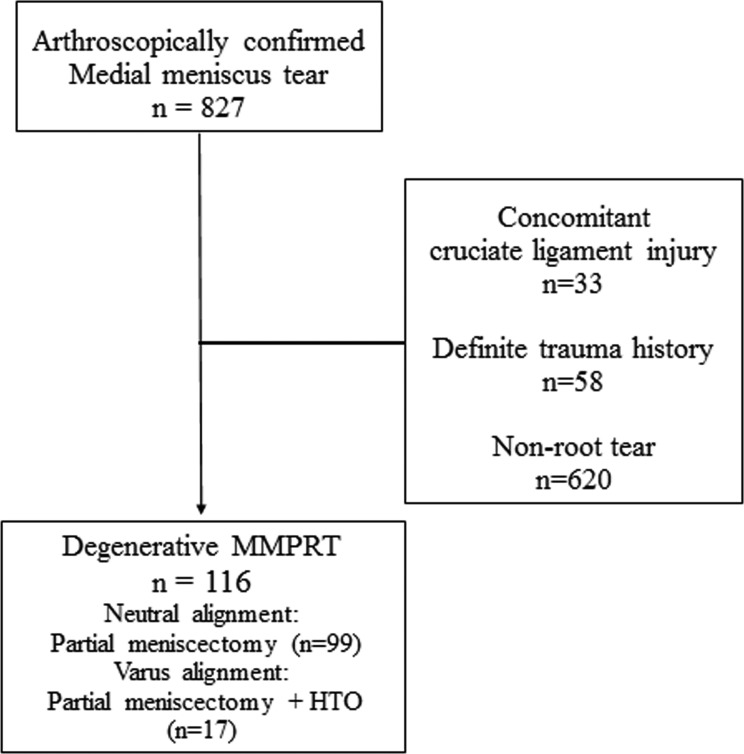
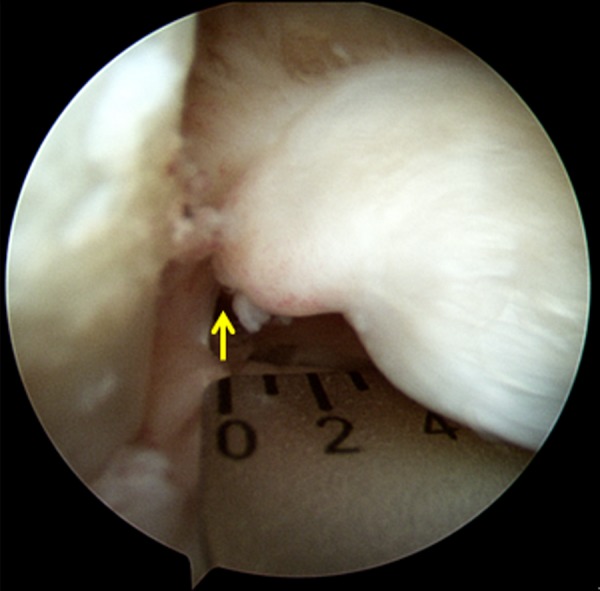
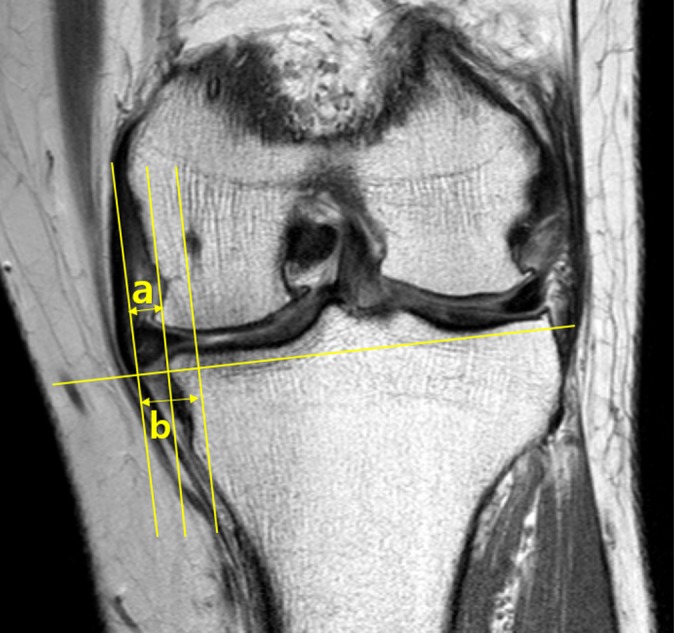
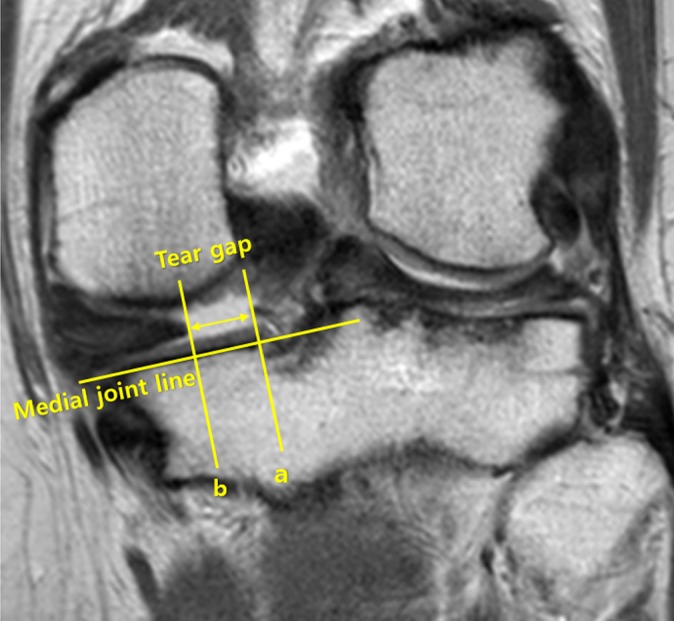
Patients who underwent arthroscopic surgery, performed by a single orthopaedic surgeon, for degenerative MMPRTs between August 2006 and February 2017 were included. MMPRTs were classified according to tear patterns observed during arthroscopic surgery (type 1, incomplete root tear; types 2-5, complete root tears), with each type further divided by the size of the tear gap, defined as the degree of tear displacement from the root (type 2, no gap or overlapped; type 3, gap of 1-3 mm; type 4, gap of 4-6 mm; type 5, gap of ≥7 mm). We compared preoperative factors, including the Kellgren-Lawrence (K-L) grade, absolute extrusion, relative percentage of extrusion (RPE), tear gap on magnetic resonance imaging (MRI), and mechanical alignment, as well as intraoperative factors, including chondral wear at surgery, between each MMPRT type.
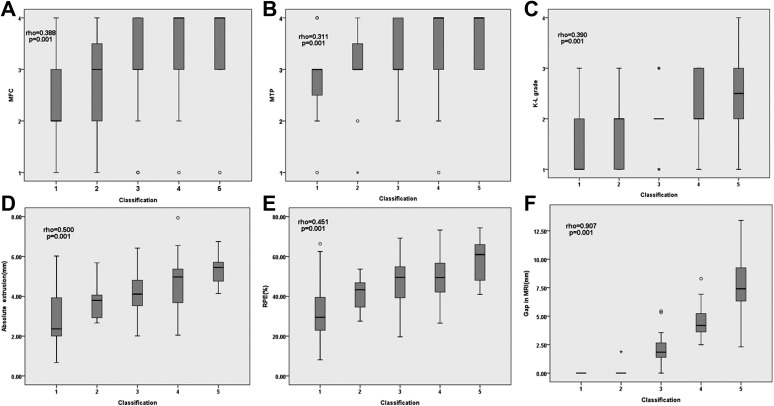
A total of 116 root tears were categorized according to this classification: type 1, 16.4% (19 knees); type 2, 9.5% (11 knees); type 3, 40.5% (47 knees); type 4, 25.0% (29 knees); and type 5, 8.6% (10 knees). Chondral wear of the medial femoral condyle (MFC) ( = .001), K-L grade ( = .001), meniscal extrusion ( = .001), and tear gap on MRI ( = .001) showed a tendency to increase with a higher tear type. Chondral wear (ρ for MFC = 0.388; ρ for MTP = 0.311), K-L grade (ρ = 0.390), and meniscal extrusion (ρ for absolute extrusion = 0.500; ρ for RPE = 0.451) showed a moderate correlation with tear type, whereas tear gap on MRI (ρ = 0.907) showed a strong correlation with tear type.
Our study introduces a new classification based on the tear gap that can concisely describe a degenerative MMPRT. The classification system demonstrated that a higher tear type (increasing displacement of the tear gap in arthroscopic surgery) is associated with higher meniscal extrusion, severe chondral wear, and greater severity of arthritis.
据报道,退行性内侧半月板后根撕裂(MMPRTs)与内侧间室骨关节炎和半月板挤出有关,且根部插入处存在移位间隙。然而,根据关节镜检查结果,退行性MMPRTs尚未得到明确分类。
根据撕裂间隙对退行性MMPRTs进行分类,并研究该分类如何恰当地反映关节状况。
队列研究;证据等级,3级。
纳入2006年8月至2017年2月间由一名骨科医生进行关节镜手术治疗退行性MMPRTs的患者。根据关节镜手术中观察到的撕裂模式对MMPRTs进行分类(1型,不完全根部撕裂;2 - 5型,完全根部撕裂),每种类型再根据撕裂间隙大小进一步划分,撕裂间隙定义为从根部的撕裂移位程度(2型,无间隙或重叠;3型,间隙为1 - 3毫米;4型,间隙为4 - 6毫米;5型,间隙≥7毫米)。我们比较了术前因素,包括凯尔格伦 - 劳伦斯(K - L)分级、绝对挤出量、相对挤出百分比(RPE)、磁共振成像(MRI)上的撕裂间隙以及机械对线情况,以及术中因素,包括手术时软骨磨损情况,比较各MMPRT类型之间的差异。
根据该分类共对116例根部撕裂进行了分类:1型,16.4%(19膝);2型,9.5%(11膝);3型,40.5%(47膝);4型,25.0%(29膝);5型,8.6%(10膝)。股骨内侧髁(MFC)的软骨磨损(P = 0.001)、K - L分级(P = 0.001)、半月板挤出(P = 0.001)以及MRI上的撕裂间隙(P = 0.001)均呈现出随着撕裂类型增高而增加的趋势。软骨磨损(MFC的ρ = 0.388;胫骨平台内侧的ρ = 0.311)、K - L分级(ρ = 0.390)以及半月板挤出(绝对挤出量的ρ = 0.500;RPE的ρ = 0.451)与撕裂类型呈中度相关,而MRI上的撕裂间隙(ρ = 0.907)与撕裂类型呈强相关。
我们的研究引入了一种基于撕裂间隙的新分类方法,该方法能够简洁地描述退行性MMPRTs。该分类系统表明,更高的撕裂类型(关节镜手术中撕裂间隙移位增加)与更高的半月板挤出、严重的软骨磨损以及更严重的关节炎相关。