Lai Yanqiu, Yu Lilei, Jiang Hong
Department of Cardiology, Renmin Hospital of Wuhan University, Wuhan, China.
Cardiovascular Research Institute, Wuhan University, Wuhan, China.
Front Physiol. 2019 Mar 11;10:200. doi: 10.3389/fphys.2019.00200. eCollection 2019.
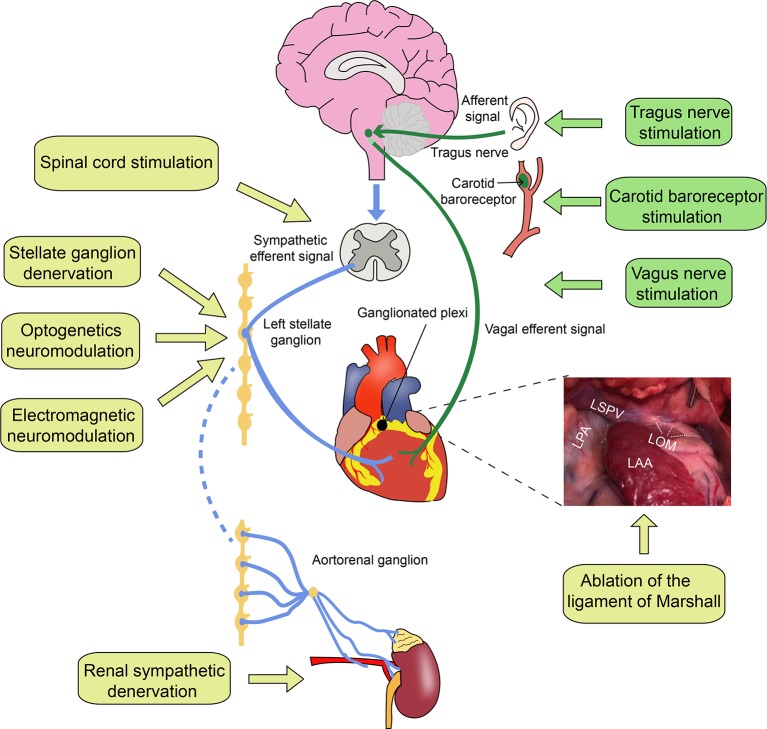
The cardiac autonomic nervous system (CANS) is associated with modulation of cardiac electrophysiology and arrhythmogenesis. In this mini review, we will briefly introduce cardiac autonomic anatomy and autonomic activity in ventricular arrhythmias (VAs) and discuss novel approaches of CANS modulation for treating VAs. Studies over the decades have provided a better understanding of cardiac autonomic innervation and revealed overwhelming evidence of the relationship between autonomic tone and VAs. A high sympathetic tone and low parasympathetic (vagal) tone are considered as the major triggers of VAs in patients with myocardial ischemia, which can cause sudden cardiac death. In recent years, novel methods of autonomic neuromodulation have been investigated to prevent VAs, and they have been verified as being beneficial for malignant VAs in animal models and humans. The clinical outcome of autonomic neuromodulation depends on the level of cardiac neuraxis, stimulation parameters, and patient's pathological status. Since autonomic modulation for VA treatment is still in the early stage of clinical application, more basic and clinical studies should be performed to clarify these mechanisms and optimize autonomic neuromodulation therapies for patients with VAs in the future.
心脏自主神经系统(CANS)与心脏电生理调节和心律失常的发生有关。在这篇小型综述中,我们将简要介绍心脏自主神经解剖结构以及室性心律失常(VAs)中的自主神经活动,并讨论调节CANS治疗VAs的新方法。几十年来的研究使我们对心脏自主神经支配有了更好的理解,并揭示了大量关于自主神经张力与VAs之间关系的证据。高交感神经张力和低副交感(迷走)神经张力被认为是心肌缺血患者发生VAs的主要触发因素,这可能导致心源性猝死。近年来,人们研究了自主神经调节的新方法来预防VAs,并且已证实这些方法对动物模型和人类的恶性VAs有益。自主神经调节的临床结果取决于心脏神经轴的水平、刺激参数和患者的病理状态。由于用于VA治疗的自主神经调节仍处于临床应用的早期阶段,未来应开展更多基础和临床研究以阐明这些机制,并为VAs患者优化自主神经调节疗法。