Li Cheng, Bian Yangshuang, Zhao Zhiyuan, Liu Yunqi, Guo Yunlong
Beijing National Laboratory for Molecular Sciences, Key Laboratory of Organic Solids, Institute of Chemistry, Chinese Academy of Sciences, Beijing 100190, China.
School of Chemical Sciences, University of Chinese Academy of Sciences, Beijing 100049, China.
Cyborg Bionic Syst. 2024 Oct 18;5:0172. doi: 10.34133/cbsystems.0172. eCollection 2024.
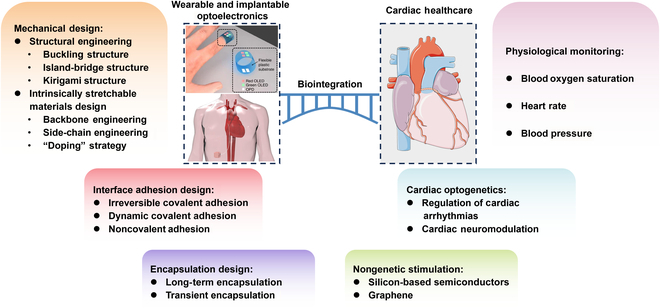
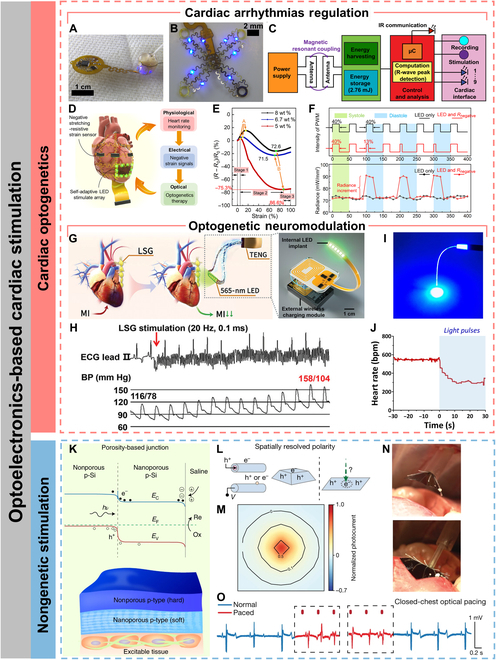
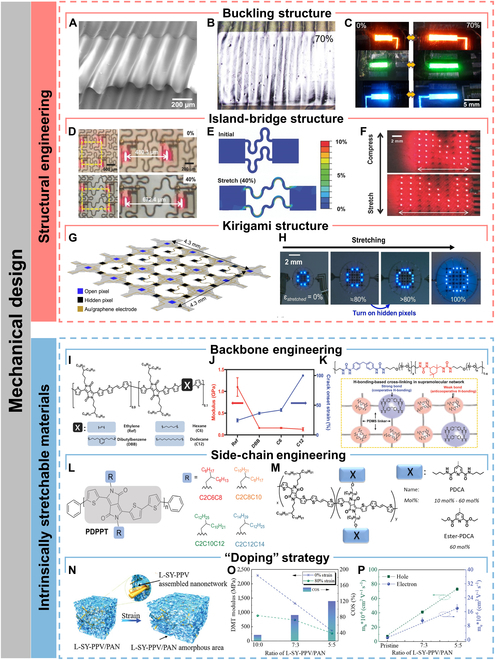
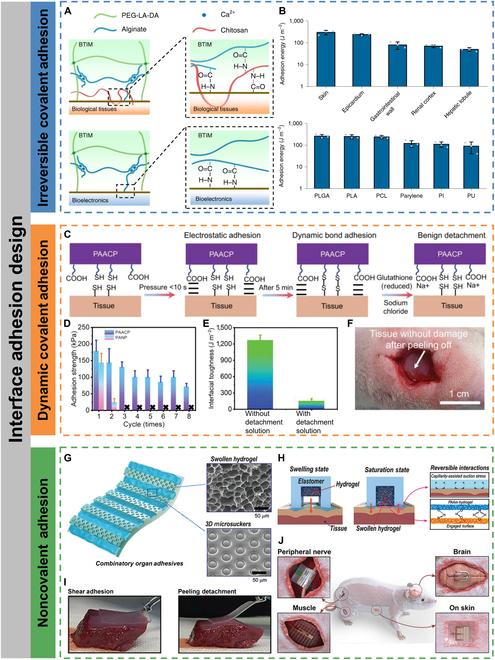
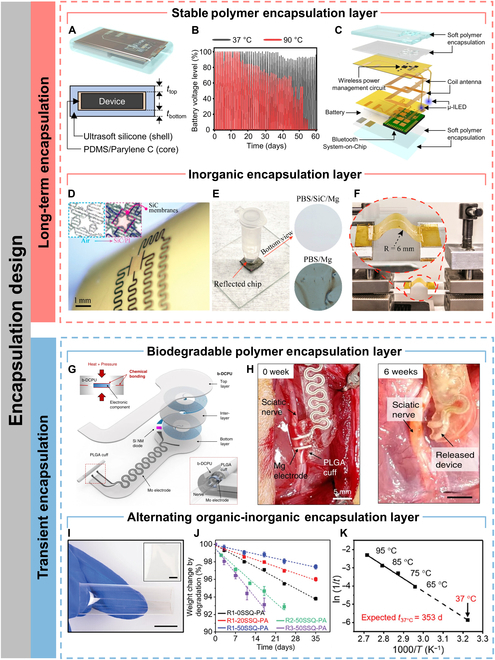
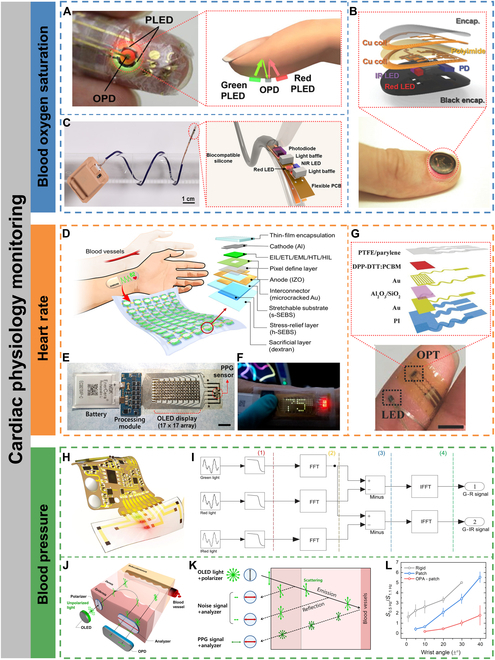
With the prevalence of cardiovascular disease, it is imperative that medical monitoring and treatment become more instantaneous and comfortable for patients. Recently, wearable and implantable optoelectronic devices can be seamlessly integrated into human body to enable physiological monitoring and treatment in an imperceptible and spatiotemporally unconstrained manner, opening countless possibilities for the intelligent healthcare paradigm. To achieve biointegrated cardiac healthcare, researchers have focused on novel strategies for the construction of flexible/stretchable optoelectronic devices and systems. Here, we overview the progress of biointegrated flexible and stretchable optoelectronics for wearable and implantable cardiac healthcare devices. Firstly, the device design is addressed, including the mechanical design, interface adhesion, and encapsulation strategies. Next, the practical applications of optoelectronic devices for cardiac physiological monitoring, cardiac optogenetics, and nongenetic stimulation are presented. Finally, an outlook on biointegrated flexible and stretchable optoelectronic devices and systems for intelligent cardiac healthcare is discussed.
随着心血管疾病的流行,医疗监测和治疗必须对患者来说变得更加即时和舒适。最近,可穿戴和可植入的光电器件可以无缝集成到人体中,以一种难以察觉且不受时空限制的方式实现生理监测和治疗,为智能医疗模式开启了无数可能性。为了实现生物集成心脏医疗,研究人员专注于构建柔性/可拉伸光电器件和系统的新策略。在此,我们概述了用于可穿戴和可植入心脏医疗设备的生物集成柔性和可拉伸光电子学的进展。首先,讨论了器件设计,包括机械设计、界面粘附和封装策略。接下来,介绍了光电器件在心脏生理监测、心脏光遗传学和非基因刺激方面的实际应用。最后,探讨了用于智能心脏医疗的生物集成柔性和可拉伸光电器件及系统的前景。