Recabarren Romina Evelyn, Gaillard Claudie, Guillod Matthias, Martin-Soelch Chantal
Division of Clinical and Health Psychology, IReach Lab, Department of Psychology, University of Fribourg, Fribourg, Switzerland.
Front Psychiatry. 2019 Mar 12;10:88. doi: 10.3389/fpsyt.2019.00088. eCollection 2019.
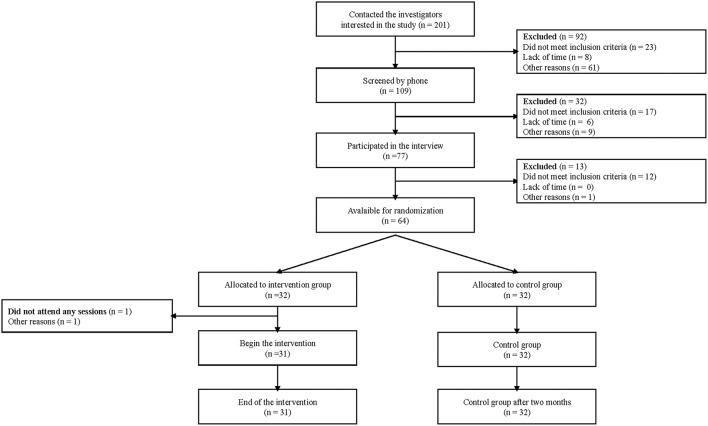
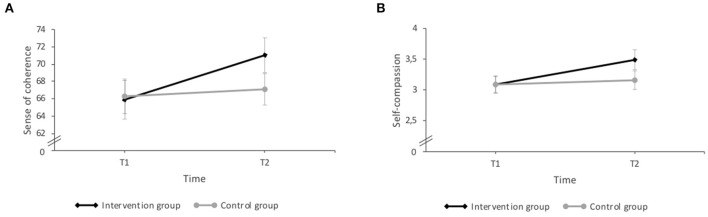
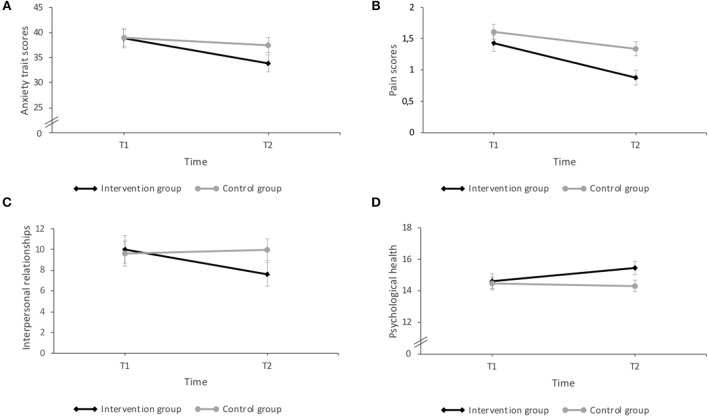
It is well-documented that university students have an increased risk in developing psychological problems because they face multiple stressors. Cognitive, behavioral, and mindfulness-based stress prevention programs were shown to reduce symptoms of anxiety, depression, and perceived stress in university students. However, little is known of their effect on resource activation. Additionally, most validated interventions are unidimensional, i.e., including one stress-coping approach. In this study, we investigated the short-term effects of a multidimensional stress prevention program on students' quality of life, psychological symptoms and resources, and resilience factors against stress. Using an experimental design, 64 healthy undergraduate students (56 women), between 18 and 34 years old (M = 21.34, = 2.53), from the University of Fribourg, Switzerland, were randomly allocated either to the intervention or the wait-list control group. The intervention group participated in a multidimensional stress prevention program, integrating mindfulness-based activities, cognitive and behavioral strategies, social skills, and emotional regulation exercises. The program consisted of eight 2-h weekly sessions. Before and after the intervention, participants completed self-reported questionnaires evaluating quality of life; psychological symptoms such as depression, anxiety, social anxiety, and interpersonal problems; as well as psychological resources like self-efficacy, sense of coherence, self-compassion, and social support, presented online. A standardized clinical interview was performed at pre- and post-measurement times. To analyze the sort-term effects of the program, we used mixed, two-factorial ANOVAs (per-protocol analyses). In accordance with our hypotheses, our results showed significant reduction of psychological symptoms, including anxiety, interpersonal problems, and symptoms of pain; a significant increase in quality of life, sense of coherence, and self-compassion in students who participated in the intervention program compared to the control group, (all < 0.05). No significant results were found for symptoms of depression, social anxiety, self-efficacy, and social support. These preliminary findings indicate specific short-term effects of our multidimensional stress prevention program on psychological symptoms and on quality of life as well as promising effects on psychological resources and factors associated with resilience against stress. Future studies should investigate the long-term effects of the intervention as well as the effects in clinical samples.
有充分文献记载,大学生由于面临多种压力源,出现心理问题的风险增加。认知、行为和基于正念的压力预防项目已被证明可减轻大学生的焦虑、抑郁和感知压力症状。然而,它们对资源激活的影响却鲜为人知。此外,大多数经过验证的干预措施都是单维的,即只包括一种压力应对方法。在本研究中,我们调查了一个多维压力预防项目对学生生活质量、心理症状和资源以及抗压弹性因素的短期影响。采用实验设计,来自瑞士弗里堡大学的64名健康本科生(56名女性),年龄在18至34岁之间(M = 21.34, = 2.53),被随机分配到干预组或等待名单对照组。干预组参加了一个多维压力预防项目,该项目整合了基于正念的活动、认知和行为策略、社交技能以及情绪调节练习。该项目包括每周8次,每次2小时的课程。在干预前后,参与者完成了自我报告问卷,评估生活质量;抑郁、焦虑、社交焦虑和人际问题等心理症状;以及在线呈现的自我效能感、连贯感、自我同情和社会支持等心理资源。在测量前后进行了标准化的临床访谈。为了分析该项目的短期效果,我们使用了混合双因素方差分析(按方案分析)。与我们的假设一致,我们的结果显示,与对照组相比,参与干预项目的学生的心理症状,包括焦虑、人际问题和疼痛症状显著减轻;生活质量、连贯感和自我同情显著提高(所有P < 0.05)。在抑郁症状、社交焦虑、自我效能感和社会支持方面未发现显著结果。这些初步发现表明,我们的多维压力预防项目对心理症状和生活质量有特定的短期影响,对心理资源和与抗压弹性相关的因素也有显著影响。未来的研究应该调查该干预措施的长期影响以及在临床样本中的效果。