Jiang Xun, Beust Andreas, Sappa Praveen K, Völker Uwe, Dinse Theresa, Herglotz Julia, Reinhold-Hurek Barbara
Department of Microbe-Plant Interactions, Faculty of Biology and Chemistry, Center for Biomolecular Interactions Bremen, University of Bremen, Bremen, Germany.
Interfaculty Institute of Genetics and Functional Genomics, University Medicine Greifswald, Greifswald, Germany.
Front Microbiol. 2019 Mar 12;10:459. doi: 10.3389/fmicb.2019.00459. eCollection 2019.
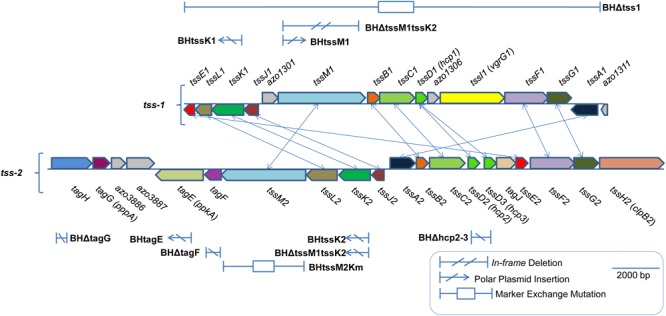
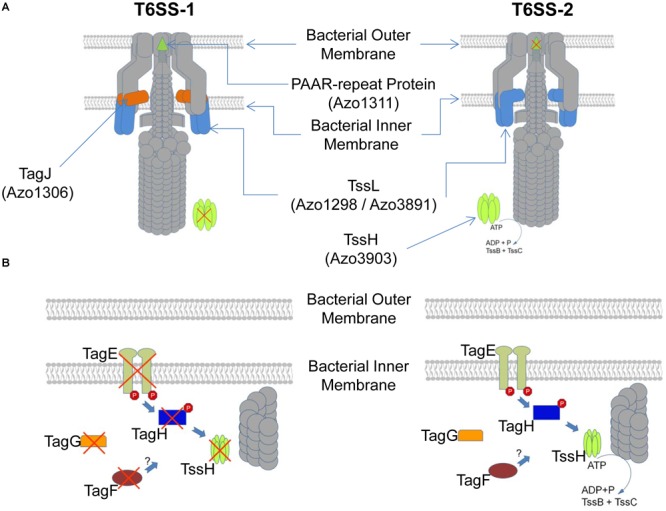
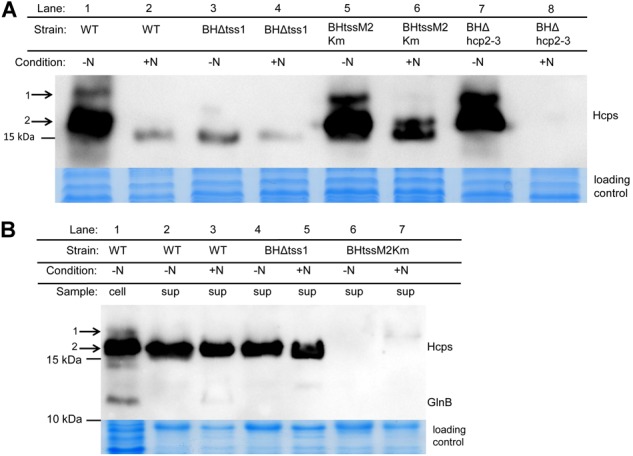
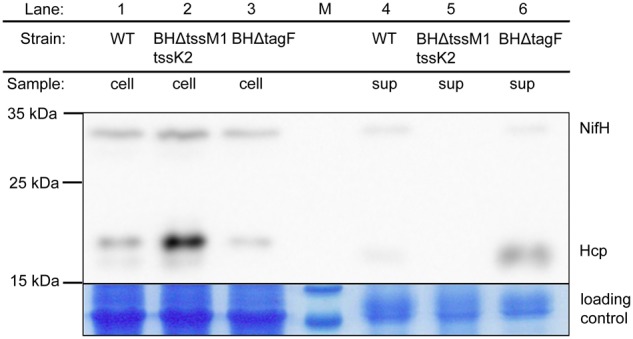
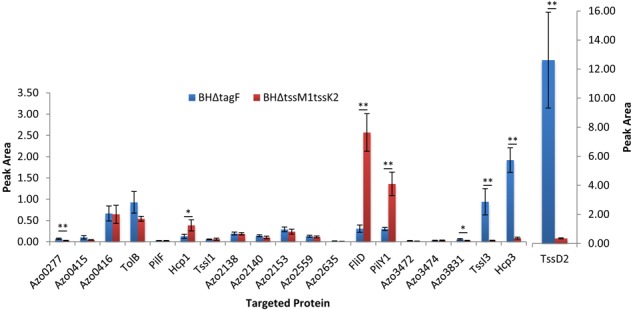
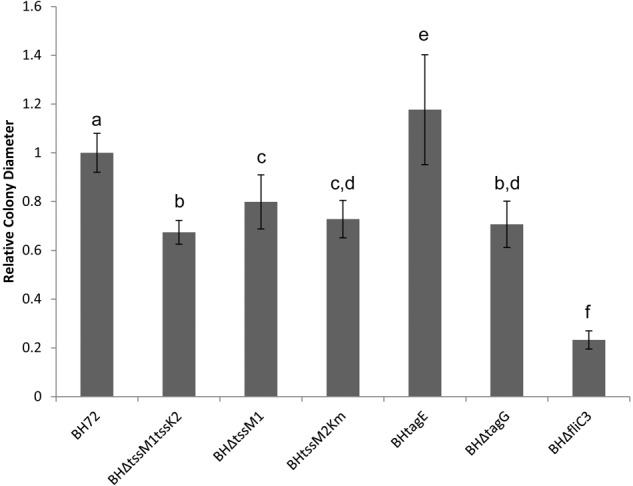
Type VI protein secretion systems (T6SSs) have been identified in many plant-associated bacteria. However, despite the fact that effector proteins may modulate host responses or interbacterial competition, only a few have been functionally dissected in detail. We dissected the T6SS in strain BH72, a nitrogen-fixing model endophyte of grasses. The genome harbors two gene clusters encoding putative T6SSs, and , of which only T6SS-2 shared genetic organization and functional homology with the H1-T6SS of . While genes were constitutively expressed, genes were strongly up-regulated under conditions of nitrogen fixation. A comparative analysis of the wild type and mutants lacking either functional or allowed to differentiate the functions of both secretion systems. Abundance of Hcp in the culture supernatant as an indication for T6SS activity revealed that only T6SS-2 was active, either under aerobic or nitrogen-fixing conditions. Our data show that T6SS-2 but not T6SS-1 is post-translationally regulated by phosphorylation mediated by TagE/TagG (PpkA/PppA), and by the phosphorylation-independent inhibitory protein TagF, similar to published work in . Therefore, T6SS-1 appears to be post-translationally regulated by yet unknown mechanisms. Thus, both T6SS systems appear to perform different functions in , one of them specifically adapted to the nitrogen-fixing lifestyle.
VI型分泌系统(T6SSs)已在许多与植物相关的细菌中被鉴定出来。然而,尽管效应蛋白可能调节宿主反应或细菌间竞争,但只有少数效应蛋白的功能得到了详细解析。我们对BH72菌株中的T6SS进行了剖析,BH72是一种固氮的禾本科植物内生菌模型。该基因组含有两个编码假定T6SSs的基因簇,即T6SS-1和T6SS-2,其中只有T6SS-2与[某种细菌]的H1-T6SS具有基因组织和功能同源性。虽然T6SS-1基因组成型表达,但T6SS-2基因在固氮条件下强烈上调。对野生型和缺乏功能性T6SS-1或T6SS-2的突变体进行比较分析,有助于区分这两种分泌系统的功能。培养上清液中Hcp的丰度作为T6SS活性的指标表明,无论是在需氧还是固氮条件下,只有T6SS-2是活跃的。我们的数据表明,与[已发表研究中的某种细菌]的情况类似,T6SS-2而非T6SS-1在翻译后受到由TagE/TagG(PpkA/PppA)介导的磷酸化以及磷酸化非依赖性抑制蛋白TagF的调节。因此,T6SS-1似乎在翻译后受到未知机制的调节。因此,这两种T6SS系统在[该细菌]中似乎执行不同的功能,其中之一特别适应固氮生活方式。