Randall Centre for Cell and Molecular Biophysics, School of Basic and Medical Biosciences, King's College London, London, United Kingdom.
Asthma UK Centre, Allergic Mechanisms in Asthma, King's College London, London, United Kingdom.
Front Immunol. 2019 Mar 11;10:402. doi: 10.3389/fimmu.2019.00402. eCollection 2019.
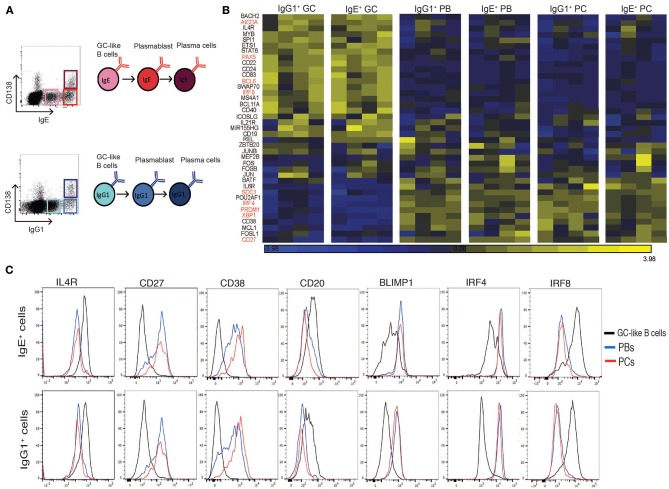
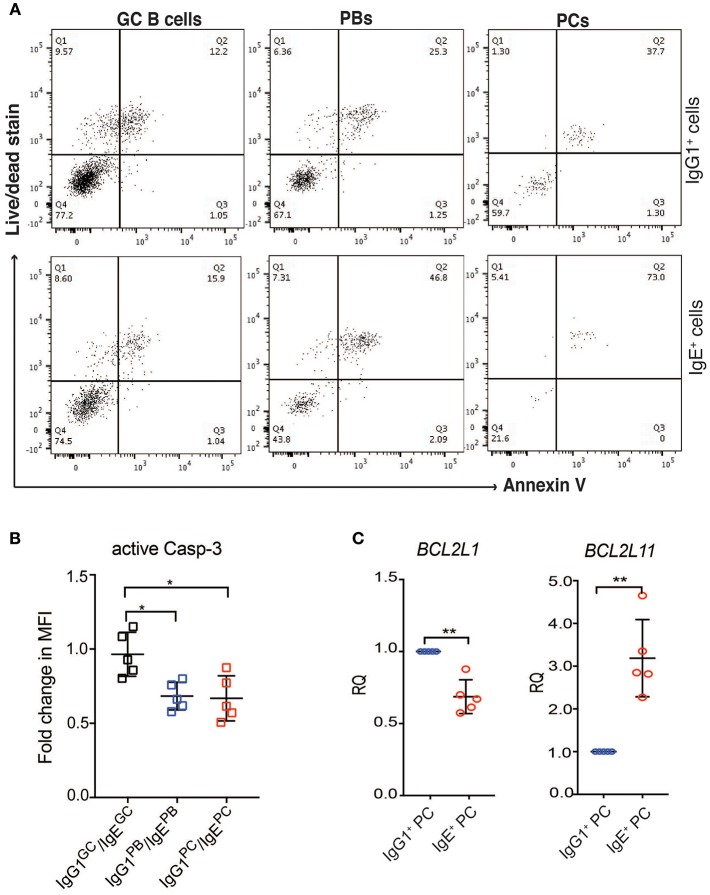
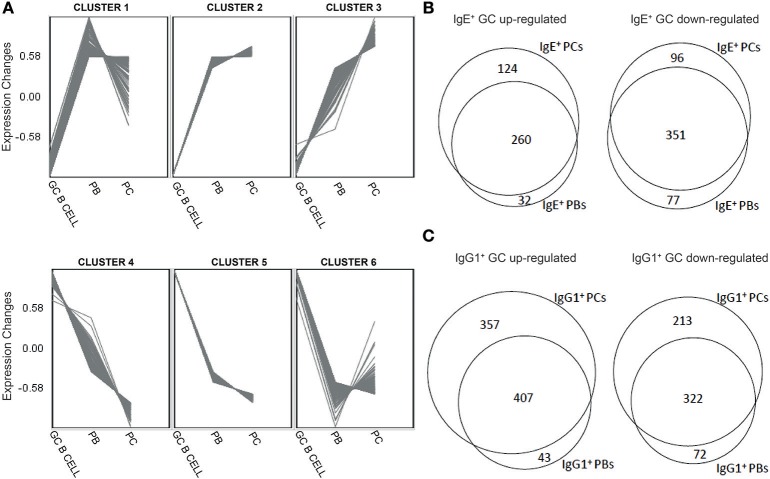
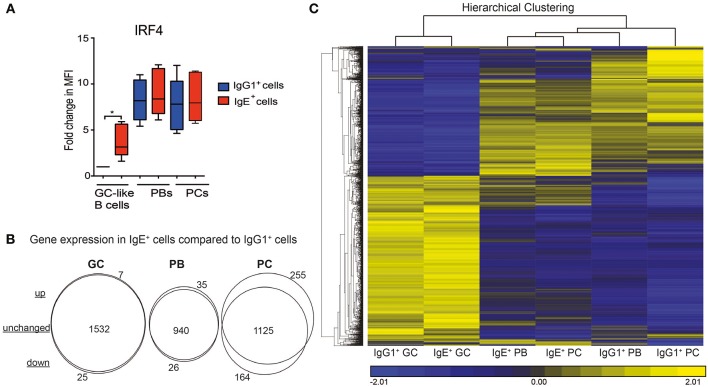
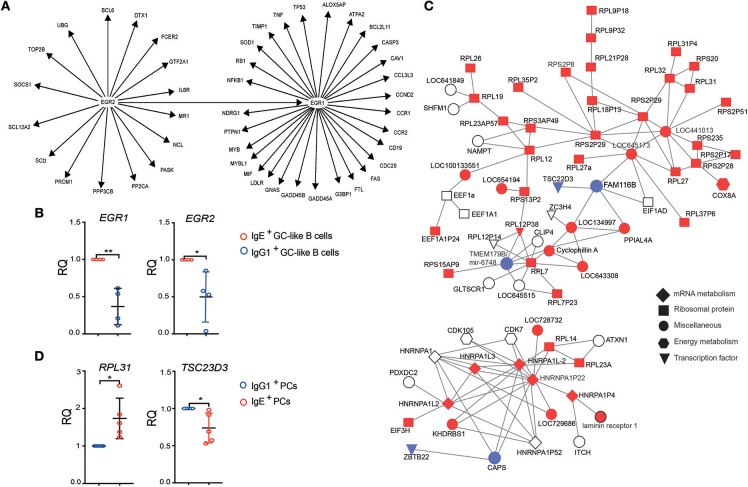
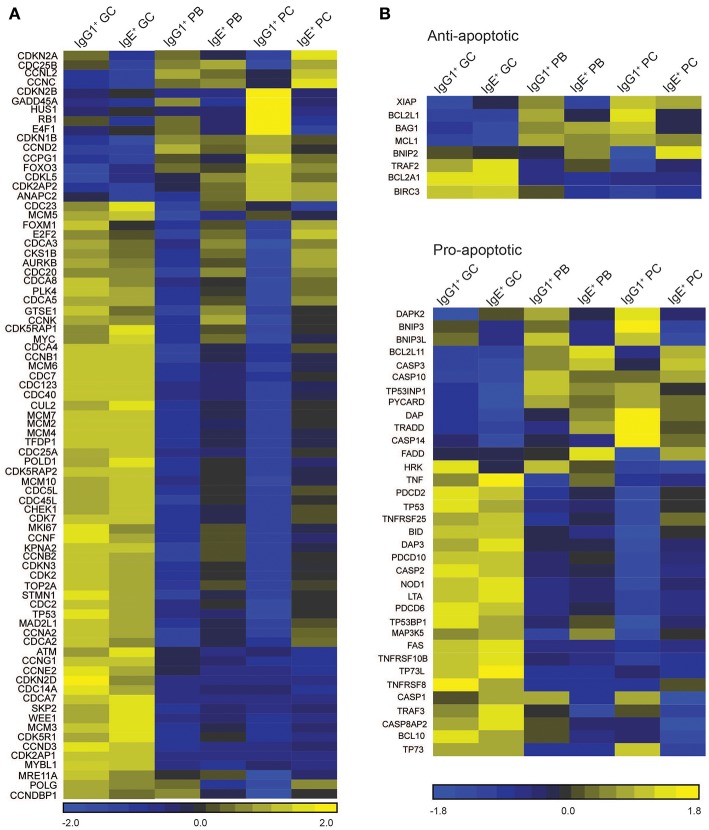
IgE is secreted by plasma cells (PCs) and is central to allergic disease. Using an tonsil B cell culture system, which mimics the Th2 responses , we have recently characterized the development pathway of human IgE-expressing PCs. In this system, as in mice, we reported the predisposition of IgE-expressing B cells to differentiate into PCs. To gain a comprehensive understanding of the molecular events involved in the differentiation of human IgE B cells into PCs we have used the Illumina HumanHT-12 v4 Expression BeadChip array to analyse the gene expression profile of generated human IgE B cells at various stages of their differentiation into PCs. We also compared the transcription profiles of IgE and IgG1 cells to discover isotype-specific patterns. Comparisons of IgE and IgG1 cell transcriptional profiles revealed molecular signatures specific for IgE cells, which diverge from their IgG1 cell counterparts upon differentiation into PCs. At the germinal center (GC) stage of development, unlike in some mouse studies of IgE biology, we observed similar rates of apoptosis and no significant differences in the expression of apoptosis-associated genes between the IgE and IgG1 B cells. We identified a gene interaction network associated with early growth response 1 () that, together with the up-regulated IRF4, may account for the predisposition of IgE B cells to differentiate into PCs. However, despite their swifter rates of PC differentiation, the transcription profile of IgE PCs is more closely related to IgE and IgG1 plasmablasts (PBs) than to IgG1 PCs, suggesting that the terminal differentiation of IgE cells is impeded. We also show that IgE PCs have increased levels of apoptosis suggesting that the IgE PCs generated in our tonsil B cell cultures, as in mice, are short-lived. We identified gene regulatory networks as well as cell cycle and apoptosis signatures that may explain the diverging PC differentiation programme of these cells. Overall, our study provides a detailed analysis of the transcriptional pathways underlying the differentiation of human IgE-expressing B cells and points to molecular signatures that regulate IgE PC differentiation and function.
IgE 由浆细胞(PC)分泌,是过敏疾病的核心。我们使用扁桃体 B 细胞培养系统,该系统模拟了 Th2 反应,最近对人类 IgE 表达 PC 的发育途径进行了特征描述。在这个系统中,与在小鼠中一样,我们报告了 IgE 表达 B 细胞向 PC 分化的倾向性。为了全面了解参与人类 IgE B 细胞分化为 PC 的分子事件,我们使用 Illumina HumanHT-12 v4 Expression BeadChip 阵列分析了在其分化为 PC 的各个阶段生成的人类 IgE B 细胞的基因表达谱。我们还比较了 IgE 和 IgG1 细胞的转录谱,以发现同种型特异性模式。IgE 和 IgG1 细胞转录谱的比较揭示了 IgE 细胞的特异性分子特征,这些特征在分化为 PC 时与其 IgG1 细胞对应物不同。在生发中心(GC)发育阶段,与一些关于 IgE 生物学的小鼠研究不同,我们观察到 IgE 和 IgG1 B 细胞之间凋亡率相似,并且凋亡相关基因的表达没有显著差异。我们确定了一个与早期生长反应 1(EGR1)相关的基因相互作用网络,该网络与上调的 IRF4 一起,可能解释了 IgE B 细胞向 PC 分化的倾向性。然而,尽管 IgE PC 的分化速度更快,但 IgE PC 的转录谱与 IgE 和 IgG1 浆母细胞(PB)更相似,而不是 IgG1 PC,这表明 IgE 细胞的终末分化受到阻碍。我们还表明,IgE PC 具有更高水平的凋亡,这表明我们在扁桃体 B 细胞培养物中生成的 IgE PC 与在小鼠中一样,寿命较短。我们确定了基因调控网络以及细胞周期和凋亡特征,这些可能解释了这些细胞分化程序的差异。总的来说,我们的研究提供了人类 IgE 表达 B 细胞分化的转录途径的详细分析,并指出了调节 IgE PC 分化和功能的分子特征。