Department of Clinical, Neuro and Developmental Psychology, Amsterdam Public Health Research Institute, Vrije Universiteit Amsterdam, Amsterdam, The Netherlands.
Department of Otolaryngology-Head and Neck Surgery, Cancer Center Amsterdam (CCA), Amsterdam UMC, VU University Medical Center, Amsterdam, The Netherlands.
Support Care Cancer. 2019 Dec;27(12):4543-4553. doi: 10.1007/s00520-019-04714-3. Epub 2019 Mar 27.
Stepped care (SC), consisting of watchful waiting, guided self-help, problem-solving therapy, and psychotherapy/medication is, compared to care-as-usual (CAU), effective in improving psychological distress. This study presents secondary analyses on subgroups of patients who might specifically benefit from watchful waiting, guided self-help, or the entire SC program.
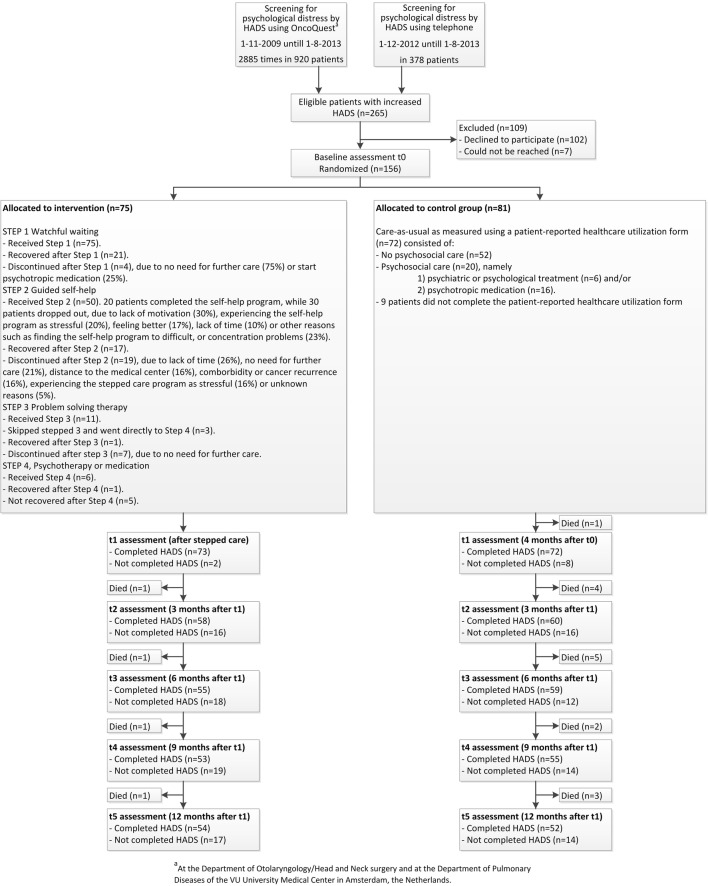
In this randomized controlled trial, head and neck and lung cancer patients with distress (n = 156) were randomized to SC or CAU. Univariate logistic regression analyses were performed to investigate baseline factors associated with recovery after watchful waiting and guided self-help. Potential moderators of the effectiveness of SC compared to CAU were investigated using linear mixed models.
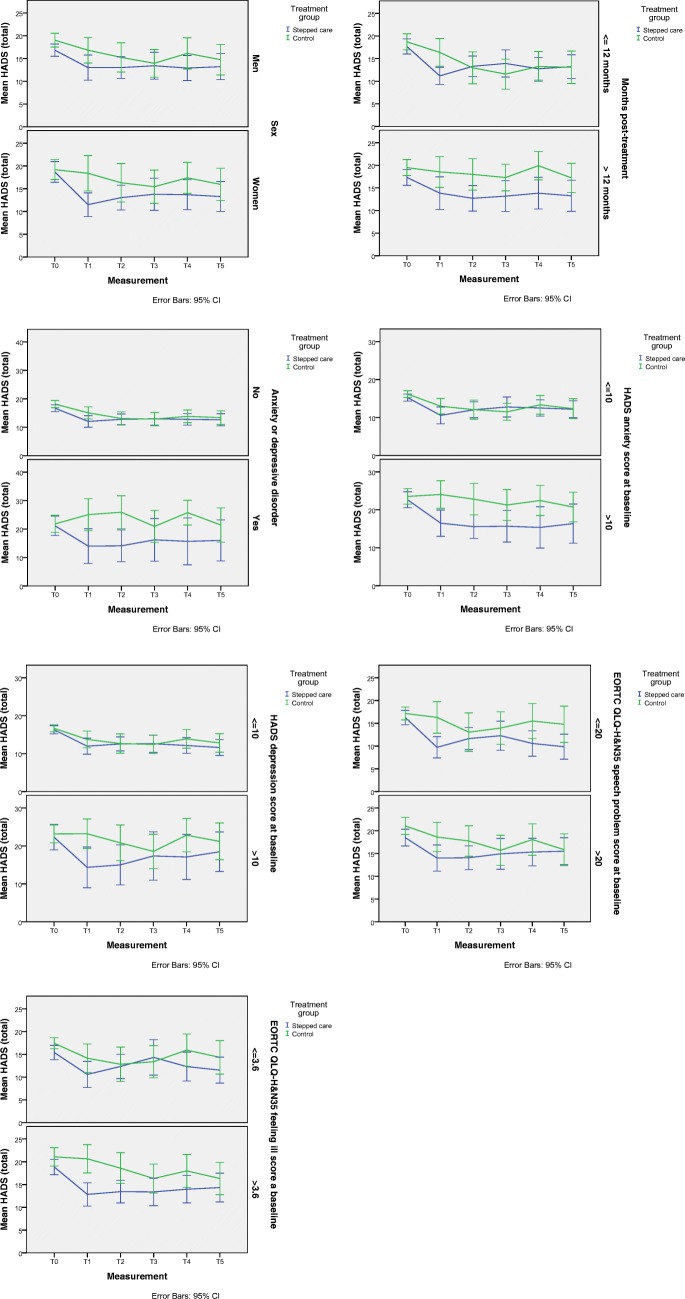
Patients without a psychiatric disorder, with better psychological outcomes (HADS: all scales) and better health-related quality of life (HRQOL) (EORTC QLQ-C30/H&N35: global QOL, all functioning, and several symptom domains) were more likely to recover after watchful waiting. Patients with better scores on distress, emotional functioning, and dyspnea were more likely to recover after guided self-help. Sex, time since treatment, anxiety or depressive disorder diagnosis, symptoms of anxiety, symptoms of depression, speech problems, and feeling ill at baseline moderated the efficacy of SC compared to CAU.
Patients with distress but who are relatively doing well otherwise, benefit most from watchful waiting and guided self-help. The entire SC program is more effective in women, patients in the first year after treatment, patients with a higher level of distress or anxiety or depressive disorder, patients who are feeling ill, and patients with less speech problems.
NTR1868.
阶梯式护理(SC)包括静观等待、指导自助、解决问题疗法和心理治疗/药物治疗,与常规护理(CAU)相比,在改善心理困扰方面更有效。本研究对可能特别受益于静观等待、指导自助或整个 SC 方案的患者亚组进行了二次分析。
在这项随机对照试验中,有困扰的头颈部和肺癌患者(n=156)被随机分配到 SC 组或 CAU 组。进行单变量逻辑回归分析,以调查与静观等待和指导自助后康复相关的基线因素。使用线性混合模型研究 SC 与 CAU 相比的有效性的潜在调节因素。
无精神障碍、心理结局更好(HADS:所有量表)和健康相关生活质量(EORTC QLQ-C30/H&N35:总体生活质量、所有功能和几个症状领域)更好的患者更有可能在静观等待后康复。困扰、情绪功能和呼吸困难评分较好的患者更有可能在指导自助后康复。性别、治疗后时间、焦虑或抑郁障碍诊断、焦虑症状、抑郁症状、言语问题和基线时感觉不适在 SC 与 CAU 相比的疗效中起到了调节作用。
有困扰但整体情况较好的患者,最受益于静观等待和指导自助。整个 SC 方案在女性、治疗后第一年的患者、困扰或焦虑或抑郁障碍程度较高的患者、感觉不适的患者和言语问题较少的患者中更有效。
NTR1868。