van der Meulen Ingeborg C, May Anne M, de Leeuw J Rob J, Koole Ron, Oosterom Miriam, Hordijk Gert-Jan, Ros Wynand J G
Julius Center for Health Sciences and Primary Care, University Medical Center Utrecht, Str. 6.131, Po Box: 85500, 3508, GA, Utrecht, The Netherlands,
Support Care Cancer. 2015 Aug;23(8):2417-26. doi: 10.1007/s00520-015-2603-2. Epub 2015 Jan 23.
Little is known about the variables that moderate the response to psychosocial interventions to decrease depressive symptoms in cancer patients. The purpose of this study was to determine whether variables associated with depressive symptoms in cancer patients in general moderate the response to a nurse-led psychosocial intervention in patients with head and neck cancer.
This study is a secondary analysis of a randomized controlled trial evaluating the effect of the nurse counseling and after intervention (NUCAI) on depressive symptoms 12 months after cancer treatment in patients with head and neck cancer. Of 205 patients, 103 received the NUCAI and 102 care as usual. Twenty-one variables were selected for analysis and a linear regression analyses including interaction terms was performed for each variable separately. Significant moderators were post hoc probed.
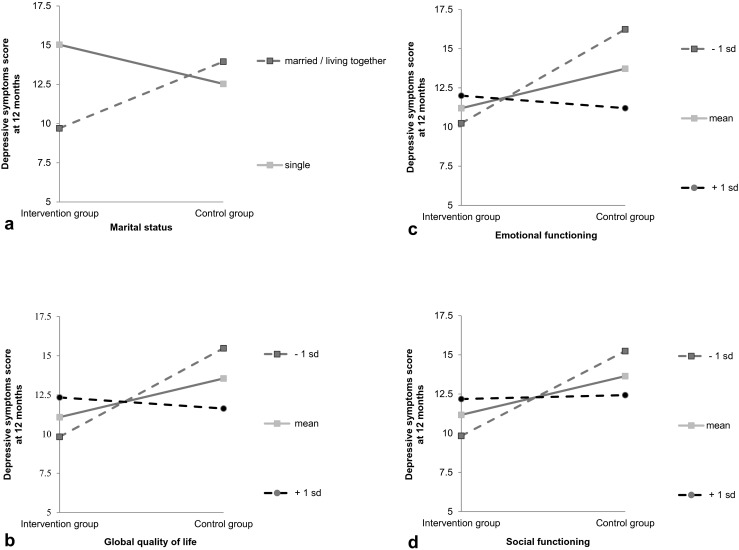
Four moderators were found: marital status, global quality of life, emotional functioning, and social functioning. Patients who were married/living together or had low scores for global quality of life, and emotional or social functioning at baseline benefited more from the NUCAI than patients who were single or with high scores for global quality of life and emotional or social functioning.
Marital status, global quality of life, and emotional and social functioning of head and neck cancer patients should be evaluated to determine whether they might benefit from a psychosocial intervention to combat depressive symptoms. Further research is necessary to replicate results and to contribute to the knowledge needed to make screening and personalized patient care possible.
关于调节心理社会干预对癌症患者抑郁症状反应的变量,人们了解甚少。本研究的目的是确定一般癌症患者中与抑郁症状相关的变量是否会调节头颈癌患者对护士主导的心理社会干预的反应。
本研究是一项随机对照试验的二次分析,该试验评估了护士咨询与干预后(NUCAI)对头颈癌患者癌症治疗12个月后抑郁症状的影响。205名患者中,103名接受了NUCAI,102名接受常规护理。选择21个变量进行分析,并对每个变量分别进行包括交互项的线性回归分析。对显著的调节因素进行事后探究。
发现了四个调节因素:婚姻状况、总体生活质量、情绪功能和社会功能。与单身或基线时总体生活质量、情绪或社会功能得分高的患者相比,已婚/同居或基线时总体生活质量、情绪或社会功能得分低的患者从NUCAI中获益更多。
应评估头颈癌患者的婚姻状况、总体生活质量以及情绪和社会功能,以确定他们是否可能从对抗抑郁症状的心理社会干预中获益。有必要进行进一步研究以复制结果,并为实现筛查和个性化患者护理所需的知识做出贡献。