Schutte Laura E R, Melissant Heleen C, Jansen Femke, Lissenberg-Witte Birgit I, Leemans C René, Sprangers Mirjam A G, Vergeer Marije R, Verdonck-de Leeuw Irma M, Laan Ellen T M
Department of Sexology and Psychosomatic Gynaecology, Amsterdam University Medical Centers, Location AMC, University of Amsterdam, Amsterdam, The Netherlands.
Department of Clinical, Neuro- and Developmental Psychology, Faculty of Behavioral and Movement Sciences, Amsterdam Public Health Research Institute, Vrije Universiteit Amsterdam, Amsterdam, The Netherlands.
Sex Med. 2021 Feb;9(1):100304. doi: 10.1016/j.esxm.2020.100304. Epub 2021 Jan 15.
A recent randomized controlled trial (RCT) in patients with head and neck cancer (HNC) with psychological distress showed that a stepped care (SC) program targeting psychological distress compared with care as usual (CAU), is (cost)effective in reducing psychological distress.
The aim of the present study was to investigate whether SC can coalleviate problems with sexual interest and enjoyment. A secondary aim was to investigate whether the presence of an unmet sexual health need and having a psychiatric disorder (depression or anxiety) at baseline moderated any effect of SC on these sexual variables until 1-year follow-up.
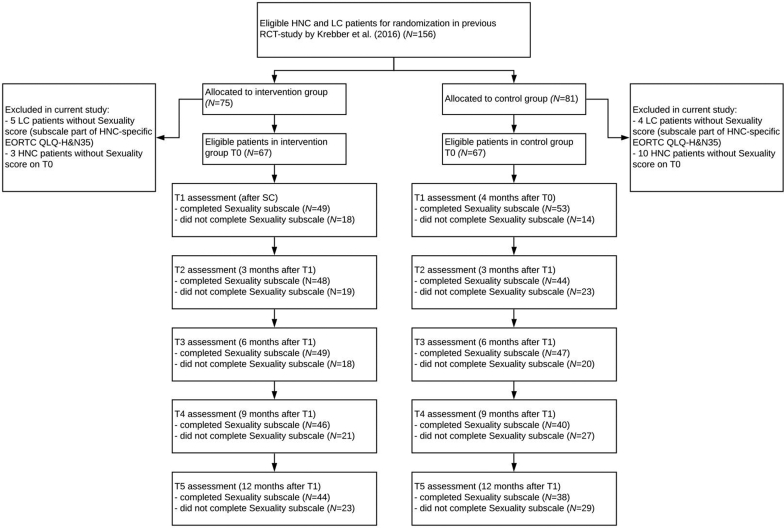
HNC survivors (N = 134), randomized to SC or CAU, were assessed regarding their sexual interest and enjoyment before and after the intervention and at 3, 6, 9, and 12 months follow-up. Linear mixed models were used to evaluate differences in the course of sexual interest and enjoyment between SC and CAU.
The "sexuality" symptom subscale, part of the European Organization for Research and Treatment of Cancer, Quality of Life Questionnaire, Head and Neck Cancer-specific module.
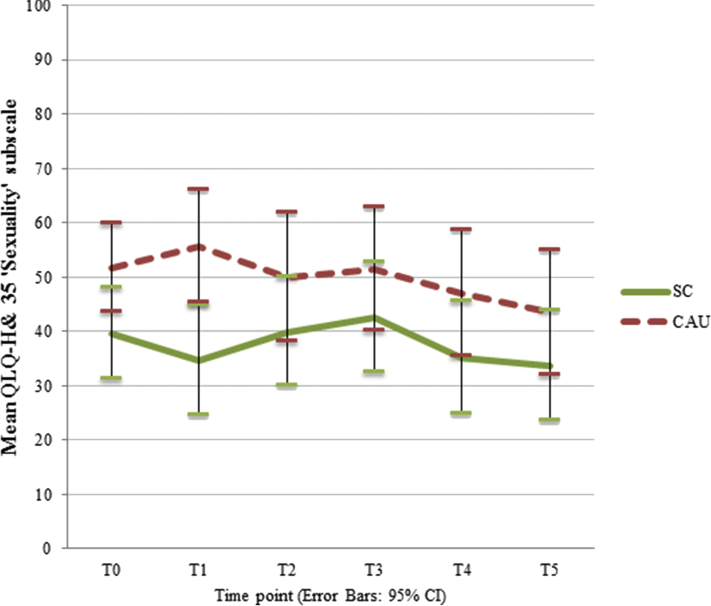
Of all patients, 76.1% had an unmet sexual need at baseline, 24.6% had a psychiatric disorder (anxiety or depression). SC did not reduce problems with sexual interest and enjoyment at any of the follow-up measurements compared with CAU (P = .85). This was neither moderated by an unmet sexual health need at baseline (P = .64) nor by the presence of a psychiatric disorder at baseline (P = .59).
A substantial number of patients with HNC have unmet sexual health needs. SC targeting psychological distress does not reduce problems with sexuality in these patients. Interventions specifically targeting sexuality are recommended. Schutte LER, Melissant HC, Jansen F, et al. Effect of Stepped Care on Sexual Interest and Enjoyment in Distressed Patients with Head and Neck Cancer: A Randomized Controlled Trial. Sex Med 2021;9:100304.
最近一项针对患有心理困扰的头颈癌(HNC)患者的随机对照试验(RCT)表明,与常规护理(CAU)相比,针对心理困扰的阶梯式护理(SC)方案在减轻心理困扰方面具有(成本)效益。
本研究的目的是调查SC是否可以缓解性兴趣和性享受方面的问题。次要目的是调查在基线时未满足的性健康需求以及患有精神疾病(抑郁症或焦虑症)是否会在1年随访期内调节SC对这些性变量的任何影响。
将134名HNC幸存者随机分为SC组或CAU组,在干预前后以及3、6、9和12个月随访时评估他们的性兴趣和性享受情况。使用线性混合模型评估SC组和CAU组在性兴趣和性享受过程中的差异。
欧洲癌症研究与治疗组织生活质量问卷头颈癌特定模块中的“性”症状子量表。
在所有患者中,76.1%在基线时有未满足的性需求,24.6%患有精神疾病(焦虑症或抑郁症)。与CAU相比,SC在任何随访测量中均未减少性兴趣和性享受方面的问题(P = 0.85)。这既未受到基线时未满足的性健康需求的调节(P = 0.64),也未受到基线时存在精神疾病的调节(P = 0.59)。
大量HNC患者存在未满足的性健康需求。针对心理困扰的SC并不能减少这些患者的性方面问题。建议采取针对性的性方面干预措施。舒特LER、梅利桑特HC、扬森F等。阶梯式护理对患有心理困扰的头颈癌患者性兴趣和性享受的影响:一项随机对照试验。性医学2021;9:100304。