Division of Pharmacoepidemiology and Clinical Pharmacology, Utrecht Institute for Pharmaceutical Sciences, Utrecht University, Utrecht, Netherlands.
Department of Pediatrics, Medical Centre Leeuwarden, Leeuwarden, Netherlands.
JMIR Mhealth Uhealth. 2019 Mar 27;7(3):e12411. doi: 10.2196/12411.
Mobile health (mHealth) apps have the potential to support patients' medication use and are therefore increasingly used. Apps with broad functionality are suggested to be more effective; however, not much is known about the actual use of different functionalities and the effective engagement.
The aim of this study was to explore the use and the effective engagement of adolescents (aged 12 to 18 years) with the Adolescent Adherence Patient Tool (ADAPT).
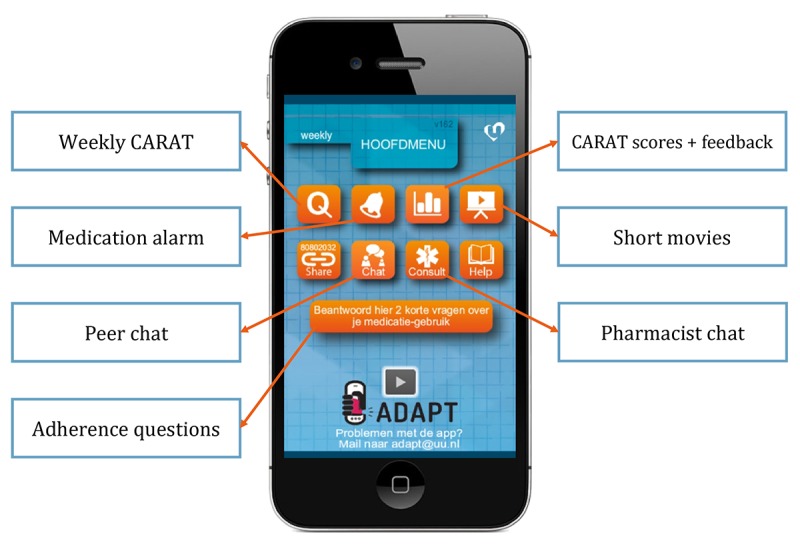
The ADAPT intervention consisted of an app for patients, which was connected to a management system for their pharmacist. The aim of the ADAPT intervention was to improve medication adherence and, therefore, the app contained multiple functionalities: questionnaires to monitor symptoms and adherence, medication reminders, short movies, pharmacist chat, and peer chat. For this study, data of the ADAPT study and a cluster randomized controlled trial were used. Adolescents with asthma had 6 months' access to the ADAPT intervention, and all app usage was securely registered in a log file.
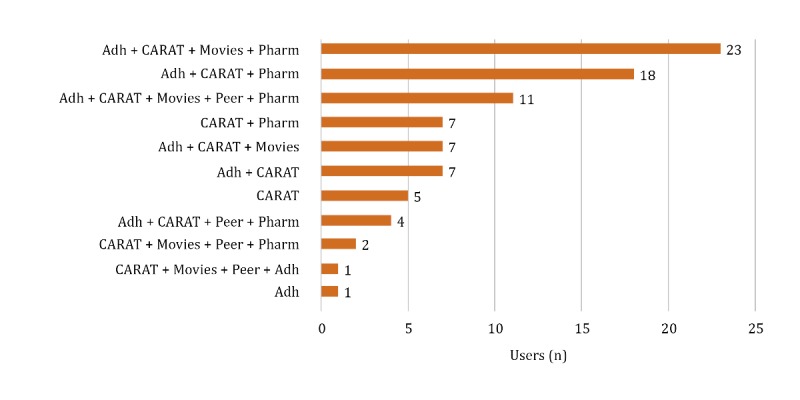
In total, 86 adolescents (mean age 15.0, SD 2.0 years) used the ADAPT app 17 times (range 1-113) per person. Females used the app more often than males (P=.01) and for a longer period of time (P=.03). On average, 3 different functionalities were used, and 13% of the adolescents used all functionalities of the app. The questionnaires to monitor symptoms and adherence were used by most adolescents. The total app use did not affect adherence; however, activity in the pharmacist chat positively affected medication adherence (P=.03), in particular, if patients sent messages to their pharmacist (P=.01).
mHealth apps for adolescents with asthma should contain different functionalities to serve the diverging needs and preferences of individual patients. Suggested key functionalities to promote use and effectiveness in adolescents with asthma are questionnaires to monitor symptoms and a health care provider chat.
移动医疗(mHealth)应用有支持患者用药的潜力,因此越来越多地被使用。具有广泛功能的应用被认为更有效;然而,对于不同功能的实际使用情况和有效参与程度,我们知之甚少。
本研究旨在探讨青少年(12 至 18 岁)使用青少年用药依从性患者工具(ADAPT)的使用情况和有效参与度。
ADAPT 干预措施包括一个供患者使用的应用程序,该程序与他们的药剂师管理系统相连。ADAPT 干预的目的是提高药物依从性,因此该应用程序包含多个功能:监测症状和依从性的问卷、用药提醒、短片、药剂师聊天和同伴聊天。在这项研究中,使用了 ADAPT 研究和一项集群随机对照试验的数据。患有哮喘的青少年有 6 个月的机会使用 ADAPT 干预措施,所有应用程序的使用情况都安全地记录在日志文件中。
共有 86 名青少年(平均年龄 15.0 岁,标准差 2.0 岁)每人使用 ADAPT 应用程序 17 次(范围 1-113 次)。女性比男性更频繁地使用该应用程序(P=.01),使用时间也更长(P=.03)。平均而言,有 3 种不同的功能被使用,13%的青少年使用了该应用程序的所有功能。监测症状和依从性的问卷被大多数青少年使用。总的应用程序使用情况并没有影响到依从性;然而,药剂师聊天的活动确实对药物依从性产生了积极影响(P=.03),特别是如果患者向他们的药剂师发送信息(P=.01)。
针对哮喘青少年的移动医疗应用程序应包含不同的功能,以满足个体患者不同的需求和偏好。建议在青少年哮喘患者中推广使用和提高有效性的关键功能包括监测症状的问卷和医疗保健提供者聊天。