Kluess Heidi A, Neidert Leslie E, Sandage Mary J, Plexico Laura W
School of Kinesiology.
Department of Communication Disorders, Auburn University, Auburn, Alabama.
Medicine (Baltimore). 2019 Mar;98(13):e14982. doi: 10.1097/MD.0000000000014982.
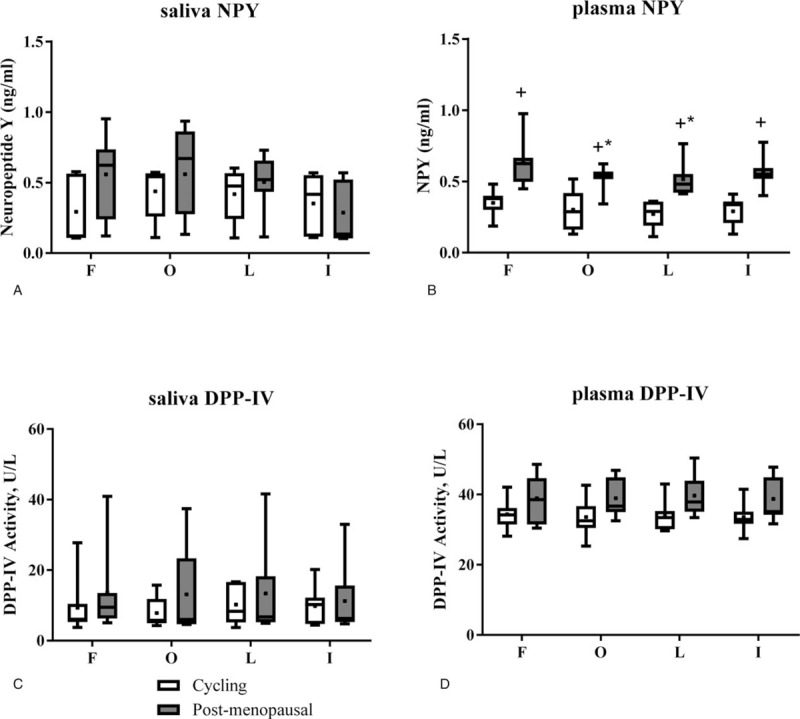
The purpose was to investigate changes in neuropeptide Y (NPY) protein and dipeptidyl peptidase IV (DPP-IV) activity in the plasma and saliva in normally cycling women and women after menopause. We recruited 7 cycling women and 7 postmenopausal women for a cross-sectional, prospective pilot study. Blood via venipuncture and saliva samples were taken at each point in the menstrual cycle (premenopausal) or once per week (postmenopausal) for 2 months. Blood and saliva were analyzed for estrogen, NPY using ELISA and DPP-IV activity using a fluorometric assay. Plasma β-estradiol was an average of 96.45 ± 57.04 pg/mL over 2 cycles in the premenopausal group and 1.72 ± 0.35 pg/mL over 2 months in the postmenopausal group (P < .05). In the cycling group, there were no significant differences in saliva or plasma NPY or DPP-IV over the cycle. For the postmenopausal group, salivary NPY and DPP-IV did not change over 2 months. Plasma NPY was lowest in the middle 2 weeks (average: 0.52 ± 0.10 ng/mL) compared to the first and fourth weeks (average of week 1 and 4: 0.60 ± 0.14 ng/mL; P < .05). Plasma NPY in postmenopausal women was higher overall (0.56 ± 0.13 ng/mL) compared to cycling women (0.30 ± 0.11 ng/mL; P < .05). Plasma DPP-IV activity was unchanged by time in the postmenopausal group. Saliva DPP-IV and saliva NPY in the cycling group had a significant negative correlation (R = -0.95; P < .05). We found that saliva measures of NPY and DPP-IV activity appear to be poor estimates of plasma concentrations and activities, but a larger sample size is required to conform this. Differences in plasma NPY concentrations between the groups and the relationship between salivary NPY and DPP-IV suggests that there may be some unique differences between these groups.
目的是研究正常月经周期女性和绝经后女性血浆及唾液中神经肽Y(NPY)蛋白和二肽基肽酶IV(DPP-IV)活性的变化。我们招募了7名处于月经周期的女性和7名绝经后女性进行一项横断面、前瞻性初步研究。在月经周期的每个时间点(绝经前)或每周一次(绝经后)采集静脉血和唾液样本,持续2个月。对血液和唾液进行雌激素、使用酶联免疫吸附测定法检测NPY以及使用荧光测定法检测DPP-IV活性的分析。绝经前组在2个月经周期内血浆β-雌二醇平均为96.45±57.04 pg/mL,绝经后组在2个月内平均为1.72±0.35 pg/mL(P<0.05)。在月经周期组中,整个周期内唾液或血浆中的NPY及DPP-IV无显著差异。对于绝经后组,唾液中的NPY和DPP-IV在2个月内未发生变化。与第一周和第四周(第1周和第4周平均值:0.60±0.14 ng/mL)相比,血浆NPY在中间2周最低(平均值:0.52±0.10 ng/mL;P<0.05)。绝经后女性的血浆NPY总体上高于月经周期女性(0.56±0.13 ng/mL比0.30±0.11 ng/mL;P<0.05)。绝经后组血浆DPP-IV活性随时间无变化。月经周期组中唾液DPP-IV与唾液NPY呈显著负相关(R=-0.95;P<0.05)。我们发现,唾液中NPY和DPP-IV活性的检测结果似乎不能很好地估计血浆浓度和活性,但需要更大样本量来证实这一点。两组之间血浆NPY浓度的差异以及唾液NPY与DPP-IV之间的关系表明,这些组之间可能存在一些独特差异。