Cho Geum Joon, Han Sung Won, Shin Jung-Ho, Kim Tak
Department of Obstetrics and Gynecology, Korea University Anam Hospital, Korea University College of Medicine School of Industrial Management Engineering, Korea University, Seoul, Republic of Korea.
Medicine (Baltimore). 2017 May;96(21):e6876. doi: 10.1097/MD.0000000000006876.
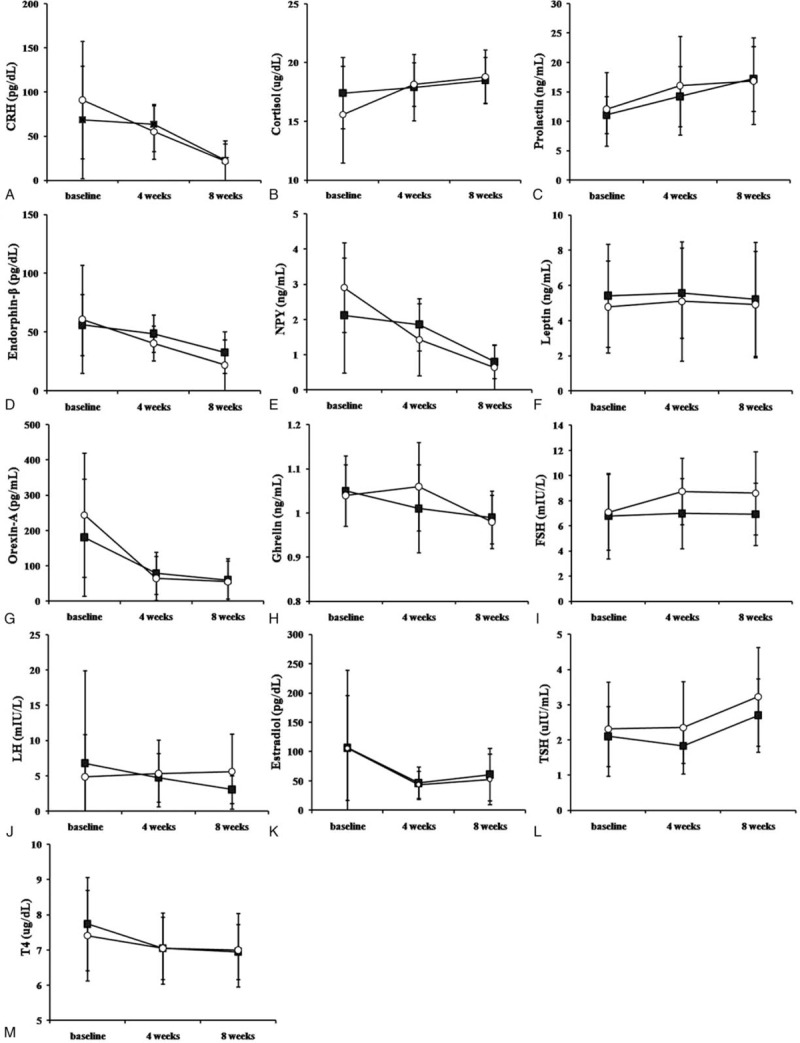
The aim of this study was to assess the effects of intensive training on menstrual function and related serum hormones and peptides.Forty female participants who attended a training course for an officer at the Korea Third Military Academy, and had regular menstrual periods were enrolled. Menstrual questionnaires and fasting blood samples were collected before entry and at 4-week intervals for 8 weeks. The levels of corticotropin-releasing hormone (CRH), cortisol, prolactin, endorphin-β, neuropeptide Y (NPY), leptin, orexin-A, ghrelin, follicle-stimulating hormone (FSH), luteinizing hormone (LH), estradiol (E2), thyrotropin (TSH), and thyroxine (T4) were determined.Body mass index and waist circumference decreased during the training course. Intensive training of military cadets resulted in changes of menstruation and related biomarkers. The levels of CRH, endorphin-β, NPY, orexin-A, ghrelin, E2, and T4 decreased substantially, and cortisol, prolactin, and TSH increased. Seventy percent of participants with regular menstrual periods before developed irregular during the training course. Participants were then categorized into 2 groups: those with regular menstruation (n = 12) and those with irregular menstruation (n = 28). The levels of hormones and peptides were not different between the 2 groups.In conclusion, cortisol, prolactin, and TSH level increased but levels of CRH, endorphin-β, NPY, orexin-A, ghrelin, E2, and T4 decreased throughout the training. Moreover, the levels were not different between participants with normal menstruation and those with irregular menstruation. Further research should extend these findings by investigating the exact mechanism by which high exercise levels, including intensive training, interfere with regular menstruation.
本研究旨在评估强化训练对月经功能以及相关血清激素和肽类的影响。招募了40名参加韩国第三军事学院军官培训课程且月经周期规律的女性参与者。在入学前以及之后的8周内,每隔4周收集月经问卷和空腹血样。测定促肾上腺皮质激素释放激素(CRH)、皮质醇、催乳素、β-内啡肽、神经肽Y(NPY)、瘦素、食欲素-A、胃饥饿素、促卵泡生成素(FSH)、促黄体生成素(LH)、雌二醇(E2)、促甲状腺激素(TSH)和甲状腺素(T4)的水平。在训练课程期间,体重指数和腰围下降。军校学员的强化训练导致月经及相关生物标志物发生变化。CRH、β-内啡肽、NPY、食欲素-A、胃饥饿素、E2和T4的水平大幅下降,而皮质醇、催乳素和TSH升高。之前月经周期规律的参与者中有70%在训练课程期间出现月经不规律。参与者随后被分为两组:月经规律组(n = 12)和月经不规律组(n = 28)。两组之间激素和肽类的水平没有差异。总之,在整个训练过程中,皮质醇、催乳素和TSH水平升高,而CRH、β-内啡肽、NPY、食欲素-A、胃饥饿素、E2和T4水平下降。此外,月经正常的参与者和月经不规律的参与者之间的水平没有差异。进一步的研究应通过调查包括强化训练在内的高强度运动干扰正常月经的确切机制来扩展这些发现。