Department of Neuroscience, Section of Rehabilitation, University of Padova, via Giustiniani 3, 35128 Padova, Italy.
Department of Statistical Sciences, University of Padova, via C. Battisti 241, 35121 Padova, Italy.
Neuroimage Clin. 2019;22:101768. doi: 10.1016/j.nicl.2019.101768. Epub 2019 Mar 18.
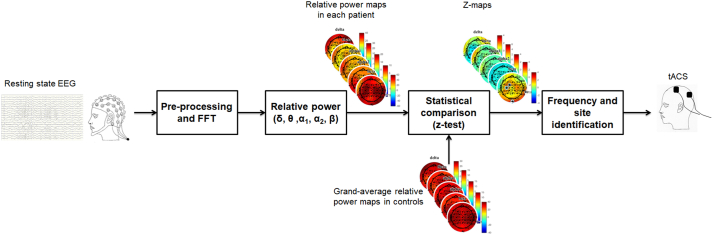
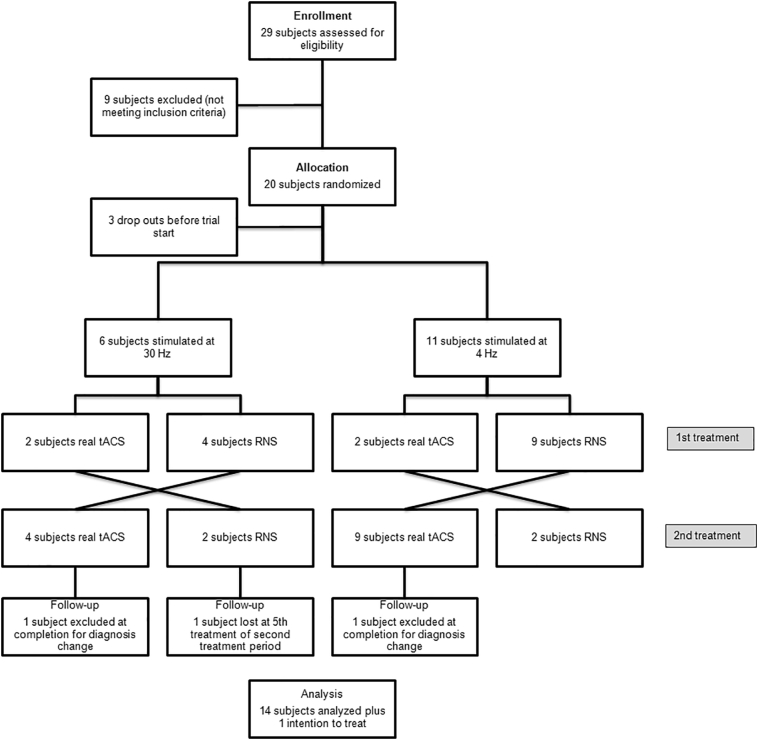
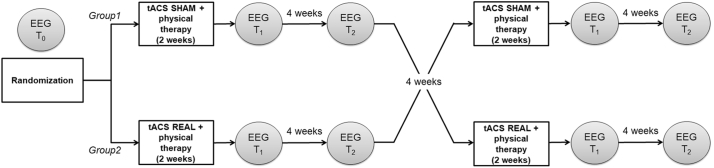
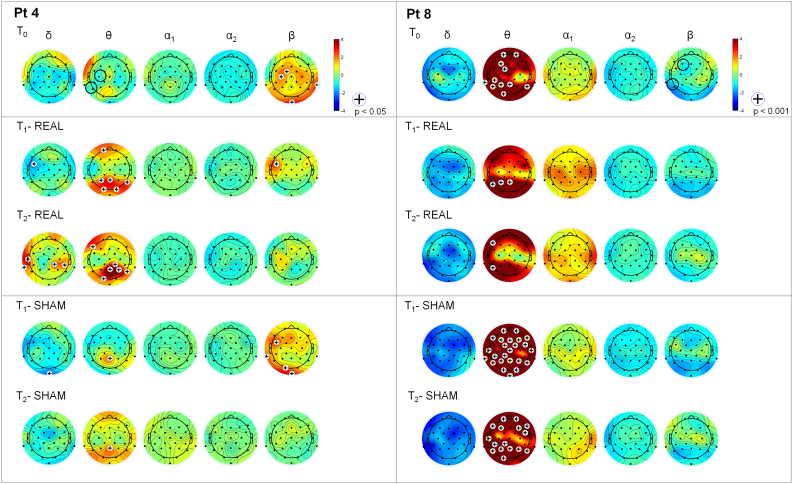
Abnormal cortical oscillations are markers of Parkinson's Disease (PD). Transcranial alternating current stimulation (tACS) can modulate brain oscillations and possibly impact on behaviour. Mapping of cortical activity (prevalent oscillatory frequency and topographic scalp distribution) may provide a personalized neurotherapeutic target and guide non-invasive brain stimulation. This is a cross-over, double blinded, randomized trial. Electroencephalogram (EEG) from participants with PD referred to Specialist Clinic, University Hospital, were recorded. TACS frequency and electrode position were individually defined based on statistical comparison of EEG power spectra maps with normative data from our laboratory. Stimulation frequency was set according to the EEG band displaying higher power spectra (with beta excess on EEG map, tACS was set at 4 Hz; with theta excess, tACS was set at 30 Hz). Participants were randomized to tACS or random noise stimulation (RNS), 5 days/week for 2-weeks followed by ad hoc physical therapy. EEG, motor (Unified Parkinson's Disease Rating Scale-motor: UPDRS III), neuropsychological (frontal, executive and memory tests) performance and mood were measured before (T), after (T) and 4-weeks after treatment (T). A linear model with random effects and Wilcoxon test were used to detect differences. Main results include a reduction of beta rhythm in theta-tACS vs. RNS group at T over right sensorimotor area (p = .014) and left parietal area (p = .010) and at T over right sensorimotor area (p = .004) and left frontal area (p = .039). Bradykinesia items improved at T (p = .002) and T (p = .047) compared to T in the tACS group. In the tACS group the Montréal Cognitive Assessment (MoCA) improved at T compared with T (p = .049). Individualized tACS in PD improves motor and cognitive performance. These changes are associated with a reduction of excessive fast EEG oscillations.
皮质异常震荡是帕金森病(PD)的标志物。经颅交流电刺激(tACS)可调节脑震荡,并可能影响行为。皮质活动的映射(主要震荡频率和头皮分布地形图)可能提供个性化神经治疗靶标并指导非侵入性脑刺激。这是一项交叉、双盲、随机试验。记录了来自专家诊所的 PD 参与者的脑电图(EEG)。根据 EEG 功率谱图与我们实验室的规范数据的统计比较,单独确定 tACS 频率和电极位置。刺激频率根据显示更高功率谱的 EEG 带设置(如果 EEG 图上的β过量,则 tACS 设置为 4 Hz;如果θ过量,则 tACS 设置为 30 Hz)。参与者随机分为 tACS 或随机噪声刺激(RNS)组,每周 5 天,连续 2 周,然后进行特定的物理治疗。在治疗前(T)、治疗后(T)和治疗后 4 周(T)时测量脑电图、运动(统一帕金森病评定量表-运动:UPDRS III)、神经心理学(额叶、执行和记忆测试)表现和情绪。使用具有随机效应的线性模型和 Wilcoxon 检验来检测差异。主要结果包括与 RNS 组相比,θ-tACS 组在 T 时右侧感觉运动区(p=0.014)和左侧顶叶区(p=0.010)以及 T 时右侧感觉运动区(p=0.004)和左侧额区(p=0.039)的β节律减少。与 T 相比,tACS 组在 T(p=0.002)和 T(p=0.047)时运动迟缓项目改善。在 tACS 组中,蒙特利尔认知评估(MoCA)在 T 时与 T 时相比有所改善(p=0.049)。PD 中的个体化 tACS 可改善运动和认知表现。这些变化与过快的 EEG 震荡减少有关。