Department of Surgery, Leiden University Medical Center, Albinusdreef 2, 2333ZA, Leiden, the Netherlands.
Department of Pathology, Leiden University Medical Center, Albinusdreef 2, 2333ZA, Leiden, the Netherlands.
BMC Cancer. 2019 Mar 29;19(1):284. doi: 10.1186/s12885-019-5462-2.
The tumor microenvironment has a critical role in regulating cancer cell behavior. Tumors with high stromal content are associated with poor patient outcome. The tumor-stroma ratio (TSR) identifies colorectal cancers (CRC) with poor patient prognosis based on hematoxylin & eosin stained sections. The desmoplastic reaction consists to a great extent of cancer-associated fibroblasts (CAFs) of which different subtypes are known. The aim of this study is to investigate and quantify CAFs present in the tumor stroma of CRC stratified by the TSR to possibly add prognostic significance to the TSR.
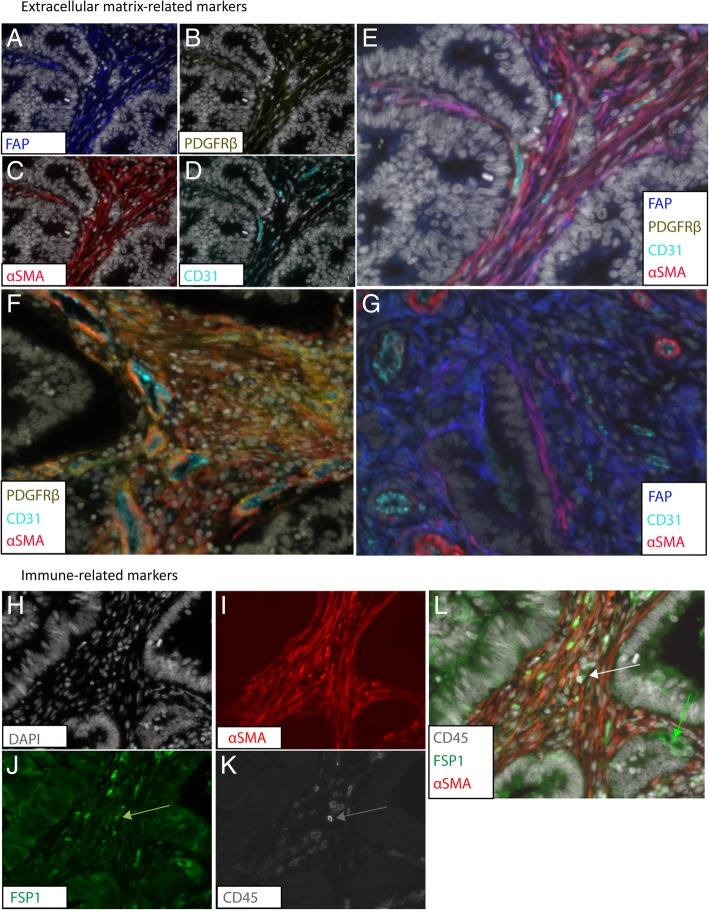
The expression of established CAF markers was compared between stroma-low and stroma-high tumors using transcriptomic data of 71 stage I - III CRC. Based on literature, fibroblast and stromal markers were selected to perform multiplex immunofluorescent staining on formalin fixed, paraffin-embedded tumor sections of patients diagnosed with stage III colon cancer. Antibodies against the following markers were used: αSMA, PDGFR -β, FAP, FSP1 and the stromal markers CD45 and CD31 as reference. The markers were subsequently quantified in the stroma using the Vectra imaging microscope.
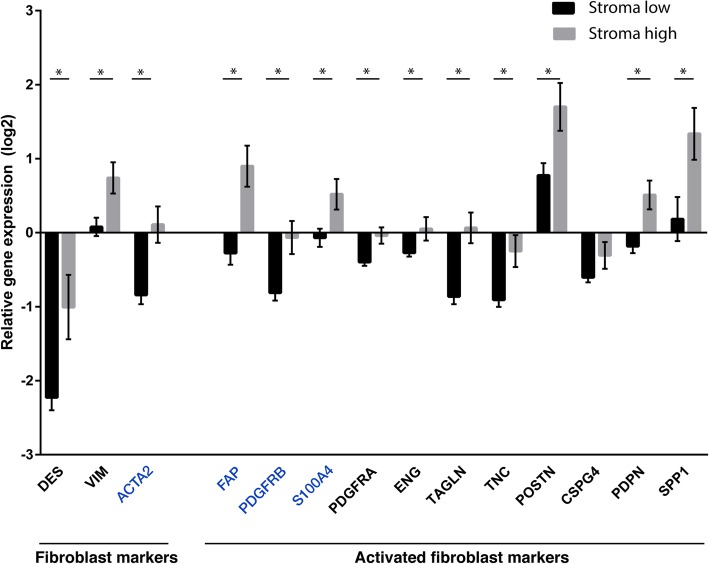
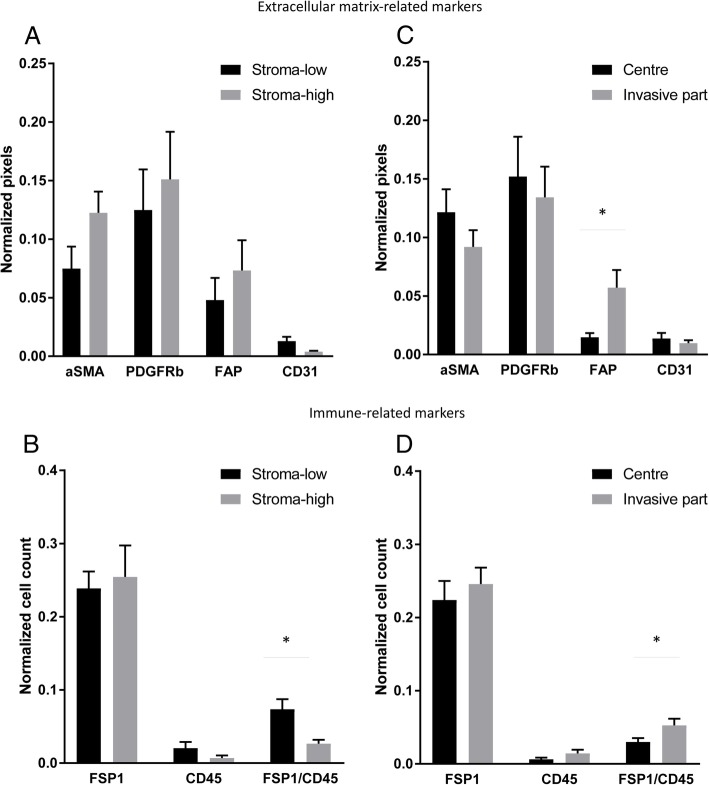
The transcriptomic data showed that all CAF markers except one were higher expressed in stroma-high compared to stroma-low tumors. Histologically, stroma-high tumors showed a decreased number of FSP1/CD45 cells and a trend of an increased expression of FAP compared to stroma-low tumors. FAP was higher expressed at the invasive part compared to the tumor center in both stroma-high and stroma-low tumors.
The increased expression of FAP at the invasive part and in stroma-high tumors might contribute to the invasive behavior of cancer cells. Future functional experiments should investigate the contribution of FAP to cancer cell invasion. Combining the quantity of the stroma as defined by the TSR with the activity level of CAFs using the expression of FAP may result in an expanded stroma-based tool for patient stratification.
肿瘤微环境在调节癌细胞行为方面起着关键作用。富含基质的肿瘤与患者预后不良相关。肿瘤基质比(TSR)基于苏木精和伊红染色切片识别出具有不良患者预后的结直肠癌(CRC)。促结缔组织增生反应在很大程度上由癌症相关成纤维细胞(CAFs)组成,已知其有不同的亚型。本研究的目的是通过 TSR 对结直肠癌肿瘤基质中的 CAFs 进行分层,以确定其是否对 TSR 有预后意义。
使用 71 例 I-III 期 CRC 的转录组数据比较了 TSR 低和 TSR 高肿瘤之间的 CAF 标志物的表达。基于文献,选择成纤维细胞和基质标志物,对诊断为 III 期结肠癌的患者的福尔马林固定、石蜡包埋肿瘤切片进行多聚免疫荧光染色。使用以下标志物的抗体:αSMA、PDGFR-β、FAP、FSP1 和基质标志物 CD45 和 CD31 作为参考。随后使用 Vectra 成像显微镜在基质中对标志物进行定量。
转录组数据显示,除一个标志物外,所有 CAF 标志物在 TSR 高肿瘤中的表达均高于 TSR 低肿瘤。组织学上,与 TSR 低肿瘤相比,TSR 高肿瘤中 FSP1/CD45 细胞数量减少,FAP 表达增加的趋势。在 TSR 高和 TSR 低肿瘤中,FAP 在侵袭部位的表达均高于肿瘤中心。
FAP 在侵袭部位和 TSR 高肿瘤中的高表达可能有助于癌细胞的侵袭行为。未来的功能实验应研究 FAP 对癌细胞侵袭的贡献。将 TSR 定义的基质数量与 FAP 的表达相结合,以评估 CAFs 的活性水平,可能会产生一种扩展的基于基质的患者分层工具。