Department of Radiation Oncology, Dalin Tzu Chi Hospital, Buddhist Tzu Chi Medical Foundation, No. 2, Min-Sheng Road, Dalin, Chia-Yi, Taiwan, Republic of China.
School of Medicine, Buddhist Tzu Chi University, Hualien, Taiwan, Republic of China.
BMC Cancer. 2019 Mar 28;19(1):275. doi: 10.1186/s12885-019-5461-3.
Hepatocellular carcinoma (HCC) accounts for 75-85% of primary liver cancers and is prevalent in the Asia-Pacific region. Till now, trans-arterial chemoembolization (TACE) is still one of common modalities in managing unresectable intermediate-stage HCC. However, post-TACE residual viable HCC is not uncommon, resulting in unsatisfied overall survival after TACE alone. Recently, stereotactic ablative radiotherapy (SABR) has been suggested to manage HCC curatively. However, evidence from phase-III trials is largely lacking. Hence, the present phase III randomized trial is designed to compare clinical outcomes between SABR and re-TACE for unresectable HCC patients who had incomplete response after initial TACE.
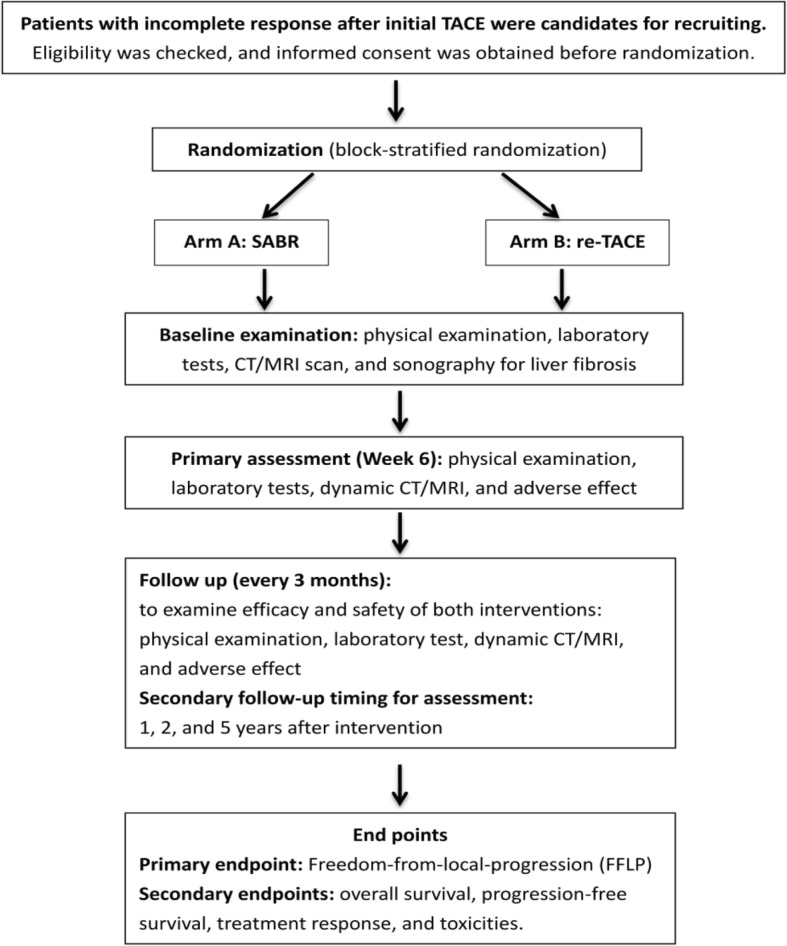
The present study is an open-label, parallel, randomized controlled trial. A total of 120 patients will be included into two study groups, i.e., SABR and re-TACE, with a 1:1 allocation rate. A 3-year allocating period is planned. Patients with incomplete response after initial TACE will be enrolled and randomized. The primary endpoint is 1-year freedom-form-local-progression rate. Secondary endpoints are disease-progression-free survival, overall survival, local control, response rate, toxicity, and duration of response of the treated tumor.
SABR has been reported as an effective modality in managing intermediate-stage HCC patients, but evidence from phase-III randomized trials is largely lacking. As a result, conducting randomized trials to demarcate the role of SABR in these patients is warranted, especially in the Asia-Pacific region, where HBV- and HCV-related HCCs are prevalent.
Before enrolling participants, the present study was registered prospectively on ClinicalTrials.gov (trial identifier, NCT02921139 ) on Sep. 29, 2016. This study is ongoing.
肝细胞癌(HCC)占原发性肝癌的 75-85%,在亚太地区较为普遍。到目前为止,经动脉化疗栓塞(TACE)仍然是治疗不可切除的中期 HCC 的常用方法之一。然而,TACE 后残留的存活 HCC 并不少见,导致单独 TACE 后的总体生存率不满意。最近,立体定向消融放疗(SABR)已被建议用于治疗 HCC。然而,III 期试验的证据还很少。因此,本 III 期随机试验旨在比较 SABR 和再 TACE 治疗初始 TACE 后不完全缓解的不可切除 HCC 患者的临床结果。
本研究为开放标签、平行、随机对照试验。共纳入 120 例患者,分为 SABR 和再 TACE 两组,分配比例为 1:1。计划进行 3 年的分配期。将招募并随机分配初始 TACE 后不完全缓解的患者。主要终点为 1 年无局部进展率。次要终点为无疾病进展生存期、总生存期、局部控制率、缓解率、毒性和治疗肿瘤的缓解持续时间。
SABR 已被报道为治疗中期 HCC 患者的有效方法,但 III 期随机试验的证据还很少。因此,有必要进行随机试验来确定 SABR 在这些患者中的作用,特别是在乙型肝炎病毒和丙型肝炎病毒相关 HCC 较为普遍的亚太地区。
在招募参与者之前,本研究于 2016 年 9 月 29 日在 ClinicalTrials.gov(试验标识符,NCT02921139)前瞻性注册。本研究正在进行中。