Winblad Stefan, Lindberg Christopher
Department of Psychology, University of Gothenburg, Box 500, 405 30, Gothenburg, Sweden.
Neuromuscular Centre, Department of Neurology, Sahlgrenska University Hospital, Gothenburg, Sweden.
BMC Neurol. 2019 Mar 28;19(1):45. doi: 10.1186/s12883-019-1280-z.
The aim of this study was to explore perceived fatigue, experienced functional limitations due to fatigue and clinical correlates in patients with Myotonic Dystrophy type 1 (DM1).
In total, 32 consecutive patients with DM1 (14 women and 18 men) and 30 sex, age and education matched healthy control subjects participated. Perceived fatigue was rated on the Fatigue Impact Scale (FIS). Patients also completed a set of assessments aimed to characterize CTG-repeat size, muscle impairment, depression and cognitive functions. Non-parametric analysis were performed as appropriate, including Mann-Whitney U-test and Spearman correlation test.
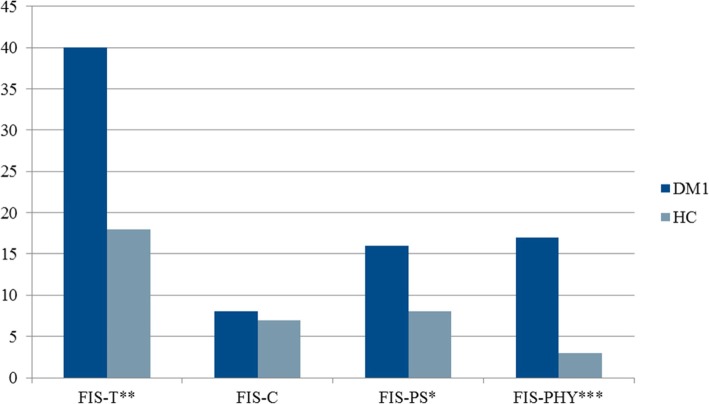
DM1 patients had higher FIS total score than healthy controls, suggesting higher fatigue levels. More specifically, DM1 patients scored higher on the FIS physical and psychosocial subscales than controls but not on the FIS cognitive scale. Scores on fatigue correlated significantly with muscle impairment and depression.
Perceived fatigue is significantly more common in patients with DM1 than in healthy controls. Higher ratings on depression and muscle impairment were associated with the condition. This indicates that both depression and muscle impairment may contribute to the experience of fatigue in DM1.
本研究旨在探讨1型强直性肌营养不良症(DM1)患者的感知疲劳、因疲劳导致的功能受限以及临床相关因素。
共有32例连续的DM1患者(14名女性和18名男性)以及30名性别、年龄和教育程度匹配的健康对照者参与研究。使用疲劳影响量表(FIS)对感知疲劳进行评分。患者还完成了一系列旨在表征CTG重复序列大小、肌肉损伤、抑郁和认知功能的评估。酌情进行非参数分析,包括曼-惠特尼U检验和斯皮尔曼相关性检验。
DM1患者的FIS总分高于健康对照者,表明疲劳水平更高。更具体地说,DM1患者在FIS身体和心理社会子量表上的得分高于对照组,但在FIS认知量表上得分无差异。疲劳评分与肌肉损伤和抑郁显著相关。
DM1患者中感知疲劳明显比健康对照者更常见。抑郁和肌肉损伤评分较高与该疾病相关。这表明抑郁和肌肉损伤都可能导致DM1患者出现疲劳。