School of Engineering and Physical Sciences, Heriot-Watt University, Edinburgh, EH14 4AS, UK.
Nat Commun. 2019 Mar 28;10(1):1401. doi: 10.1038/s41467-019-09475-5.
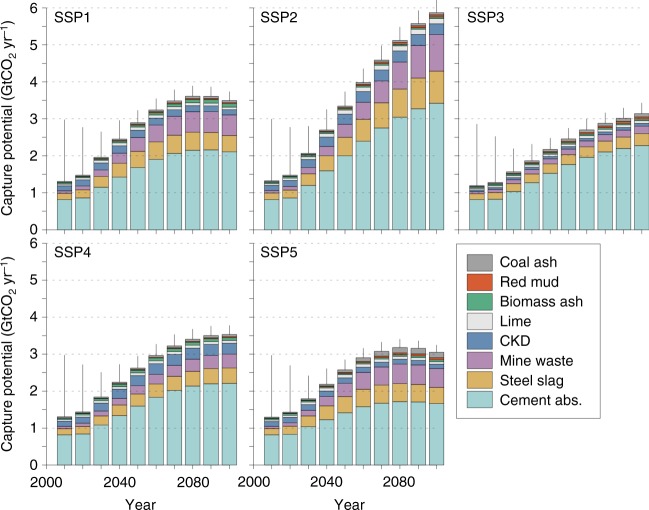
7 billion tonnes of alkaline materials are produced globally each year as a product or by-product of industrial activity. The aqueous dissolution of these materials creates high pH solutions that dissolves CO to store carbon in the form of solid carbonate minerals or dissolved bicarbonate ions. Here we show that these materials have a carbon dioxide storage potential of 2.9-8.5 billion tonnes per year by 2100, and may contribute a substantial proportion of the negative emissions required to limit global temperature change to <2 °C.
每年全球有 70 亿吨碱性材料作为工业活动的产品或副产品被生产出来。这些材料的水溶液会产生高 pH 值的溶液,从而溶解 CO,将碳以固体碳酸盐矿物或溶解的碳酸氢根离子的形式储存起来。在这里,我们表明,到 2100 年,这些材料的二氧化碳储存潜力为每年 29 亿至 85 亿吨,并且可能会对限制全球温度变化到 <2°C 所需的负排放做出重大贡献。