MRC Molecular Haematology Unit, Weatherall Institute of Molecular Medicine, Radcliffe Department of Medicine, University of Oxford, John Radcliffe Hospital, Oxford, OX3 9DS, UK.
Stem Cell Research, Nuffield Division of Clinical Laboratory Sciences, Radcliffe Department of Medicine, University of Oxford, and NHS Blood and Transplant, John Radcliffe Hospital, Oxford, OX3 9BQ, UK.
Sci Rep. 2019 Mar 28;9(1):5300. doi: 10.1038/s41598-019-41803-z.
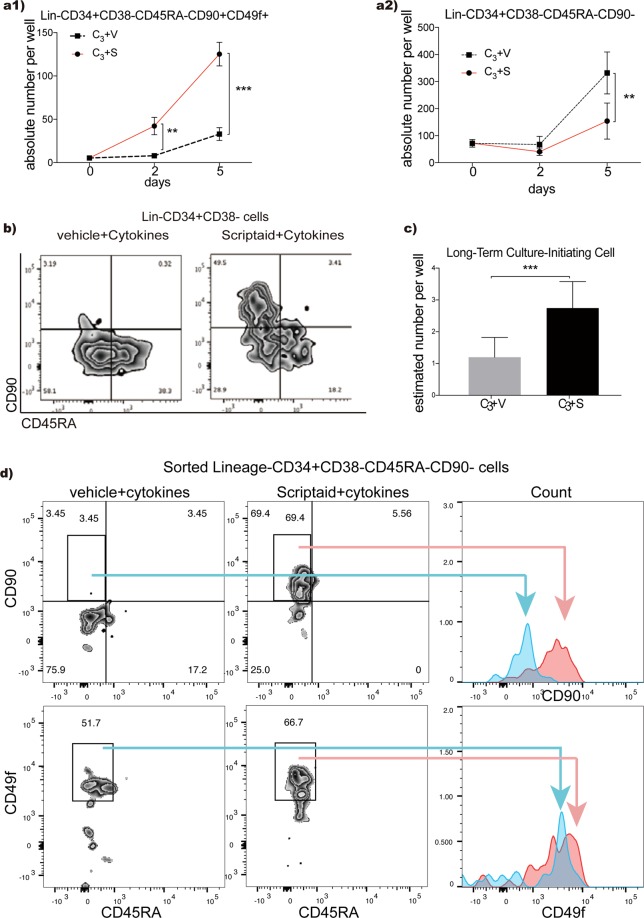
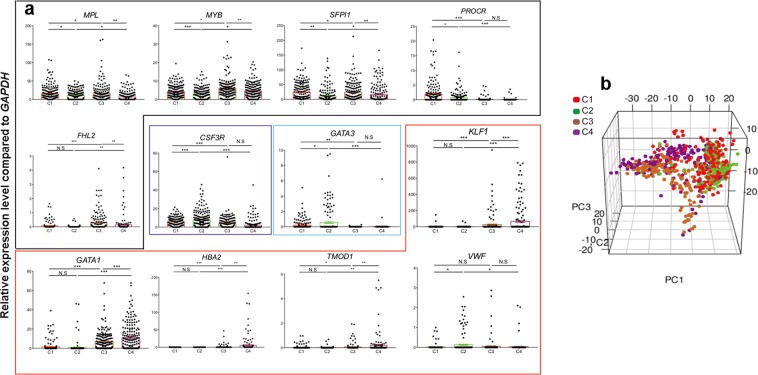
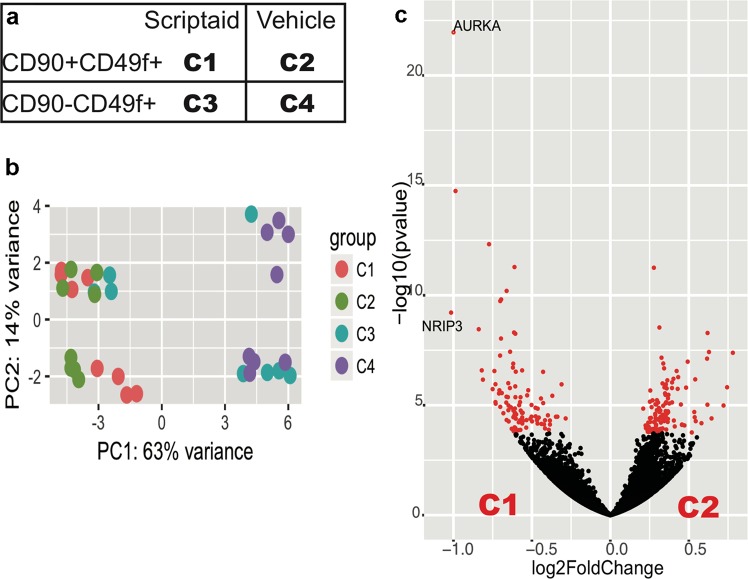
Priming haematopoietic stem/progenitor cells (HSPCs) in vitro with specific chromatin modifying agents and cytokines under serum-free-conditions significantly enhances engraftable HSC numbers. We extend these studies by culturing human CD133+ HSPCs on nanofibre scaffolds to mimic the niche for 5-days with the HDAC inhibitor Scriptaid and cytokines. Scriptaid increases absolute Lin-CD34+CD38-CD45RA-CD90+CD49f+ HSPC numbers, while concomitantly decreasing the Lin-CD38-CD34+CD45RA-CD90- subset. Hypothesising that Scriptaid plus cytokines expands the CD90+ subset without differentiation and upregulates CD90 on CD90- cells, we sorted, then cultured Lin-CD34+CD38-CD45RA-CD90- cells with Scriptaid and cytokines. Within 2-days and for at least 5-days, most CD90- cells became CD90+. There was no significant difference in the transcriptomic profile, by RNAsequencing, between cytokine-expanded and purified Lin-CD34+CD38-CD45RA-CD49f+CD90+ cells in the presence or absence of Scriptaid, suggesting that Scriptaid maintains stem cell gene expression programs despite expansion in HSC numbers. Supporting this, 50 genes were significantly differentially expressed between CD90+ and CD90- Lin-CD34+CD38-CD45RA-CD49f+ subsets in Scriptaid-cytokine- and cytokine only-expansion conditions. Thus, Scriptaid treatment of CD133+ cells may be a useful approach to expanding the absolute number of CD90+ HSC, without losing their stem cell characteristics, both through direct effects on HSC and potentially also conversion of their immediate CD90- progeny into CD90+ HSC.
在无血清条件下,用特定的染色质修饰剂和细胞因子体外预刺激造血干/祖细胞 (HSPC),可显著提高可植入性 HSC 的数量。我们通过在纳米纤维支架上培养人 CD133+ HSPC 来扩展这些研究,以模拟 5 天的龛位,同时使用 HDAC 抑制剂 Scriptaid 和细胞因子。Scriptaid 增加了绝对 Lin-CD34+CD38-CD45RA-CD90+CD49f+ HSPC 的数量,同时减少了 Lin-CD38-CD34+CD45RA-CD90-亚群。假设 Scriptaid 加细胞因子在不分化的情况下扩增 CD90+亚群,并上调 CD90-细胞上的 CD90,我们对 Lin-CD34+CD38-CD45RA-CD90-细胞进行分选,然后用 Scriptaid 和细胞因子培养。在 2 天内,至少在 5 天内,大多数 CD90-细胞成为 CD90+。在存在或不存在 Scriptaid 的情况下,通过 RNA 测序,细胞因子扩增和纯化的 Lin-CD34+CD38-CD45RA-CD49f+CD90+细胞的转录组图谱没有显著差异,这表明尽管 HSC 数量增加,Scriptaid 仍维持干细胞基因表达程序。支持这一点,在 Scriptaid 细胞因子和细胞因子单独扩增条件下,CD90+和 CD90-Lin-CD34+CD38-CD45RA-CD49f+ 亚群之间有 50 个基因差异表达显著。因此,Scriptaid 处理 CD133+细胞可能是一种有用的方法,可以在不丧失其干细胞特征的情况下,增加 CD90+ HSC 的绝对数量,这既可以通过直接作用于 HSC,也可以通过潜在地将其直接的 CD90-后代转化为 CD90+ HSC 来实现。