Business School, Sichuan University, Wangjiang Road No. 29, Chengdu 610064, China.
Department of Economics, Soochow University,56, Kueiyang St., Sec. 1, Taipei 10048, Taiwan.
Int J Environ Res Public Health. 2019 Mar 28;16(7):1122. doi: 10.3390/ijerph16071122.
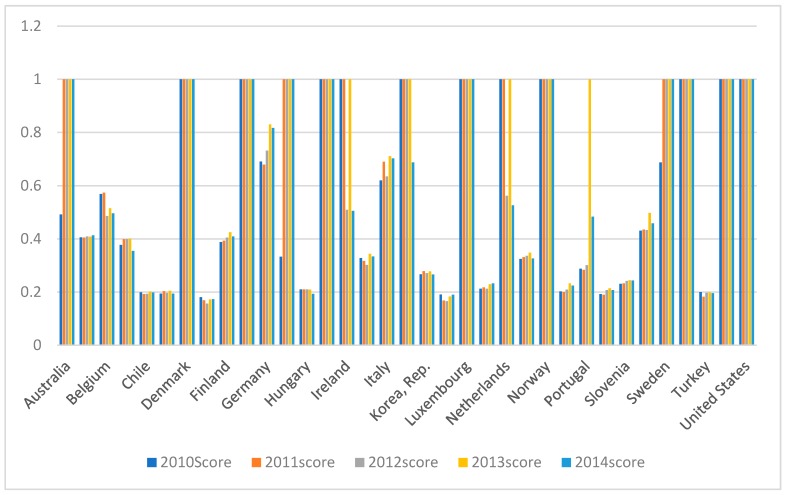
To mitigate the problems associated with climate change, the low-carbon economy concept is now being championed around the world in an effort to reduce greenhouse gas emissions and ensure sustainable economic growth. Therefore, to reduce the dependence on traditional energy sources, the Organization for Economic Co-operation and Development (OECD) has been actively promoting the use of renewable energy. Past research has tended to neglect the influence of other pollutants such as fine particulate matter (PM) and sulfur dioxide (SO₂) and have mainly been based on static analyses. To make up for these research gaps, this study examined OECD country data from 2010⁻2014, with labor, fixed assets, new energy, and traditional energy as the inputs, and Gross Domestic Product (GDP), carbon dioxide (CO₂), and PM as the outputs, from which it was found: (1) the overall efficiency of the individual countries varied significantly, with nine countries being found to have efficiencies of 1 for all five years, but many others having efficiencies below 0.2; (2) in countries where there was a need for improvements in traditional energy (which here refers to coal, petroleum and other fossil energy sources), there was also a significant need for improvement in new energy sources (which here refers to clean energy which will produce pollutant emissions and can be directly used for production and life, including resources like nuclear energy and "renewable energy"); (3) countries with poor traditional energy and new energy efficiencies also had poor CO₂ and PM efficiencies; (4) many OECD countries have made progress towards sustainable new energy developments.
为了缓解气候变化带来的问题,低碳经济的概念目前在全球范围内得到了倡导,旨在减少温室气体排放,确保经济的可持续增长。因此,为了减少对传统能源的依赖,经济合作与发展组织(OECD)一直在积极推动可再生能源的使用。过去的研究往往忽略了其他污染物如细颗粒物(PM)和二氧化硫(SO₂)的影响,并且主要基于静态分析。为了弥补这些研究空白,本研究考察了 OECD 国家 2010 年至 2014 年的数据,以劳动力、固定资产、新能源和传统能源为投入,以国内生产总值(GDP)、二氧化碳(CO₂)和 PM 为产出,结果发现:(1)各国的整体效率差异很大,有 9 个国家在所有 5 年的效率均为 1,但也有许多国家的效率低于 0.2;(2)在需要改进传统能源(这里指煤炭、石油和其他化石能源)的国家,新能源(这里指清洁能源,会产生污染物排放,可以直接用于生产和生活,包括核能和“可再生能源”等资源)也需要显著改进;(3)传统能源和新能源效率较差的国家,CO₂和 PM 的效率也较差;(4)许多 OECD 国家在可持续新能源发展方面取得了进展。