Lieb Wolfgang, Jacobs Gunnar, Wolf Andreas, Richter Gesine, Gaede Karoline I, Schwarz Jeanette, Arnold Norbert, Böhm Ruwen, Buyx Alena, Cascorbi Ingolf, Franke Andre, Glinicke Christine, Held-Feindt Janka, Junker Ralf, Kalthoff Holger, Kramer Hans-Heiner, Leypoldt Frank, Maass Nicolai, Maetzler Walter, May Sandra, Mehdorn H Maximilian, Röcken Christoph, Schafmayer Clemens, Schrappe Martin, Schreiber Stefan, Sebens Susanne, Stephani Ulrich, Synowitz Michael, Weimer Jörg, Zabel Peter, Nöthlings Ute, Röder Christian, Krawczak Michael
Institute of Epidemiology Kiel University and PopGen Biobank, University Hospital Schleswig-Holstein UKSH, Campus Kiel Hs. 1, Niemannsweg 11, 24105, Kiel, Germany.
Institute of Medical Informatics and Statistics, Kiel University, Kiel, Germany.
J Community Genet. 2019 Oct;10(4):523-530. doi: 10.1007/s12687-019-00417-8. Epub 2019 Mar 29.
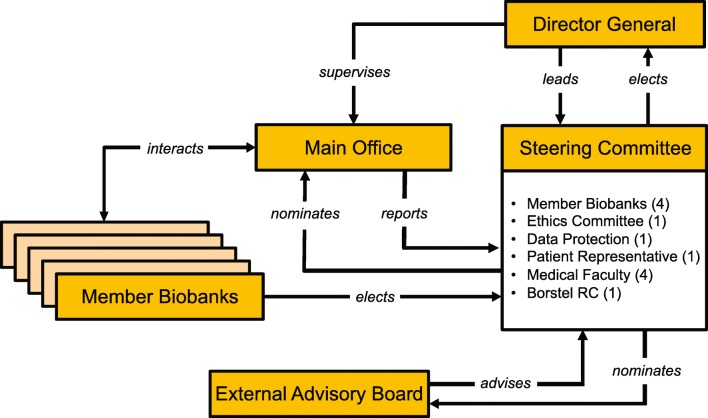
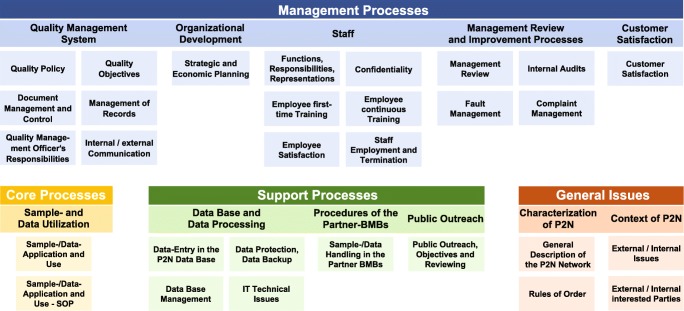
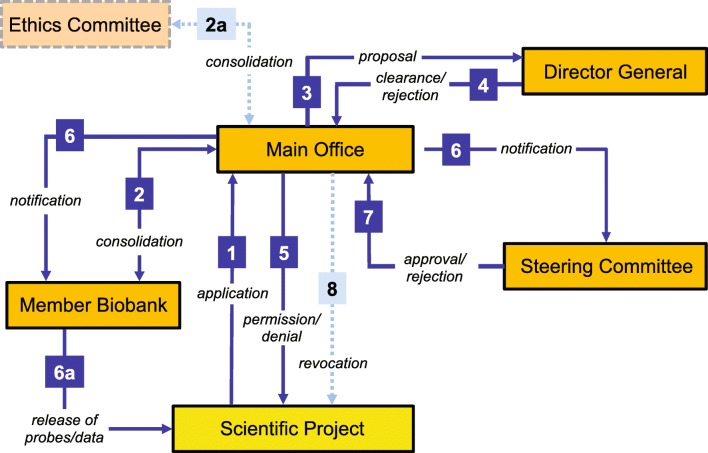
The significance of human biorepositories for modern medical research, particularly for comprehensive population-based genetic analyses, is constantly growing. While large and centralized institutions are usually considered best suited to meet the increasing demand for high-quality "biobanks," most medical research institutions still host rather heterogeneous and fragmented biobanking activities, undertaken by clinical departments with oftentimes rather different scientific scope. Undoubtedly, most clinicians and medical researchers would appreciate infrastructural support in terms of the storage and handling of their biosamples, but they are also likely to expect access to their samples avoiding extensive formal requirements. We report on the establishment of the PopGen 2.0 Network (P2N), an overarching alliance of initially seven biobanks from Northern Germany which adopted a joint but lean governance structure and use-and-access policy for their samples and data. In addition, the members of P2N have pursued an intense collaboration on ethical, legal and social issues and maintain a common IT infrastructure. The implementation of P2N has substantially improved the prospects of biobank-based research at the participating institutions. The network may thus serve as a role model for similar initiatives geared at linking pre-existing biorepositories for the benefit of research quality, efficiency, and transparency.
人类生物样本库对于现代医学研究,尤其是基于人群的全面基因分析的重要性与日俱增。虽然大型集中化机构通常被认为最适合满足对高质量“生物样本库”日益增长的需求,但大多数医学研究机构仍开展着相当分散且各异的生物样本库活动,这些活动由临床科室进行,其科学范围往往差异很大。毫无疑问,大多数临床医生和医学研究人员会赞赏在生物样本的存储和处理方面提供的基础设施支持,但他们也可能期望能够获取样本,同时避免繁琐的正式要求。我们报告了PopGen 2.0网络(P2N)的建立情况,这是一个由德国北部最初的七个生物样本库组成的总体联盟,该联盟采用了联合但精简的治理结构以及样本和数据的使用与获取政策。此外,P2N的成员在伦理、法律和社会问题上开展了密切合作,并维护着共同的信息技术基础设施。P2N的实施极大地改善了参与机构基于生物样本库的研究前景。因此,该网络可以作为类似举措的典范,旨在将现有的生物样本库连接起来,以提高研究质量、效率和透明度。