Department of Neurosurgery, University Medical Center Hamburg-Eppendorf, Martinistraße 52, 20246, Hamburg, Germany.
Bioinformatics Core, University Medical Center Hamburg-Eppendorf, Martinistraße 52, 20246, Hamburg, Germany.
J Neurol. 2020 Sep;267(9):2533-2545. doi: 10.1007/s00415-020-09865-6. Epub 2020 May 4.
Genetic risk factors for unruptured intracranial aneurysms (UIA) and aneurysmal subarachnoid hemorrhage (aSAH) are poorly understood. We aimed to verify recently reported risk genes and to identify novel sequence variants involved in the etiology of UIA/aSAH.
We performed exome sequencing (ES) in 35 unrelated individuals and 3 family members, each with a history of UIA and/or aSAH. We searched for sequence variants with minor allele frequency (MAF) ≤ 5% in the reported risk genes ADAMTS15, ANGPTL6, ARHGEF17, LOXL2, PCNT, RNF213, THSD1 and TMEM132B. To identify novel putative risk genes we looked for unknown (MAF = 0) variants shared by the three relatives.
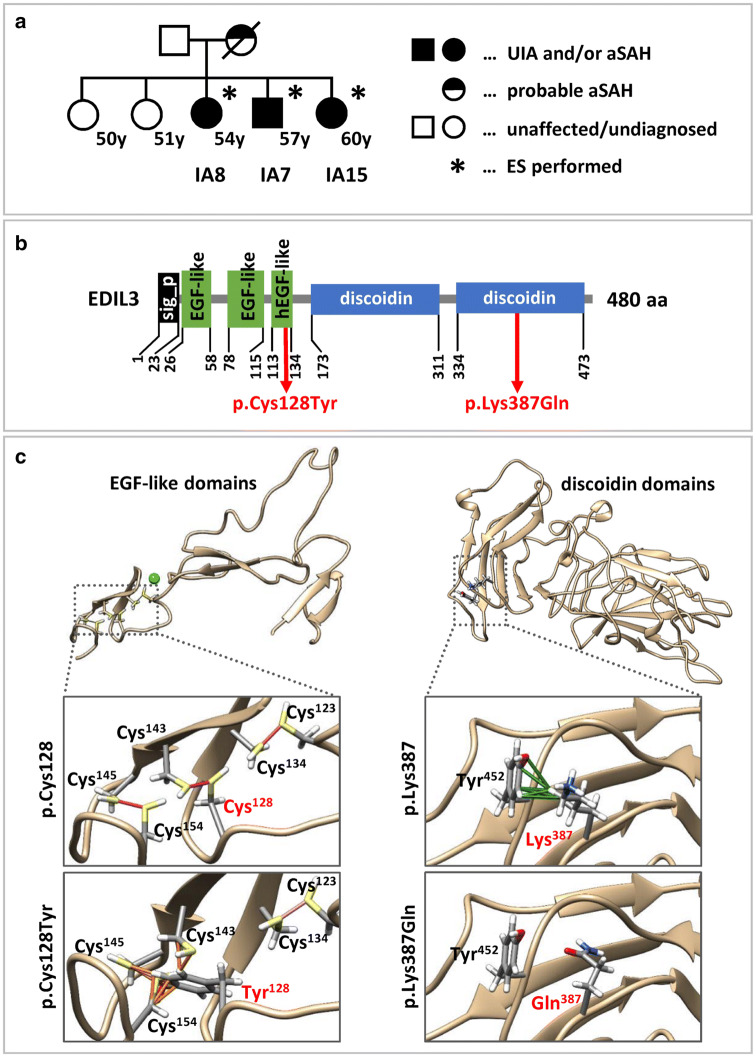
We identified 20 variants with MAF ≤ 5% in 18 individuals: 9 variants in PCNT (9 patients), 4 in RNF213 (3 patients), 3 in THSD1 (6 patients), 2 in ANGPTL6 (3 patients), 1 in ADAMTS15 (1 patient) and 1 in TMEM132B (1 patient). In the affected family, prioritization of shared sequence variants yielded five novel putative risk genes. Based on predicted pathogenicity of identified variants, population genetics data and a high functional relevance for vascular biology, EDIL3 was selected as top candidate and screened in additional 37 individuals with UIA and/or aSAH: a further very rare EDIL3 sequence variant in two unrelated sporadic patients was identified.
Our data support a role of sequence variants in PCNT, RNF213 and THSD1 as susceptibility factors for cerebrovascular disease. The documented function in vascular wall integrity, the crucial localization of affected amino acids and gene/variant association tests suggest EDIL3 as a further valid candidate disease gene for UIA/aSAH.
颅内未破裂动脉瘤(UIA)和蛛网膜下腔出血(aSAH)的遗传风险因素尚不清楚。本研究旨在验证最近报道的风险基因,并确定与 UIA/aSAH 发病机制相关的新的序列变异。
我们对 35 名无血缘关系的个体和 3 名有 UIA 和/或 aSAH 病史的家族成员进行了外显子组测序(ES)。我们在报道的风险基因 ADAMTS15、ANGPTL6、ARHGEF17、LOXL2、PCNT、RNF213、THSD1 和 TMEM132B 中搜索了等位基因频率(MAF)≤5%的序列变异。为了鉴定新的潜在风险基因,我们寻找了这 3 位亲属共有的未知(MAF=0)变异。
在 18 名个体中发现了 20 个 MAF≤5%的变异:9 个变异位于 PCNT(9 例患者),4 个变异位于 RNF213(3 例患者),3 个变异位于 THSD1(6 例患者),2 个变异位于 ANGPTL6(3 例患者),1 个变异位于 ADAMTS15(1 例患者),1 个变异位于 TMEM132B(1 例患者)。在受影响的家族中,对共享序列变异的优先级排序产生了 5 个新的潜在风险基因。根据鉴定变异的预测致病性、群体遗传学数据以及对血管生物学的高度功能相关性,选择 EDIL3 作为候选基因,并在另外 37 名患有 UIA 和/或 aSAH 的个体中进行了筛查:在两名无血缘关系的散发性患者中发现了另一个非常罕见的 EDIL3 序列变异。
本研究数据支持 PCNT、RNF213 和 THSD1 的序列变异作为脑血管疾病的易感因素。受影响氨基酸的关键定位以及基因/变异关联测试表明,EDIL3 是 UIA/aSAH 的另一个有效的候选疾病基因。