Beijing Key Laboratory for Biomaterials and Neural Regeneration, School of Biological Science and Medical Engineering, Beihang University, No. 37 Xueyuan Road, Haidian District, Beijing 100083, P.R. China.
Beijing International Cooperation Bases for Science and Technology on Biomaterials and Neural Regeneration, Beijing Advanced Innovation Center for Biomedical Engineering, Beihang University, No. 37 Xueyuan Road, Haidian District, Beijing 100083, P.R. China.
Exp Anim. 2019 Aug 14;68(3):341-349. doi: 10.1538/expanim.18-0180. Epub 2019 Apr 1.
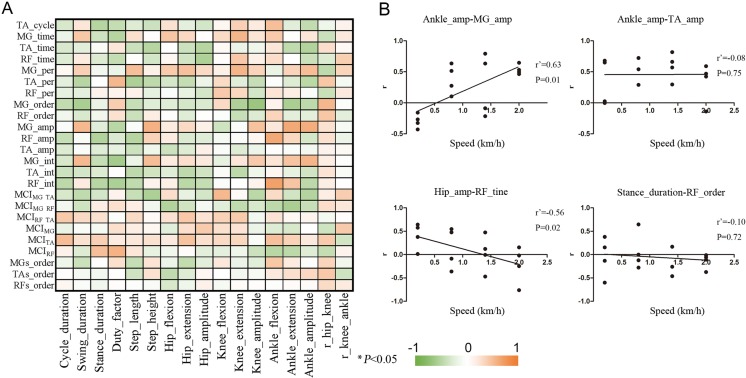
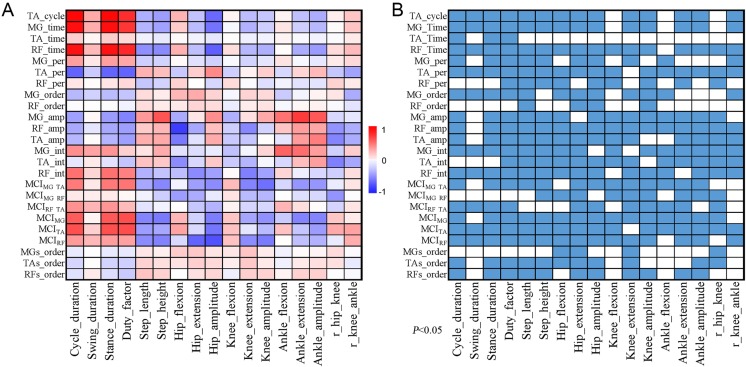
Walking is characterized by repetitive limb movements associated with highly structured patterns of muscle activity. The causal relationships between the muscle activities and hindlimb segments of walking are difficult to decipher. This study investigated these particular relationships and clarified whether they are correlated with speed to further understand the neuromuscular control pattern. Four adult female rhesus monkeys (Macaca mulatta) were selected to record gait parameters while walking on a bipedal treadmill at speeds of 0.2, 0.8, 1.4, and 2.0 km/h. We recorded 3 ipsilateral hindlimb muscles by surface recording. In this study, we calculated the correlations between electromyography (EMG) and kinematic parameters (24 EMG*17 kinematic parameters). Of the 408 calculated coefficients, 71.6% showed significant linear correlations. Significant linear correlations were found between muscle activity, such as burst amplitudes and the integral of muscle activity, and the corresponding kinematic parameters of each joint. Most of these relationships were speed independent (91.7% of all variables). Through correlation analysis, this study demonstrated a causal association between kinematic and EMG patterns of rhesus monkey locomotion. Individuals have particular musculoskeletal control patterns, and most of the relationships between hindlimb segments and muscles are speed independent. The current findings may enhance our understanding of neuromusculoskeletal control strategies.
行走的特点是与高度结构化的肌肉活动模式相关的重复肢体运动。肌肉活动与后肢运动之间的因果关系很难解释。本研究调查了这些特定的关系,并澄清它们是否与速度相关,以进一步了解神经肌肉控制模式。选择了四只成年雌性恒河猴(Macaca mulatta)在双足跑步机上以 0.2、0.8、1.4 和 2.0 km/h 的速度行走时记录步态参数。我们通过表面记录记录了 3 条同侧后肢肌肉。在这项研究中,我们计算了肌电图(EMG)和运动学参数(24 个 EMG*17 个运动学参数)之间的相关性。在计算出的 408 个系数中,有 71.6%表现出显著的线性相关性。在肌肉活动(如爆发幅度和肌肉活动积分)与每个关节的相应运动学参数之间发现了显著的线性相关性。这些关系大多与速度无关(所有变量的 91.7%)。通过相关分析,本研究证明了恒河猴运动的运动学和 EMG 模式之间存在因果关系。个体具有特定的骨骼肌肉控制模式,后肢各节段与肌肉之间的大多数关系与速度无关。目前的研究结果可能有助于我们理解神经肌肉骨骼控制策略。