Landomiel Flavie, De Pascali Francesco, Raynaud Pauline, Jean-Alphonse Frédéric, Yvinec Romain, Pellissier Lucie P, Bozon Véronique, Bruneau Gilles, Crépieux Pascale, Poupon Anne, Reiter Eric
PRC, INRA, CNRS, IFCE, Université de Tours, Nouzilly, France.
Front Endocrinol (Lausanne). 2019 Mar 13;10:148. doi: 10.3389/fendo.2019.00148. eCollection 2019.
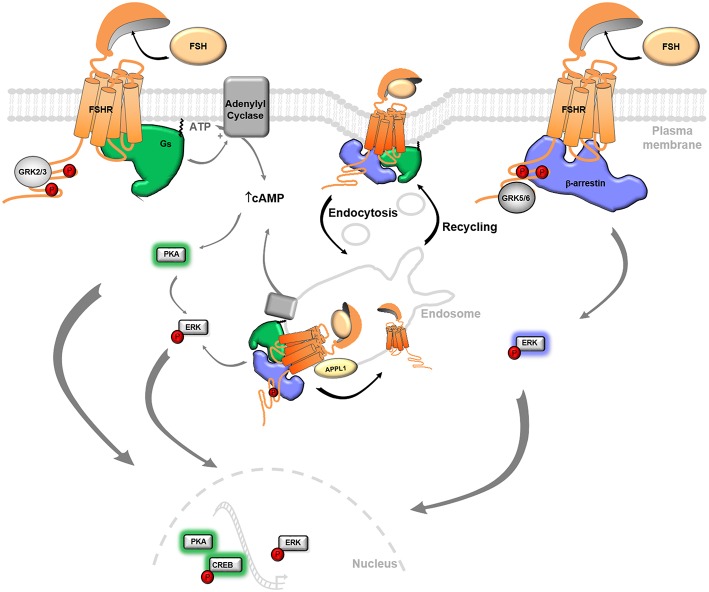
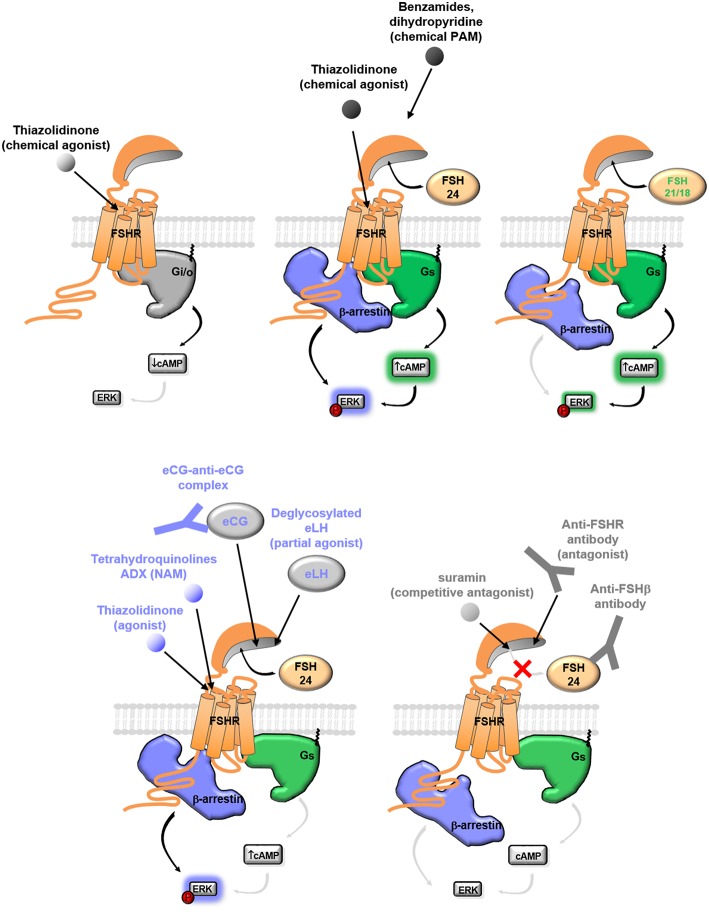
Knowledge on G protein-coupled receptor (GPCRs) structure and mechanism of activation has profoundly evolved over the past years. The way drugs targeting this family of receptors are discovered and used has also changed. Ligands appear to bind a growing number of GPCRs in a competitive or allosteric manner to elicit balanced signaling or biased signaling (i.e., differential efficacy in activating or inhibiting selective signaling pathway(s) compared to the reference ligand). These novel concepts and developments transform our understanding of the follicle-stimulating hormone (FSH) receptor (FSHR) biology and the way it could be pharmacologically modulated in the future. The FSHR is expressed in somatic cells of the gonads and plays a major role in reproduction. When compared to classical GPCRs, the FSHR exhibits intrinsic peculiarities, such as a very large NH2-terminal extracellular domain that binds a naturally heterogeneous, large heterodimeric glycoprotein, namely FSH. Once activated, the FSHR couples to Gαs and, in some instances, to other Gα subunits. G protein-coupled receptor kinases and β-arrestins are also recruited to this receptor and account for its desensitization, trafficking, and intracellular signaling. Different classes of pharmacological tools capable of biasing FSHR signaling have been reported and open promising prospects both in basic research and for therapeutic applications. Here we provide an updated review of the most salient peculiarities of FSHR signaling and its selective modulation.
在过去几年中,关于G蛋白偶联受体(GPCRs)的结构和激活机制的知识有了深刻的发展。针对这类受体的药物的发现和使用方式也发生了变化。配体似乎以竞争性或变构方式与越来越多的GPCR结合,以引发平衡信号或偏向性信号(即与参考配体相比,在激活或抑制选择性信号通路方面具有不同的效力)。这些新的概念和进展改变了我们对促卵泡激素(FSH)受体(FSHR)生物学的理解以及未来对其进行药理学调节的方式。FSHR在性腺的体细胞中表达,在生殖中起主要作用。与经典GPCR相比,FSHR具有内在的独特性,例如一个非常大的NH2末端细胞外结构域,它结合一种天然异质性的大异二聚体糖蛋白,即FSH。一旦被激活,FSHR与Gαs偶联,在某些情况下,还与其他Gα亚基偶联。G蛋白偶联受体激酶和β-抑制蛋白也被招募到该受体,并参与其脱敏、转运和细胞内信号传导。已经报道了不同类别的能够使FSHR信号偏向的药理学工具,这在基础研究和治疗应用方面都开辟了广阔的前景。在这里,我们对FSHR信号传导的最显著特点及其选择性调节进行了更新综述。