Pinto Tatiana Castro Abreu, Neves Felipe Piedade Gonçalves, Souza Aline Rosa Vianna, Oliveira Laura Maria Andrade, Costa Natália Silva, Castro Luciana Fundão Souza, Mendonça-Souza Cláudia Rezende de Vieira, Peralta José Mauro, Teixeira Lúcia Martins
Instituto de Microbiologia Paulo de Goes, Universidade Federal do Rio de Janeiro, Rio de Janeiro, Brazil.
Instituto Biomédico, Universidade Federal Fluminense, Niterói, Brazil.
Front Microbiol. 2019 Mar 14;10:486. doi: 10.3389/fmicb.2019.00486. eCollection 2019.
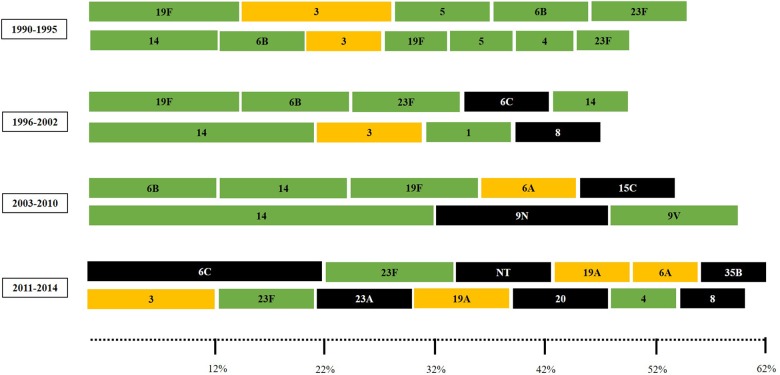
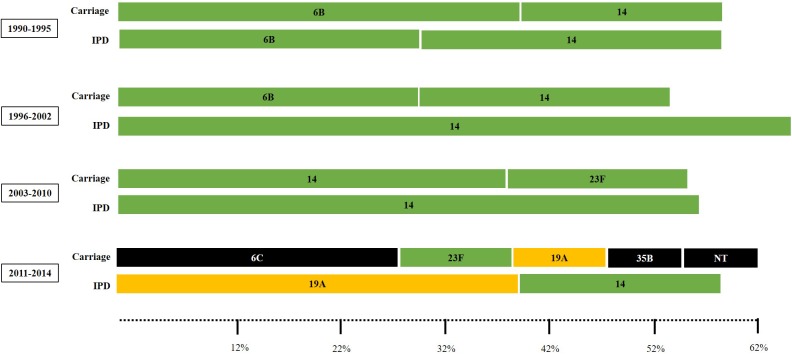
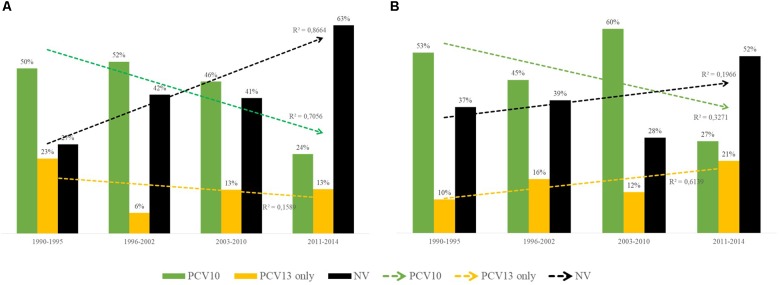
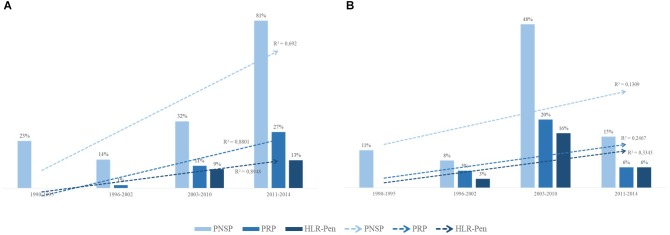
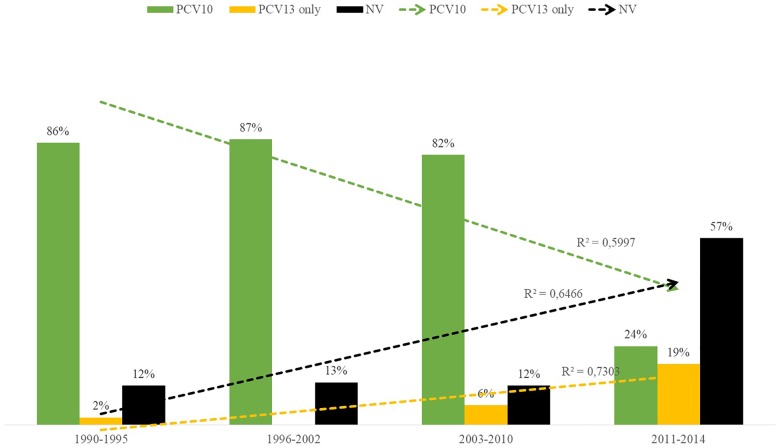
is a major cause of community-acquired pneumonia and meningitis, and it is also found as a commensal, colonizing the human upper respiratory tract of a portion of the human population. Its polysaccharide capsule allows the recognition of more than 90 capsular types and represents the target of the currently available pneumococcal conjugate vaccines (PCVs), such as the 10-valent (PCV10) and the 13-valent (PCV13). Penicillin non-susceptible pneumococci (PNSP) have been listed as one of the current major antimicrobial-resistant pathogen threats. In Brazil, the emergence of PNSP was initially detected in the mid 1990s and PCV10 has been part of the National Immunization Program since 2010. Here, we investigated the distribution of capsular types and penicillin susceptibility profiles of 783 pneumococcal strains isolated in Brazil between 1990 and 2014 to assess the evolution of penicillin non-susceptibility among pneumococci associated with asymptomatic carriage and invasive pneumococcal disease (IPD). The most common serotypes among carriage isolates were 19F, 6B, 6C, 23F, and 14. Among IPD isolates, the most frequent types were 14, 3, 6B, 5, 19F, and 4. We detected 21 types exclusively associated with IPD isolates, whereas non-typeable (NT) isolates were only detected in carriage. Nearly half of the isolates belonged to PCV10 serotypes, which remarkably decreased in occurrence (by nearly 50%) after PCV10 introduction (2011-2014), while non-PCV10 serotypes increased. PNSP frequency and levels were much higher among carriage isolates, but PNSP belonging to PCV10 serotypes were more common in IPD. While the occurrence of PNSP has decreased significantly among IPD isolates since 2011, it kept increasing among carriage strains. Such a difference can be attributed to the serotypes that emerged in each clinical source after PCV10 usage. PNSP with multidrug resistance profiles that emerged within carriage isolates comprised mostly serotypes 6C and 35B, as well as NT isolates. In turn, penicillin-susceptible capsular types 3, 20, and 8 have risen among IPD. Overall, our results reinforce the relevance of PNSP surveillance over a long period of time to better understand the dynamics of antimicrobial resistance in response to PCV introduction and may also contribute to improve control measures toward drug-resistant pneumococci.
是社区获得性肺炎和脑膜炎的主要病因,也被发现作为一种共生菌,定殖于一部分人群的人类上呼吸道。其多糖荚膜可识别90多种荚膜类型,是目前可用的肺炎球菌结合疫苗(PCV)的靶点,如10价(PCV10)和13价(PCV13)疫苗。青霉素不敏感肺炎球菌(PNSP)已被列为当前主要的抗菌药物耐药病原体威胁之一。在巴西,PNSP的出现最初在20世纪90年代中期被检测到,自2010年以来PCV10已成为国家免疫规划的一部分。在此,我们调查了1990年至2014年在巴西分离的783株肺炎球菌菌株的荚膜类型分布和青霉素敏感性谱,以评估与无症状携带和侵袭性肺炎球菌疾病(IPD)相关的肺炎球菌中青霉素不敏感性的演变。携带菌株中最常见的血清型为19F、6B、6C、23F和14。在IPD分离株中,最常见的类型为14、3、6B、5、19F和4。我们检测到21种类型仅与IPD分离株相关,而不可分型(NT)分离株仅在携带者中检测到。近一半的分离株属于PCV10血清型,在引入PCV10后(2011 - 2014年)其发生率显著下降(近50%),而非PCV10血清型增加。PNSP的频率和水平在携带菌株中要高得多,但属于PCV10血清型的PNSP在IPD中更常见。虽然自2011年以来IPD分离株中PNSP的发生率显著下降,但在携带菌株中仍在增加。这种差异可归因于PCV10使用后在每个临床来源中出现的血清型。在携带菌株中出现的具有多药耐药谱的PNSP主要包括血清型6C和35B以及NT分离株。反过来,青霉素敏感的荚膜类型3、20和8在IPD中有所增加。总体而言,我们的结果强化了长期进行PNSP监测对于更好地了解引入PCV后抗菌药物耐药动态的相关性,也可能有助于改进针对耐药肺炎球菌的控制措施。