Kim Myoung-Kwon, Ji Sang-Gu, Cha Hyun-Gyu
Department of Physical Therapy, Daegu University, 201, Daegudae-ro, Gyeongsan-si, Gyeongsangbuk-do, Republic of Korea.
Department of Physical Therapy, Eulji University Hospital, Dunsan-dong 1306, Seo-gu, Daejeon, 302-799, Republic of Korea.
Hong Kong Physiother J. 2016 Jan 25;34:27-32. doi: 10.1016/j.hkpj.2015.12.001. eCollection 2016 Jun.
Rehabilitation of subacute stroke patients represents a major challenge.
This study was conducted to examine the effects of mirror therapy on balance ability among subacute stroke patients.
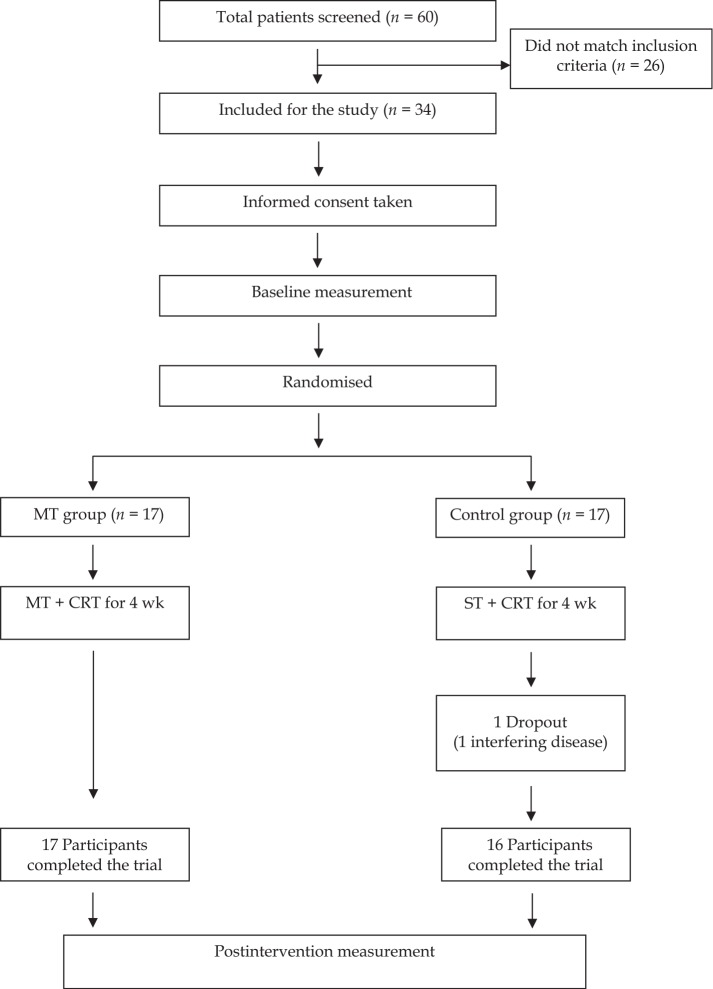
The patients were assigned to a mirror therapy group ( = 17) or a sham therapy group ( = 17). Participants in the experimental group received mirror therapy and conventional rehabilitation therapy for a total of 60 minutes (mirror therapy: 30 minutes; conventional rehabilitation therapy: 30 minutes) per day, with a 10 minute rest period halfway through the session. Participants in the experimental group received training 5 days/week for 4 weeks. Participants in the control group received sham therapy and conventional rehabilitation therapy for a total of 60 minutes (sham therapy: 30 minutes, conventional rehabilitation therapy: 30 minutes) per day on the same day. Balance Index (BI) scores were obtained using a balance measurement system.
A significant difference in post-training gains for the overall stability index and medial and lateral stability index was observed between the experimental group and the control group ( < 0.05).
We conclude that mirror therapy may be beneficial in improving balance ability among subacute stroke patients.
亚急性中风患者的康复是一项重大挑战。
本研究旨在探讨镜像疗法对亚急性中风患者平衡能力的影响。
将患者分为镜像治疗组(n = 17)和假治疗组(n = 17)。实验组参与者每天接受总共60分钟的镜像疗法和传统康复治疗(镜像疗法:30分钟;传统康复治疗:30分钟),疗程中途休息10分钟。实验组参与者每周训练5天,共4周。对照组参与者在同一天接受总共60分钟的假治疗和传统康复治疗(假治疗:30分钟,传统康复治疗:30分钟)。使用平衡测量系统获得平衡指数(BI)分数。
实验组和对照组在训练后总体稳定性指数以及内侧和外侧稳定性指数的提高方面存在显著差异(P < 0.05)。
我们得出结论,镜像疗法可能有助于改善亚急性中风患者的平衡能力。