
超小金纳米颗粒对α-凝血酶酶活性的变构抑制作用。
Allosteric inhibition of α-thrombin enzymatic activity with ultrasmall gold nanoparticles.
作者信息
Lira André L, Ferreira Rodrigo S, Torquato Ricardo J S, Oliva Maria Luiza V, Schuck Peter, Sousa Alioscka A
机构信息
Department of Biochemistry , Federal University of São Paulo , São Paulo , SP , Brazil . Email:
National Institute of Biomedical Imaging and Bioengineering , National Institutes of Health , Bethesda , MD , USA.
出版信息
Nanoscale Adv. 2019 Jan 1;1(1):378-388. doi: 10.1039/c8na00081f. Epub 2018 Sep 24.
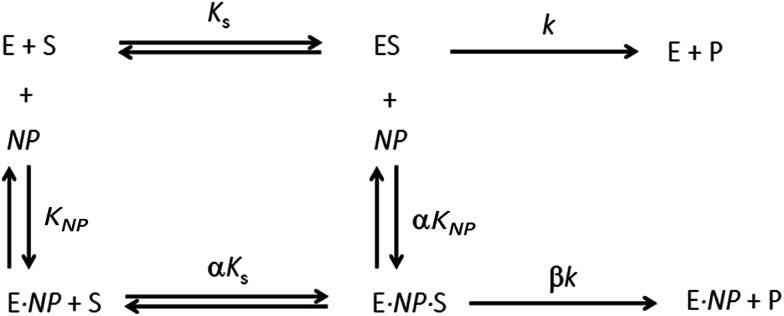
The catalytic activity of enzymes can be regulated by interactions with synthetic nanoparticles (NPs) in a number of ways. To date, however, the potential use of NPs as allosteric effectors has not been investigated in detail. Importantly, targeting allosteric (distal) sites on the enzyme surface could afford unique ways to modulate the activity, allowing for either enzyme activation, partial or full inhibition. Using -mercaptobenzoic acid-coated ultrasmall gold NPs (AuMBA) and human α-thrombin as a model system, here we experimentally tested the hypothesis that enzyme activity could be regulated through ultrasmall NP interactions at allosteric sites. We show that AuMBA interacted selectively and reversibly around two positively charged regions of the thrombin surface (exosites 1 and 2) and away from the active site. NP complexation at the exosites transmitted long-range structural changes over to the active site, altering both substrate binding affinity and catalysis. Significantly, thrombin activity was partially reduced - but not completely inhibited - by interactions with AuMBA. These findings indicate that interactions of proteins with ultrasmall NPs may mimic a typical biomolecular complexation event, and suggest the prospect of using ultrasmall particles as synthetic receptors to allosterically regulate protein function.
酶的催化活性可以通过多种方式与合成纳米颗粒(NP)相互作用来调节。然而,迄今为止,尚未详细研究NP作为变构效应剂的潜在用途。重要的是,靶向酶表面的变构(远端)位点可以提供独特的方式来调节活性,实现酶的激活、部分或完全抑制。以巯基苯甲酸包覆的超小金纳米颗粒(AuMBA)和人α-凝血酶为模型系统,我们在此通过实验验证了酶活性可通过超小NP与变构位点的相互作用来调节这一假设。我们发现AuMBA选择性且可逆地与凝血酶表面的两个带正电区域(外位点1和2)相互作用,且远离活性位点。在外位点的NP复合作用将远程结构变化传递到活性位点,改变了底物结合亲和力和催化作用。值得注意的是,与AuMBA的相互作用使凝血酶活性部分降低,但未完全抑制。这些发现表明蛋白质与超小NP的相互作用可能模拟典型的生物分子复合事件,并提示了使用超小颗粒作为合成受体来变构调节蛋白质功能的前景。


 Zotero 插件