Great Ormond Street Institute of Child Health, University College London, London, UK.
Department of Paediatrics, University of Cambridge, Cambridge, UK.
Pediatr Diabetes. 2019 Aug;20(5):494-509. doi: 10.1111/pedi.12850. Epub 2019 Apr 24.
A systematic review and meta-analysis was conducted to investigate if glycemic control measured by glycated hemoglobin (HbA1c) levels near diagnosis are predictive of future glycemic outcomes and vascular complications in childhood onset type 1 diabetes (T1D).
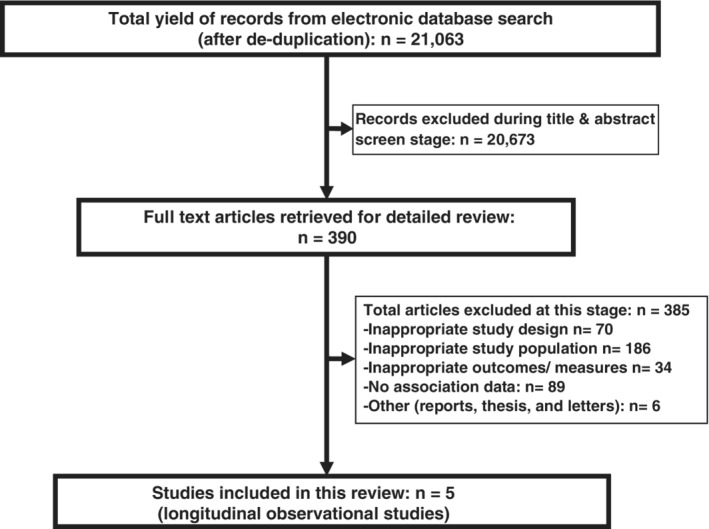
Evidence was gathered using electronic databases (MEDLINE, EMBASE, Web of Science, CINAHL, Scopus, and Cochrane Library up to February 2017) and snowballing techniques. Studies investigating the association between the exposure "early glycemic control" and main outcome: "tracking of early control" and secondary outcome: risk of future complications; in children and young people aged 0 to 19 years at baseline; were systematically double-reviewed, quality assessed, and outcome data extracted for synthesis and meta-analysis.
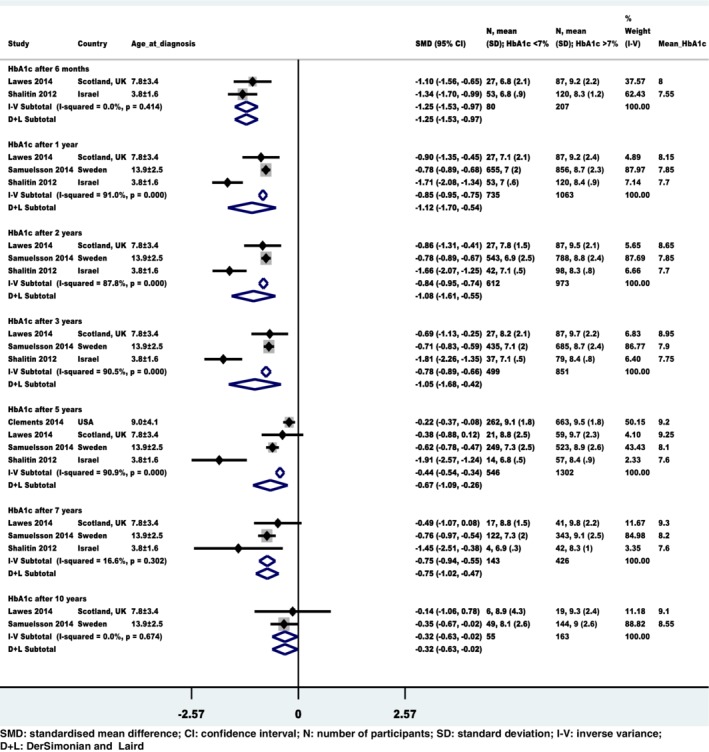
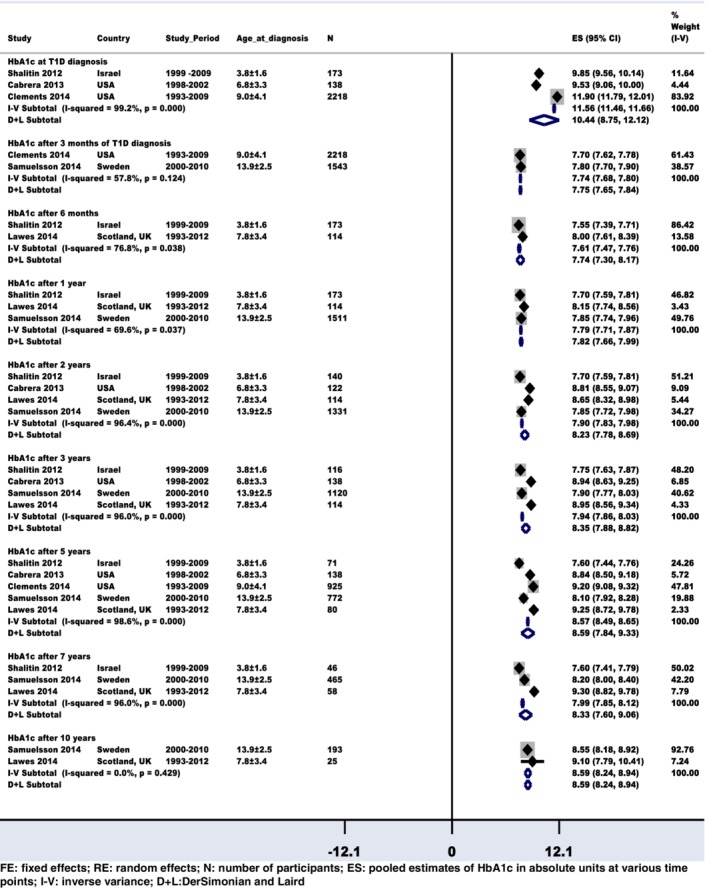
Five studies (N = 4227 participants) were eligible. HbA1c levels were sub-optimal throughout the study period but tended to stabilize in a "track" by 6 months after T1D diagnosis. The group with low HbA1c <53 mmol/mol (<7%) at baseline had lower long-term HbA1c levels than the higher HbA1c group. The estimated standardized mean difference between the sub groups showed a reduction of HbA1c levels on average by 1.6% (range -0.95% to -2.28%) from baseline. Only one study investigated the association between early glycemic control and development of vascular complications in childhood onset T1D.
Glycemic control after the first few months of childhood onset T1D, remains stable but sub-optimal for a decade. The low and high HbA1c levels at baseline seem to "track" in their respective tracks during the 10-year follow-up, however, the initial difference between groups narrows over time.
CRD42015024546 http://www.crd.york.ac.uk/PROSPERO/display_record.asp?ID=CRD42015024546.
系统评价和荟萃分析旨在研究糖化血红蛋白(HbA1c)水平在诊断时的血糖控制是否可预测儿童起病 1 型糖尿病(T1D)的未来血糖结果和血管并发症。
使用电子数据库(MEDLINE、EMBASE、Web of Science、CINAHL、Scopus 和 Cochrane Library,截至 2017 年 2 月)和滚雪球技术收集证据。系统地对研究“早期血糖控制”与主要结果“早期控制的追踪”和次要结果“未来并发症风险”之间的相关性进行综述,研究对象为基线时年龄为 0 至 19 岁的儿童和年轻人。对符合条件的研究进行了双盲审查、质量评估,并提取结果数据进行综合分析和荟萃分析。
五项研究(N=4227 名参与者)符合条件。整个研究期间 HbA1c 水平不理想,但在 T1D 诊断后 6 个月内趋于稳定“追踪”。基线时 HbA1c<53mmol/mol(<7%)的低水平组的长期 HbA1c 水平低于高水平组。两组间的估计标准化均数差显示,从基线开始,HbA1c 水平平均降低 1.6%(范围-0.95%至-2.28%)。仅有一项研究调查了儿童起病 T1D 中早期血糖控制与血管并发症发展之间的关系。
儿童起病 T1D 后的头几个月血糖控制仍不稳定,但在十年的随访中仍保持不理想。基线时的低水平和高水平 HbA1c 似乎在 10 年的随访期间各自“追踪”,但组间的初始差异随着时间的推移而缩小。
CRD42015024546 http://www.crd.york.ac.uk/PROSPERO/display_record.asp?ID=CRD42015024546.