Department of Diabetes, University Hospitals Birmingham NHS Foundation Trust, Birmingham, UK.
Public Health, Epidemiology and Biostatistics, Institute of Applied Health Research, College of Medical and Dental Sciences, University of Birmingham, Edgbaston, Birmingham, B15 2TT, UK.
Diabetologia. 2018 May;61(5):1064-1070. doi: 10.1007/s00125-018-4574-6. Epub 2018 Feb 24.
AIMS/HYPOTHESIS: Our objectives were to explore whether the phenomenon of HbA 'tracking' occurs in individuals with type 1 diabetes, how long after diagnosis does tracking take to stabilise, and whether there is an effect of sex and age at diagnosis on tracking.
A total of 4525 individuals diagnosed with type 1 diabetes between 1 January 1995 and 1 May 2015 were identified from The Health Improvement Network (THIN) database. Mixed models were applied to assess the variability of HbA levels over time with random effects on general practices (primary care units) and individuals within practices.
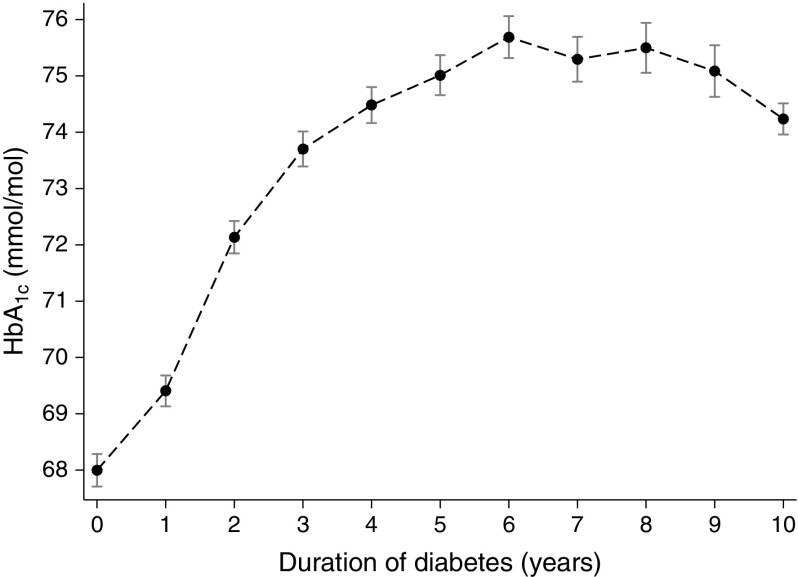
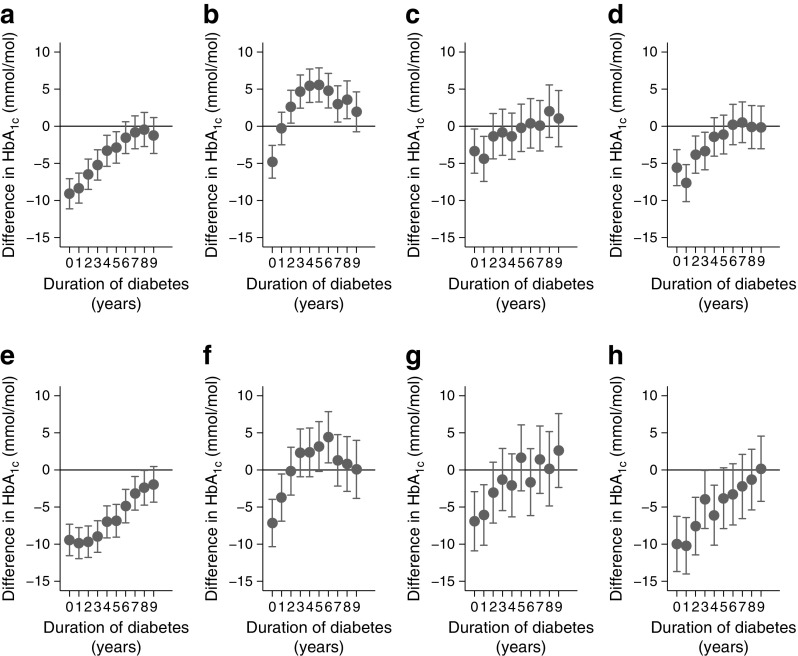
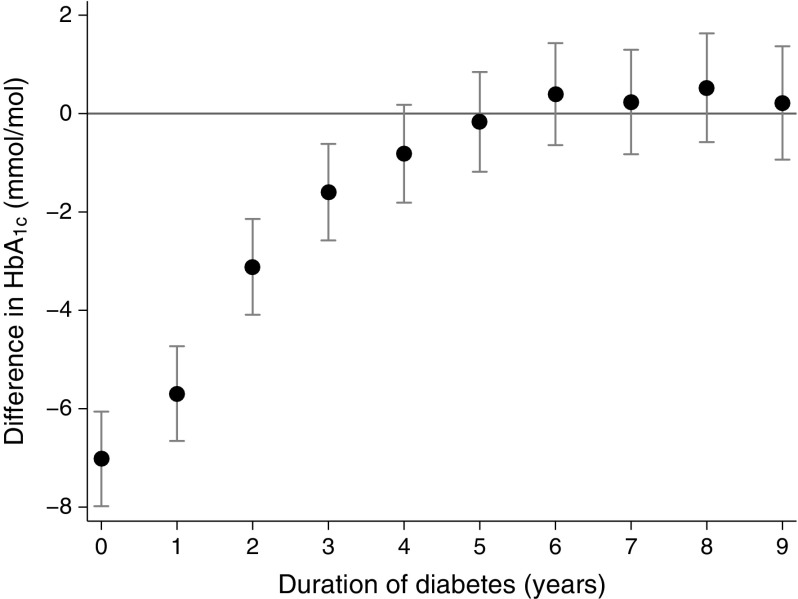
4525 individuals diagnosed with type 1 diabetes were identified in THIN over the study period. The greatest difference in mean HbA measurement (-7.0 [95% CI -8.0, -6.1] mmol/mol [0.6%]) was seen when comparing measurements made immediately after diagnosis (0-1 year since diagnosis) with those at 10 or more years (the reference category). The mean difference in HbA for the successive periods compared with 10 or more years after diagnosis declined and was no longer statistically significant after 5 years. In the stratified analysis using sex and age group there was considerable heterogeneity with adult onset type 1 diabetes appearing to track earlier and at a lower mean HbA.
CONCLUSIONS/INTERPRETATION: In individuals with type 1 diabetes, glycaemic control measured by HbA settles onto a long-term 'track' and this occurs on average by 5 years following diagnosis. Age at diagnosis modifies both the rate at which individuals settle into their track and the absolute HbA tracking level for the next 10 years.
目的/假设:我们的目的是探讨 1 型糖尿病患者是否存在 HbA“跟踪”现象,跟踪需要多长时间才能稳定,以及性别和诊断时的年龄是否对跟踪有影响。
从健康改善网络(THIN)数据库中确定了 1995 年 1 月 1 日至 2015 年 5 月 1 日期间诊断为 1 型糖尿病的 4525 名个体。混合模型用于评估个体内和个体间实践的 HbA 水平随时间的变化,随机效应为一般实践(初级保健单位)。
在研究期间,THIN 中确定了 4525 名诊断为 1 型糖尿病的个体。与诊断后 10 年或更长时间(参考类别)相比,诊断后 0-1 年内(即诊断后即刻)测量的平均 HbA 差值最大(-7.0 [95%CI-8.0,-6.1]mmol/mol [0.6%])。与诊断后 10 年或更长时间相比,连续各期的 HbA 平均差异下降,5 年后不再具有统计学意义。在使用性别和年龄组进行的分层分析中,存在相当大的异质性,成年发病的 1 型糖尿病似乎更早且平均 HbA 水平更低地跟踪。
结论/解释:在 1 型糖尿病患者中,HbA 测量的血糖控制稳定在一个长期的“轨道”上,平均在诊断后 5 年达到。诊断时的年龄既改变了个体进入轨道的速度,也改变了接下来 10 年的绝对 HbA 跟踪水平。