Calcaterra Valeria, Bosoni Pietro, Sacchi Lucia, Zuccotti Gian Vincenzo, Mannarino Savina, Bellazzi Riccardo, Larizza Cristiana
Pediatric and Adolescent Unit, Department of Internal Medicine, University of Pavia, 27100 Pavia, Italy.
Pediatric Unit, Department of Pediatrics, Children's Hospital "V. Buzzi", 20157 Milano, Italy.
Metabolites. 2020 Dec 24;11(1):5. doi: 10.3390/metabo11010005.
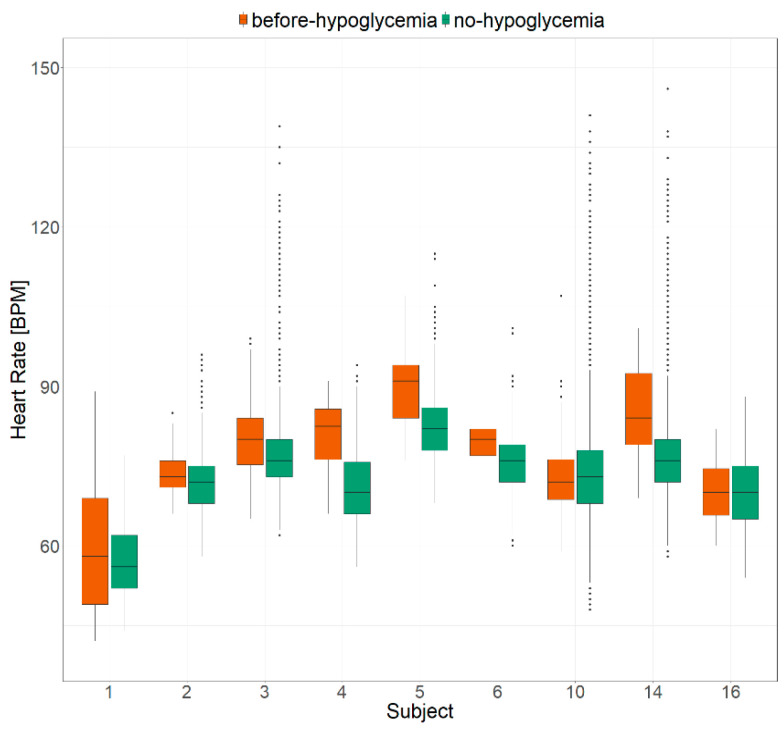
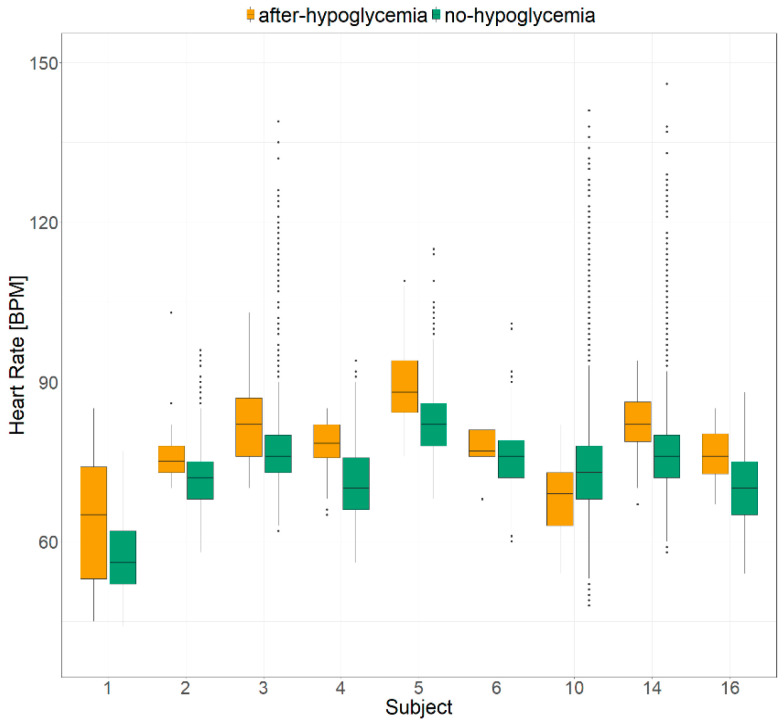
A combination of information from blood glucose (BG) and heart rate (HR) measurements has been proposed to investigate the HR changes related to nocturnal hypoglycemia (NH) episodes in pediatric subjects with type 1 diabetes (T1D), examining whether they could improve hypoglycemia prediction. We enrolled seventeen children and adolescents with T1D, monitored on average for 194 days. BG was detected by flash glucose monitoring devices, and HR was measured by wrist-worn fitness trackers. For each subject, we compared HR values recorded in the hour before NH episodes (before-hypoglycemia) with HR values recorded during sleep intervals without hypoglycemia (no-hypoglycemia). Furthermore, we investigated the behavior after the end of NH. Nine participants (53%) experienced at least three NH. Among these nine subjects, six (67%) showed a statistically significant difference between the before-hypoglycemia HR distribution and the no-hypoglycemia HR distribution. In all these six cases, the before-hypoglycemia HR median value was higher than the no-hypoglycemia HR median value. In almost all cases, HR values after the end of hypoglycemia remained higher compared to no-hypoglycemia sleep intervals. This exploratory study support that HR modifications occur during NH in T1D subjects. The identification of specific HR patterns can be helpful to improve NH detection and prevent fatal events.
有人提出结合血糖(BG)和心率(HR)测量信息,来研究1型糖尿病(T1D)儿科患者夜间低血糖(NH)发作相关的心率变化,以检验这些信息是否能改善低血糖预测。我们招募了17名患有T1D的儿童和青少年,平均监测194天。血糖通过闪光葡萄糖监测设备检测,心率通过腕戴式健身追踪器测量。对于每个受试者,我们将NH发作前一小时记录的心率值(低血糖前)与无低血糖睡眠期间记录的心率值(无低血糖)进行比较。此外,我们还研究了NH结束后的情况。9名参与者(53%)经历了至少三次NH。在这9名受试者中,6名(67%)在低血糖前心率分布与无低血糖心率分布之间存在统计学显著差异。在所有这6例中,低血糖前心率中位数高于无低血糖心率中位数。几乎在所有情况下,低血糖结束后的心率值与无低血糖睡眠期间相比仍然较高。这项探索性研究支持T1D患者在NH期间会出现心率变化。识别特定的心率模式有助于改善NH检测并预防致命事件。