Facultad de Ciencias del Mar, Departamento de Acuicultura, Universidad Católica del Norte, Larrondo 1281, Coquimbo 1781421, Chile.
Centro de Investigación y Desarrollo Tecnológico en Algas (CIDTA), Facultad de Ciencias del Mar, Universidad Católica del Norte, Larrondo 1281, Coquimbo, Chile.
Toxins (Basel). 2019 Mar 29;11(4):188. doi: 10.3390/toxins11040188.
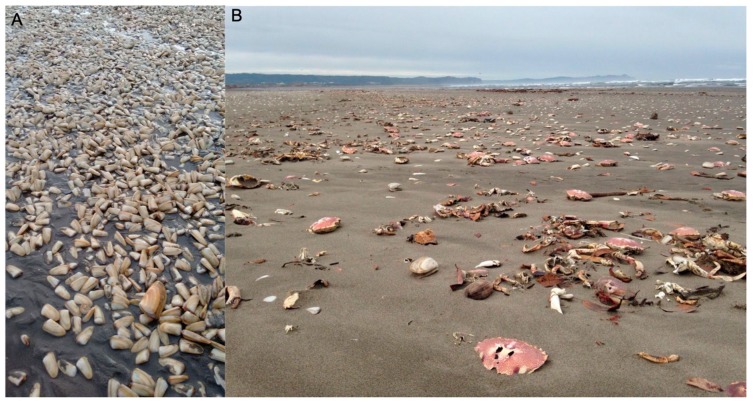
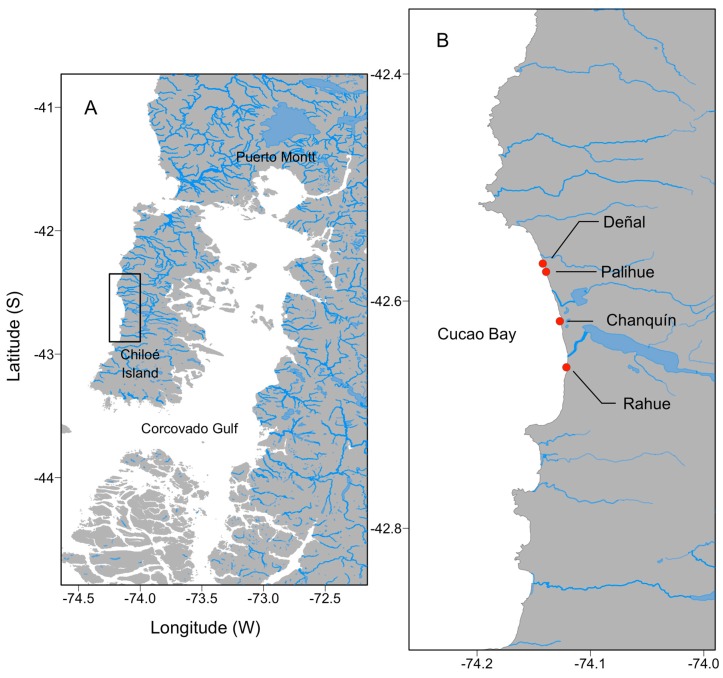
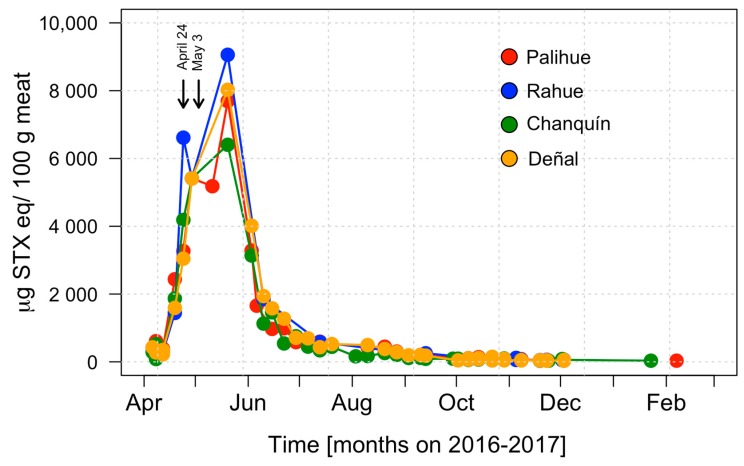
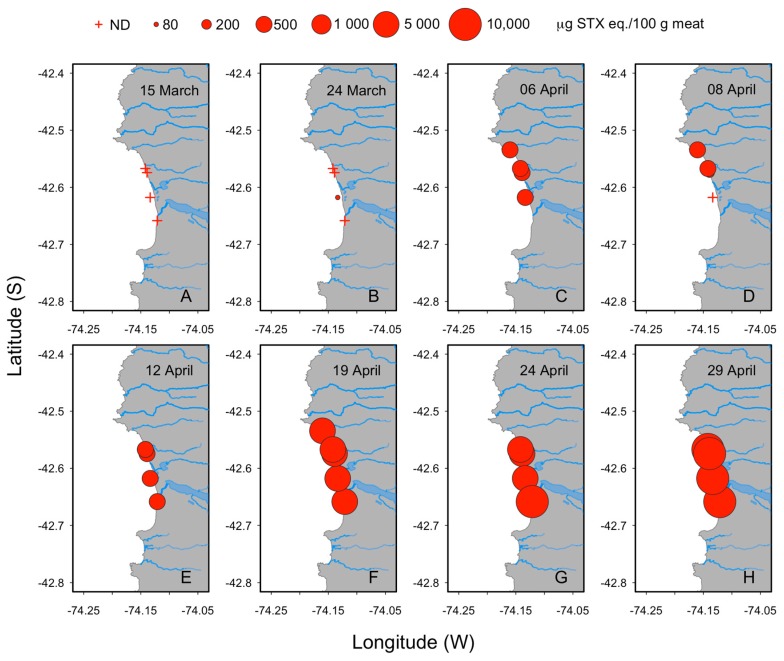
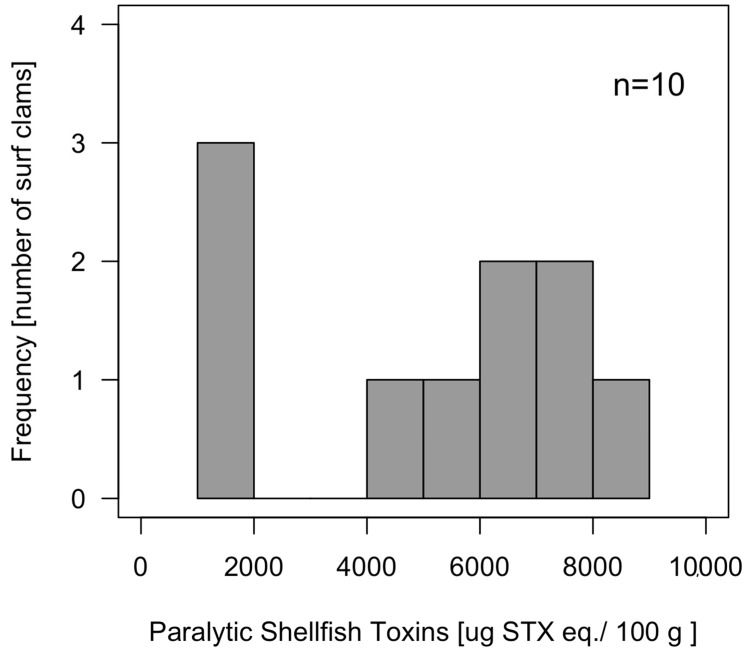
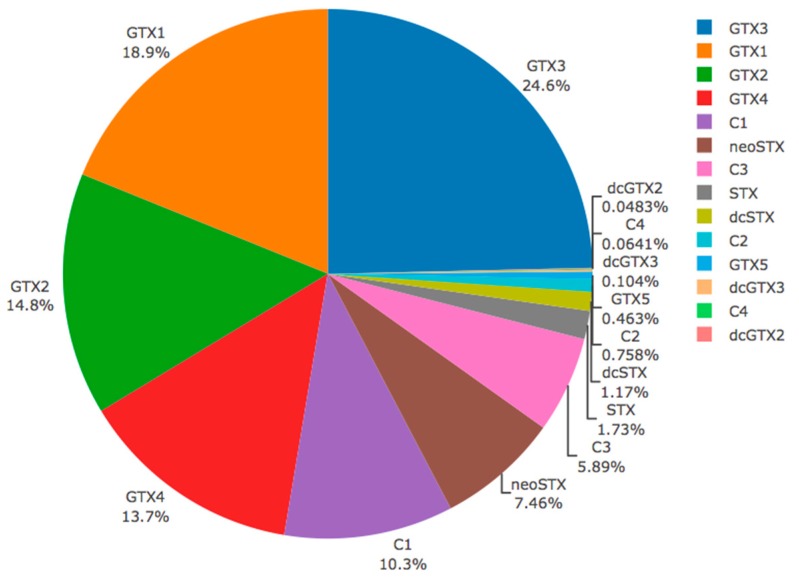
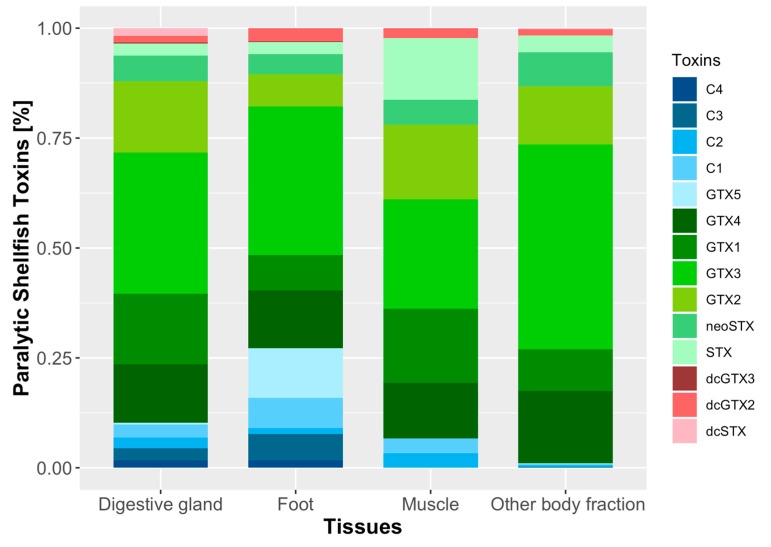
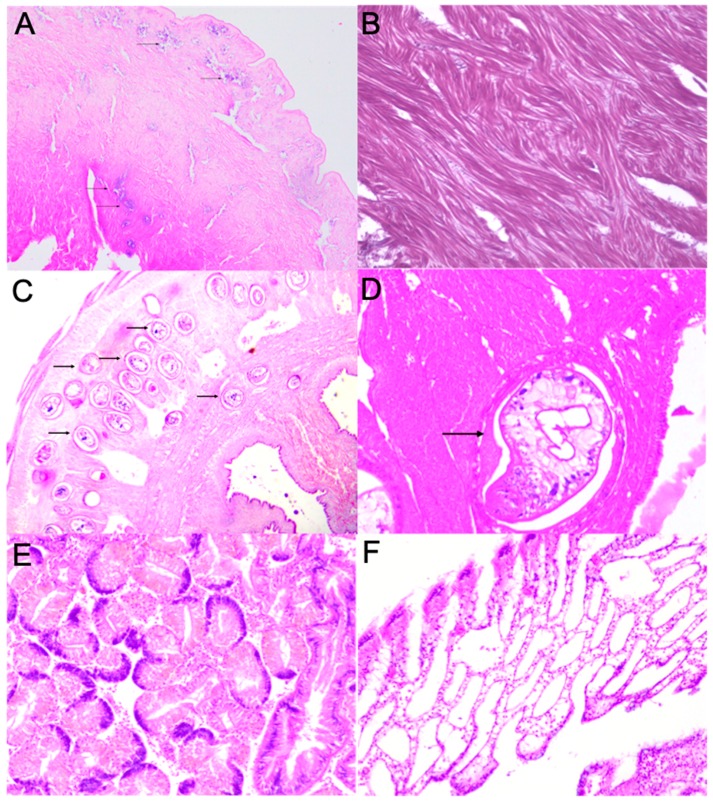
In late February 2016, a harmful algal bloom (HAB) of was detected in southern Chiloé, leading to the banning of shellfish harvesting in an extended geographical area (~500 km). On April 24, 2016, this bloom produced a massive beaching (an accumulation on the beach surface of dead or impaired organisms which were drifted ashore) of surf clams in Cucao Bay, Chiloé. To determine the effect of paralytic shellfish poisoning (PSP) toxins in , samples were taken from Cucao during the third massive beaching detected on May 3, 2016. Whole tissue toxicity evidence a high interindividual variability with values which ranged from 1008 to 8763 μg STX eq 100 g and with a toxin profile dominated by GTX3, GTX1, GTX2, GTX4, and neoSTX. Individuals were dissected into digestive gland (DG), foot (FT), adductor muscle (MU), and other body fractions (OBF), and histopathological and toxin analyses were carried out on the obtained fractions. Some pathological conditions were observed in gill and digestive gland of 40⁻50% of the individuals that correspond to hemocyte aggregation and haemocytic infiltration, respectively. The most toxic tissue was DG (2221 μg STX eq 100 g), followed by OBF (710 μg STX eq 100 g), FT (297 μg STX eq 100 g), and MU (314 μg STX eq 100 g). The observed surf clam mortality seems to have been mainly due to the desiccation caused by the incapability of the clams to burrow. Considering the available information of the monitoring program and taking into account that this episode was the first detected along the open coast of the Pacific Ocean in southern Chiloé, it is very likely that the population from Cucao Bay has not had a recurrent exposition to and, consequently, that it has not been subjected to high selective pressure for PSP resistance. However, more research is needed to determine the effects of PSP toxins on behavioral and physiological responses, nerve sensitivity, and genetic/molecular basis for the resistance or sensitivity of .
2016 年 2 月下旬,在智利南部奇洛埃岛检测到有害藻类大量繁殖(HAB),导致在一个广泛的地理区域(约 500 公里)禁止贝类捕捞。2016 年 4 月 24 日,这种藻类大量繁殖导致 Cucao 湾的栉孔扇贝大量搁浅(死或受损的生物体在海滩表面堆积,被冲上岸)。为了确定 Cucao 湾贻贝体内麻痹性贝类毒素(PSP)的影响,于 2016 年 5 月 3 日第三次大规模搁浅时采集了 Cucao 湾的贻贝样本。整体组织毒性证据表明存在高度个体间变异性,其范围为 1008 至 8763μgSTXeq100g,毒素谱以 GTX3、GTX1、GTX2、GTX4 和 neoSTX 为主。个体被解剖成消化腺(DG)、足(FT)、闭壳肌(MU)和其他身体部分(OBF),并对获得的部分进行组织病理学和毒素分析。在 40%至 50%的个体中观察到鳃和消化腺的一些病理状况,分别对应于血细胞聚集和血细胞浸润。最毒的组织是 DG(2221μgSTXeq100g),其次是 OBF(710μgSTXeq100g)、FT(297μgSTXeq100g)和 MU(314μgSTXeq100g)。观察到的栉孔扇贝死亡率似乎主要是由于贝类无法挖掘而导致的干燥。考虑到监测计划的现有信息,并考虑到这是在奇洛埃岛南部太平洋开阔海岸首次检测到的事件, Cucao 湾的栉孔扇贝种群很可能没有反复接触 PST,因此没有受到 PST 抗性的高度选择压力。然而,需要进一步的研究来确定 PSP 毒素对行为和生理反应、神经敏感性以及 PSP 抗性或敏感性的遗传/分子基础的影响。