Solhjou Karamat Allah, Hosseini Seyed Ebrahim, Vahdati Akbar, Edalatmanesh Mohammad Amin
Department of Biology, Fars Science and Research Branch, Islamic Azad University, Fars, Iran.
Department of Biology, Shiraz Branch, Islamic Azad University, Shiraz, Iran.
Iran J Med Sci. 2019 Mar;44(2):155-162.
Insecticides may have negative effects on reproductive organs. Given the interaction between leptin and the hypothalamic-pituitary-gonadal (HPG) axis, we sought to investigate the changes in leptin and the HPG axis in adult male rats poisoned with Proteus and Biscaya insecticides.
Our experimental subjects were 110 adult male Wistar rats (80-90 days of age; average weight=200-210 g). They were randomly split into 11 groups of 10 rats: control, sham, and 9 experimental groups namely treatment with 2.75, 5.5, and 11 mg/kg/BW of Proteus, treatment with 1.5, 3, and 6 mg/kg/BW of Biscaya, treatment with 2.75 mg/kg/BW of Proteus+1.5 mg/kg/BW of Biscaya, treatment with 5.5 mg/kg/BW of Proteus+3 mg/kg/BW of Biscaya, and treatment with 11 mg/kg/BW of Proteus+6 mg/kg/BW of Biscaya. Intraperitoneal injections were performed over a 14-day period. For bloodletting at the end of the experiment, blood samples were withdrawn from the rats in order to investigate the serum concentration of luteinizing hormone (LH), follicle-stimulating hormone (FSH), gonadotropin- releasing hormone (GnRH), testosterone, and leptin. The data were analyzed using SPSS, version 16, via ANOVA and the Duncan test. A P value equal to or less than 0.05 was considered statistically significant.
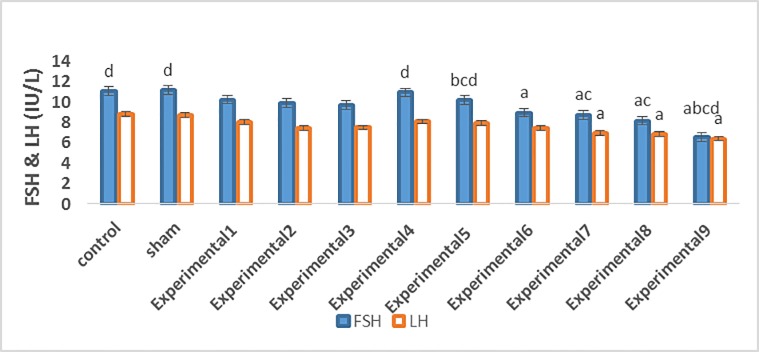
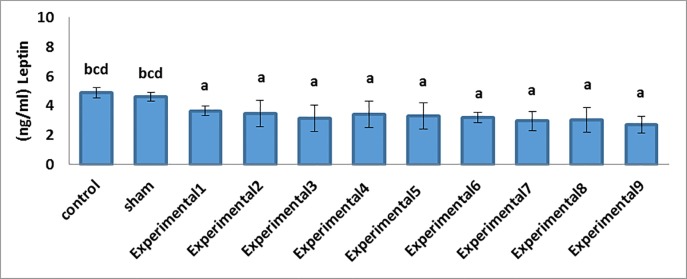
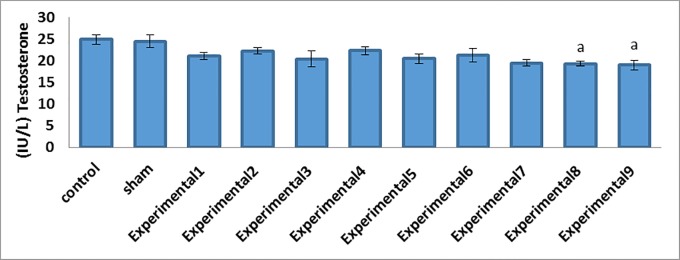
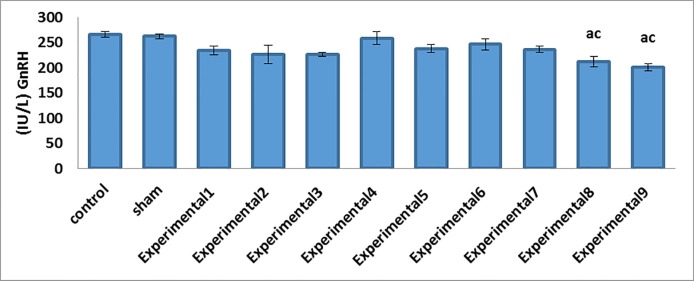
Our comparisons between the experimental groups (average and maximum compound concentrations of Proteus and Biscaya) and the control group showed a significant decrease in the mean serum levels of FSH (P=0.001), LH (P=0.001), GnRH (P=0.001), testosterone (P=0.005), and leptin (P=0.001) in all the experimental groups in a dose-dependent manner.
Proteus and Biscaya decreased GnRH, LH, FSH, and testosterone by reducing the serum level of leptin in the hypothalamus in a dose-dependent manner.
杀虫剂可能对生殖器官产生负面影响。鉴于瘦素与下丘脑 - 垂体 - 性腺(HPG)轴之间的相互作用,我们试图研究受变形杆菌和比斯卡亚杀虫剂中毒的成年雄性大鼠体内瘦素和HPG轴的变化。
我们的实验对象是110只成年雄性Wistar大鼠(80 - 90日龄;平均体重 = 200 - 210克)。它们被随机分为11组,每组10只大鼠:对照组、假手术组和9个实验组,即分别用2.75、5.5和11毫克/千克/体重的变形杆菌处理,用1.5、3和6毫克/千克/体重的比斯卡亚处理,用2.75毫克/千克/体重的变形杆菌 + 1.5毫克/千克/体重的比斯卡亚处理,用5.5毫克/千克/体重的变形杆菌 + 3毫克/千克/体重的比斯卡亚处理,以及用11毫克/千克/体重的变形杆菌 + 6毫克/千克/体重的比斯卡亚处理。在14天的时间内进行腹腔注射。在实验结束时进行采血,从大鼠身上采集血样,以研究血清中促黄体生成素(LH)、促卵泡生成素(FSH)、促性腺激素释放激素(GnRH)、睾酮和瘦素的浓度。使用SPSS 16版软件,通过方差分析和邓肯检验对数据进行分析。P值等于或小于0.05被认为具有统计学意义。
我们对实验组(变形杆菌和比斯卡亚的平均和最大化合物浓度)与对照组进行比较,结果显示所有实验组中促卵泡生成素(FSH)(P = 0.001)、促黄体生成素(LH)(P = 0.001)、促性腺激素释放激素(GnRH)(P = 0.001)、睾酮(P = 0.005)和瘦素(P = 0.001)的平均血清水平均呈剂量依赖性显著下降。
变形杆菌和比斯卡亚通过以剂量依赖性方式降低下丘脑血清瘦素水平,从而降低GnRH、LH、FSH和睾酮水平。