Dreisler Eva, Kjer Jens Joergen
Department of Gynecology, The Juliane Marie Centre, Rigshospitalet, University of Copenhagen, Copenhagen, Denmark,
Int J Womens Health. 2019 Mar 20;11:191-198. doi: 10.2147/IJWH.S165474. eCollection 2019.
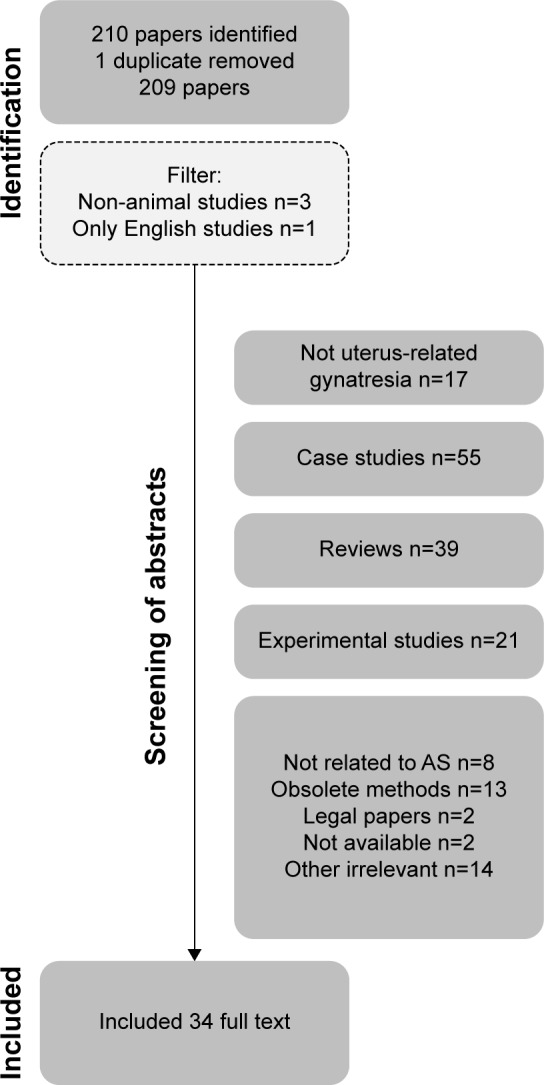
Intrauterine adhesions with symptoms like hypomenorrhea or infertility are known under the term Asherman's syndrome. Although the syndrome has been widely investigated, evidence of both prevention of the syndrome and the ideal treatment are missing. Understanding the pathogenesis of intrauterine adherences is necessary for the prevention of the formation of intrauterine scarring. Intrauterine adhesions can develop from lesion of the basal layer of the endometrium caused by curettage of the newly pregnant uterus. The syndrome may also occur after hysteroscopic surgery, uterine artery embolization or uterine tuberculosis. For initial diagnosis the less invasive contrast sonohysterography or hysterosalpingography is useful. The final diagnosis is based on hysteroscopy. Magnetic resonance imaging is required in cases with totally obliterated uterine cavity. Intrauterine adherences are classified in accordance with different classification systems based on the hysteroscopic diagnosis of severity and localization of adherences. Classification is necessary for the planning of surgery, information on prognosis and scientific purposes. Surgery is performed in symptomatic patients with either infertility or with painful periods. Intrauterine adherences are divided with a hysteroscope using scissors or a power instrument working from the central part of the uterus to the periphery. Peroperative ultrasonography is useful in an outpatient setting for the prevention of complications. Hysteroscopy with fluoroscopy is a solution in difficult cases. Use of intrauterine devices like balloon catheters or intrauterine contraceptive devices seems to be the preferred methods for the prevention of re-occurrence of adhesions after treatment. Both primary prevention after hysteroscopic surgery or curettage and secondary prevention of new adhesions after adhesiolysis have been investigated. The aim of this review was to summarize the literature on diagnosis, classification, treatment and prevention, based on a literature search with a wide range of search terms.
具有月经过少或不孕等症状的宫腔粘连被称为阿谢曼综合征。尽管该综合征已得到广泛研究,但预防该综合征的证据以及理想的治疗方法均缺失。了解宫腔粘连的发病机制对于预防宫腔瘢痕形成至关重要。宫腔粘连可由刮宫新孕子宫导致的子宫内膜基底层损伤发展而来。该综合征也可能发生在宫腔镜手术、子宫动脉栓塞或子宫结核之后。对于初步诊断,侵入性较小的超声子宫输卵管造影或子宫输卵管造影很有用。最终诊断基于宫腔镜检查。对于子宫腔完全闭塞的病例,需要进行磁共振成像检查。根据宫腔镜对粘连严重程度和部位的诊断,宫腔粘连按照不同的分类系统进行分类。分类对于手术规划、预后信息及科学研究目的而言是必要的。有不孕或经期疼痛症状的患者需进行手术。使用剪刀或动力器械通过宫腔镜从子宫中央向周边分离宫腔粘连。门诊手术中,术中超声有助于预防并发症。对于困难病例,荧光透视宫腔镜检查是一种解决办法。使用球囊导管或宫内节育器等宫内装置似乎是预防治疗后粘连复发的首选方法。宫腔镜手术或刮宫后的一级预防以及粘连松解后新粘连的二级预防均已得到研究。本综述的目的是基于使用广泛搜索词进行的文献检索,总结有关诊断、分类、治疗和预防的文献。