Ahn Jung-Kwang, Kim Yeseul, Choi Kee-Hong
Department of Psychology, Korea University Mind Health Institute, Korea University, Seoul, South Korea.
Department of Psychology, Korea University, Seoul, South Korea.
Front Psychiatry. 2019 Mar 18;10:127. doi: 10.3389/fpsyt.2019.00127. eCollection 2019.
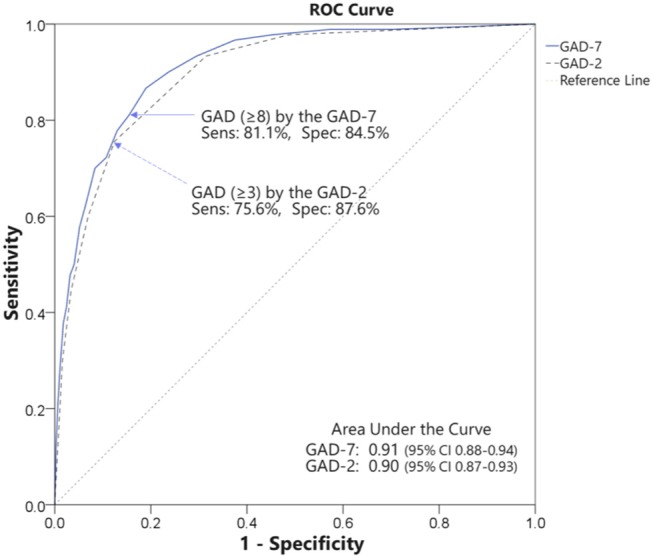
Generalized anxiety disorder (GAD) is a common but serious form of anxiety disorder. Despite this, the rate of GAD recognition in primary care remains low in both Western and Eastern countries. The GAD-7 and GAD-2 were developed to efficiently identify people with GAD, and their reliability and validity have been well-documented in Western countries. The GAD-7 and GAD-2 have also been widely utilized to screen for other anxiety disorders; however, their diagnostic utility has not been fully justified with empirical support, especially in East Asian samples. In this study, we examined the diagnostic sensitivity and specificity of these screening tools for identifying individuals with GAD or other anxiety disorders, and recommended screening cutoff scores for GAD and other anxiety disorders for use in Korea. Based on the rigorous standard suggested by the Quality Assessment of Diagnostic Accuracy Studies-2, a total of 1,157 participants randomly recruited from the community completed the GAD-7, GAD-2, and other anxiety and depression measures in a counter-balanced order. All participants were assessed, and their psychiatric diagnosis confirmed through a structured clinical interview conducted by independent clinicians blinded to the results of the self-report questionnaires. The GAD-7 and GAD-2 both showed excellent reliability and validity. Notably, both the GAD-7 and GAD-2 demonstrated acceptable diagnostic accuracy in detecting GAD with similar recommended cut-off scores as those reported in Western countries, but unacceptable diagnostic accuracy for other anxiety disorders. We conclude that given their brevity, the GAD-7 and GAD-2 can be well-utilized to identify people with GAD for preventative evaluation and treatment in Korea. Use of the GAD-7 and GAD-2 for screening other anxiety disorders should be cautioned.
广泛性焦虑障碍(GAD)是一种常见但严重的焦虑症形式。尽管如此,在西方国家和东方国家,初级保健中对GAD的识别率仍然很低。GAD-7和GAD-2旨在有效识别患有GAD的人,其可靠性和有效性在西方国家已有充分记录。GAD-7和GAD-2也被广泛用于筛查其他焦虑症;然而,它们的诊断效用尚未得到充分的实证支持,尤其是在东亚样本中。在本研究中,我们检验了这些筛查工具在识别患有GAD或其他焦虑症个体时的诊断敏感性和特异性,并推荐了用于韩国的GAD和其他焦虑症的筛查临界分数。基于诊断准确性研究质量评估-2提出的严格标准,从社区随机招募的1157名参与者以平衡顺序完成了GAD-7、GAD-2以及其他焦虑和抑郁测量。所有参与者都接受了评估,并且通过由对自我报告问卷结果不知情的独立临床医生进行的结构化临床访谈确认了他们的精神诊断。GAD-7和GAD-2均显示出出色的可靠性和有效性。值得注意的是,GAD-7和GAD-2在检测GAD时都表现出可接受的诊断准确性,推荐的临界分数与西方国家报告的相似,但在检测其他焦虑症时诊断准确性不可接受。我们得出结论,鉴于其简洁性,GAD-7和GAD-2可很好地用于在韩国识别患有GAD的人以进行预防性评估和治疗。应谨慎使用GAD-7和GAD-2筛查其他焦虑症。