Department of Psychological Sciences, Birkbeck, University of London, Malet Street, London, WC1E 7HX, UK.
Centre for Medical Imaging, University College London, Charles Bell House, 43-45 Foley Street, London, W1W 7TS, UK.
Eur Radiol. 2019 Jul;29(7):3889-3900. doi: 10.1007/s00330-019-06153-4. Epub 2019 Apr 1.
To determine the importance placed by patients on attributes associated with whole-body MRI (WB-MRI) and standard cancer staging pathways and ascertain drivers of preference.
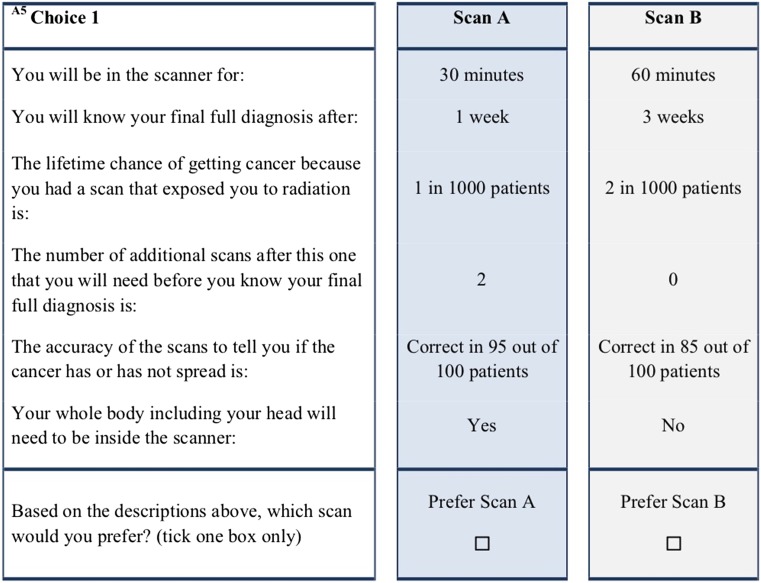
Patients recruited to two multi-centre diagnostic accuracy trials comparing WB-MRI with standard staging pathways in lung and colorectal cancer were invited to complete a discrete choice experiment (DCE), choosing between a series of alternate pathways in which 6 attributes (accuracy, time to diagnosis, scan duration, whole-body enclosure, radiation exposure, total scan number) were varied systematically. Data were analysed using a conditional logit regression model and marginal rates of substitution computed. The relative importance of each attribute and probabilities of choosing WB-MRI-based pathways were estimated.
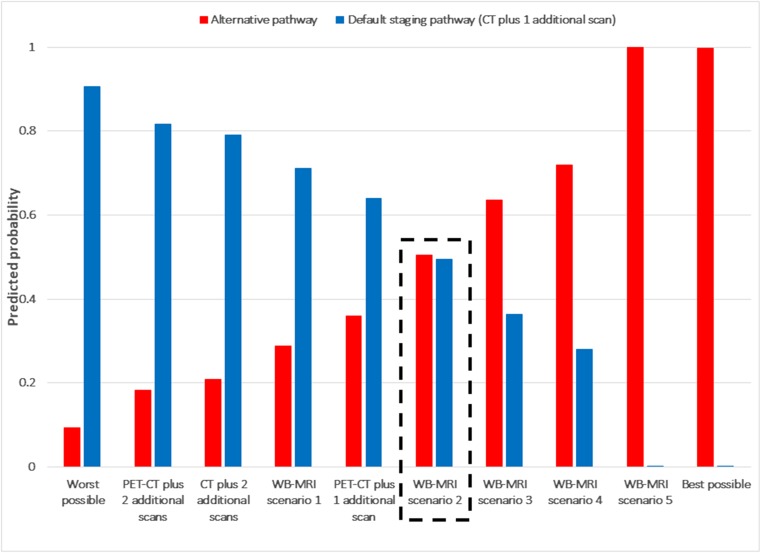
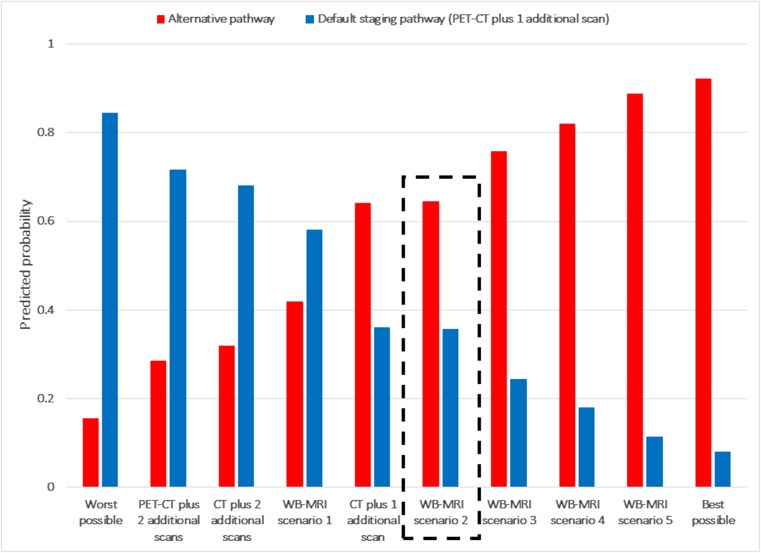
A total of 138 patients (mean age 65, 61% male, lung n = 72, colorectal n = 66) participated (May 2015 to September 2016). Lung cancer patients valued time to diagnosis most highly, followed by accuracy, radiation exposure, number of scans, and time in the scanner. Colorectal cancer patients valued accuracy most highly, followed by time to diagnosis, radiation exposure, and number of scans. Patients were willing to wait 0.29 (lung) and 0.45 (colorectal) weeks for a 1% increase in pathway accuracy. Patients preferred WB-MRI-based pathways (probability 0.64 [lung], 0.66 [colorectal]) if they were equivalent in accuracy, total scan number, and time to diagnosis compared with a standard staging pathway.
Staging pathways based on first-line WB-MRI are preferred by the majority of patients if they at least match standard pathways for diagnostic accuracy, time to diagnosis, and total scan number.
• WB-MRI staging pathways are preferred to standard pathways by the majority of patients provided they at least match standard staging pathways for accuracy, total scan number, and time to diagnosis. • For patients with lung cancer, time to diagnosis was the attribute valued most highly, followed by accuracy, radiation dose, number of additional scans, and time in a scanner. Preference for patients with colorectal cancer was similar. • Most (63%) patients were willing to trade attributes, such as faster diagnosis, for improvements in pathway accuracy and reduced radiation exposure.
确定患者对全身磁共振成像(WB-MRI)和标准癌症分期途径相关属性的重视程度,并确定偏好的驱动因素。
招募参加两项多中心诊断准确性试验的患者,这些试验比较了 WB-MRI 与肺癌和结直肠癌的标准分期途径,邀请他们完成离散选择实验(DCE),在一系列交替途径中进行选择,其中 6 个属性(准确性、诊断时间、扫描持续时间、全身包围、辐射暴露、总扫描次数)系统变化。使用条件逻辑回归模型分析数据,并计算边际替代率。估计每个属性的相对重要性和选择基于 WB-MRI 的途径的概率。
共有 138 名患者(平均年龄 65 岁,61%为男性,肺癌 72 例,结直肠癌 66 例)参与了研究(2015 年 5 月至 2016 年 9 月)。肺癌患者最看重诊断时间,其次是准确性、辐射暴露、扫描次数和扫描时间。结直肠癌患者最看重准确性,其次是诊断时间、辐射暴露和扫描次数。患者愿意等待 0.29 周(肺癌)和 0.45 周(结直肠癌),以获得 1%的途径准确性提高。如果基于 WB-MRI 的途径在准确性、总扫描次数和诊断时间方面与标准分期途径相当,患者更倾向于选择基于 WB-MRI 的途径(肺癌概率为 0.64,结直肠癌概率为 0.66)。
如果基于一线 WB-MRI 的分期途径在诊断准确性、诊断时间和总扫描次数方面至少与标准途径相当,那么大多数患者更倾向于选择这些途径。
基于 WB-MRI 的分期途径在大多数患者中优于标准途径,前提是它们在准确性、总扫描次数和诊断时间方面至少与标准分期途径相当。
对于肺癌患者,诊断时间是最受重视的属性,其次是准确性、辐射剂量、额外扫描次数和扫描时间。结直肠癌患者的偏好相似。
大多数(63%)患者愿意交换属性,例如更快的诊断,以换取途径准确性的提高和辐射暴露的降低。