Department of Cell and Molecular Biology, Faculty of Biotechnology and Biomolecular Sciences, Universiti Putra Malaysia, Serdang, Selangor, Malaysia.
Department of Microbiology, Faculty of Biotechnology and Biomolecular Sciences, Universiti Putra Malaysia, Serdang, Selangor, Malaysia.
PLoS One. 2019 Apr 2;14(4):e0214326. doi: 10.1371/journal.pone.0214326. eCollection 2019.
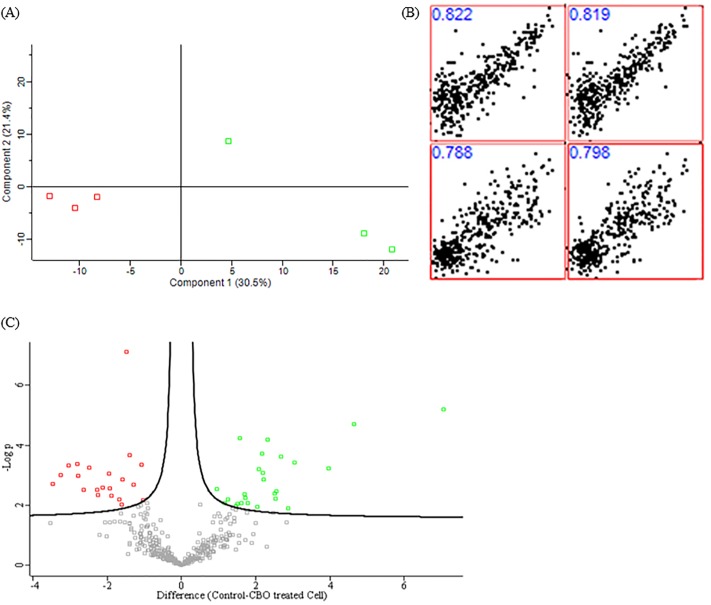
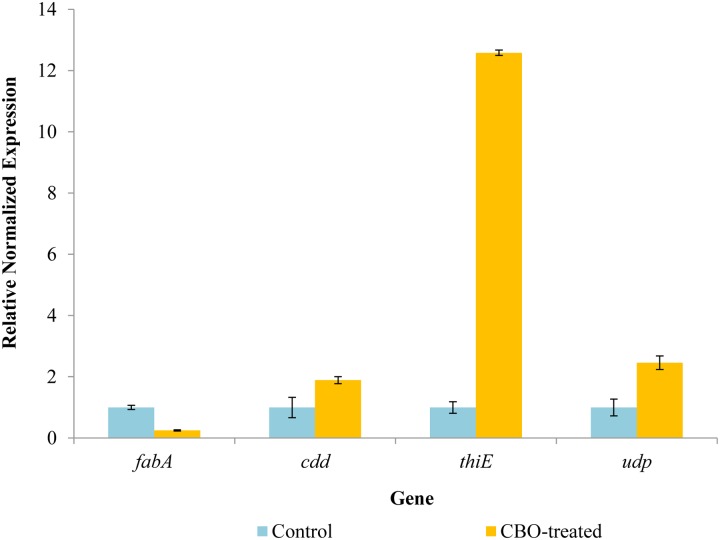
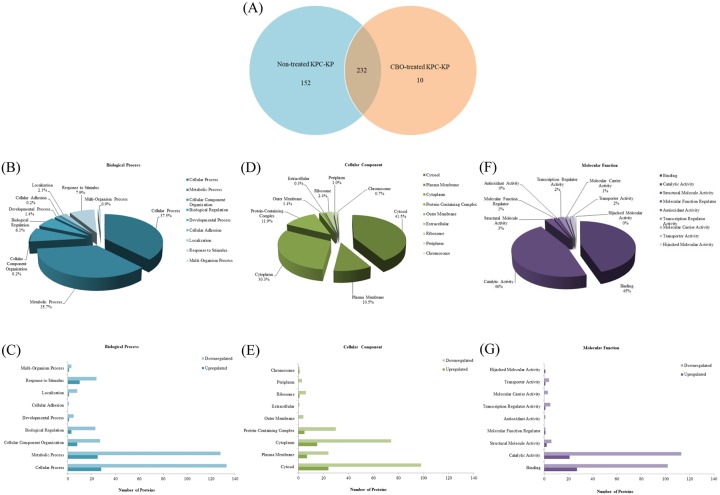
Klebsiella pneumoniae (KP) remains the most prevalent nosocomial pathogen and carries the carbapenemase (KPC) gene which confers resistance towards carbapenem. Thus, it is necessary to discover novel antimicrobials to address the issue of antimicrobial resistance in such pathogens. Natural products such as essential oils are a promising source due to their complex composition. Essential oils have been shown to be effective against pathogens, but the overall mechanisms have yet to be fully explained. Understanding the molecular mechanisms of essential oil towards KPC-KP cells would provide a deeper understanding of their potential use in clinical settings. Therefore, we aimed to investigate the mode of action of essential oil against KPC-KP cells from a proteomic perspective by comparing the overall proteome profile of KPC-KP cells treated with cinnamon bark (Cinnamomum verum J. Presl) essential oil (CBO) at their sub-inhibitory concentration of 0.08% (v/v). A total of 384 proteins were successfully identified from the non-treated cells, whereas only 242 proteins were identified from the CBO-treated cells. Proteins were then categorized based on their biological processes, cellular components and molecular function prior to pathway analysis. Pathway analysis showed that CBO induced oxidative stress in the KPC-KP cells as indicated by the abundance of oxidative stress regulator proteins such as glycyl radical cofactor, catalase peroxidase and DNA mismatch repair protein. Oxidative stress is likely to oxidize and disrupt the bacterial membrane as shown by the loss of major membrane proteins. Several genes selected for qRT-PCR analysis validated the proteomic profile and were congruent with the proteomic abundance profiles. In conclusion, KPC-KP cells exposed to CBO undergo oxidative stress that eventually disrupts the bacterial membrane possibly via interaction with the phospholipid bilayer. Interestingly, several pathways involved in the bacterial membrane repair system were also affected by oxidative stress, contributing to the loss of cells viability.
肺炎克雷伯菌(KP)仍然是最常见的医院病原体,携带碳青霉烯酶(KPC)基因,使其对碳青霉烯类药物产生耐药性。因此,有必要发现新的抗菌药物来解决此类病原体的抗菌药物耐药问题。天然产物,如精油,由于其复杂的成分,是一种很有前途的来源。精油已被证明对病原体有效,但总体机制尚未得到充分解释。从蛋白质组学的角度了解精油对 KPC-KP 细胞的作用机制,可以更深入地了解它们在临床环境中的潜在用途。因此,我们旨在从蛋白质组学的角度研究精油对 KPC-KP 细胞的作用模式,比较肉桂皮(Cinnamomum verum J. Presl)精油(CBO)在其亚抑制浓度 0.08%(v/v)下处理 KPC-KP 细胞的总蛋白质组图谱。从未经处理的细胞中成功鉴定出 384 种蛋白质,而从 CBO 处理的细胞中仅鉴定出 242 种蛋白质。然后根据其生物学过程、细胞成分和分子功能对蛋白质进行分类,然后进行途径分析。途径分析表明,CBO 诱导 KPC-KP 细胞发生氧化应激,这表明氧化应激调节剂蛋白(如甘氨酰基自由基辅因子、过氧化氢酶过氧化物酶和 DNA 错配修复蛋白)的丰度增加。氧化应激可能会氧化并破坏细菌膜,正如主要膜蛋白的丢失所表明的那样。选择进行 qRT-PCR 分析的几个基因验证了蛋白质组图谱,并与蛋白质组丰度图谱一致。总之,暴露于 CBO 的 KPC-KP 细胞发生氧化应激,最终可能通过与磷脂双层相互作用破坏细菌膜。有趣的是,参与细菌膜修复系统的几个途径也受到氧化应激的影响,导致细胞活力丧失。