Department of Medicine, Division of Rheumatology and Immunology, Medical University of South Carolina, 96 Jonathan Lucas Street, Charleston, SC, 29425, USA.
College of Medicine, Department of Public Health Sciences, Medical University of South Carolina, 96 Jonathan Lucas Street, Charleston, SC, 29425, USA.
Arthritis Res Ther. 2019 Apr 2;21(1):85. doi: 10.1186/s13075-019-1870-6.
Systemic sclerosis (SSc) is a female-predominant disease, characterized by excessive extracellular matrix deposition (ECM) with dermal and internal organ fibrosis. Considering the sex-based disparity in disease incidence, estradiol (E2), an estrogen form with pro-fibrotic effects, may play a role in SSc. We reported that post-menopausal women with diffuse cutaneous (dc)SSc have higher serum E2 levels compared to similar aged, healthy controls. Since males with SSc tend to have more severe disease, we examined serum E2 in dcSSc males in relation to disease characteristics and survival.
We measured serum E2 in 83 dcSSc men > 50 years old from the University of Pittsburgh Scleroderma Center and similar aged healthy controls. Using statistical modeling, we examined the associations between serum E2, internal organ involvement, autoantibody profiles, and survival.
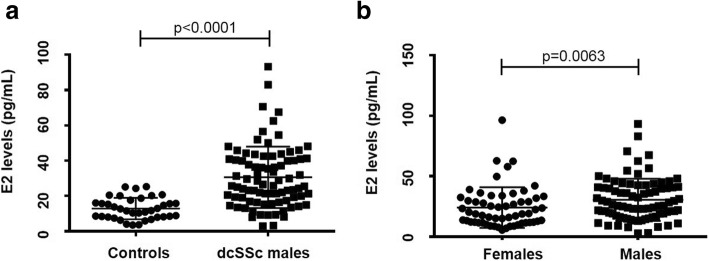
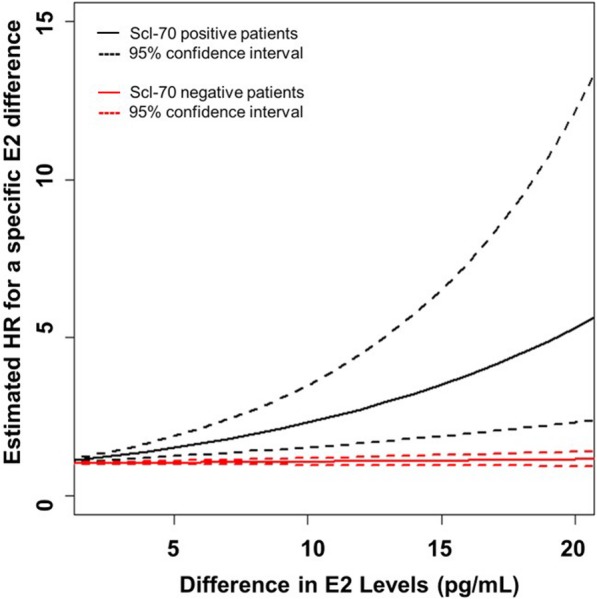
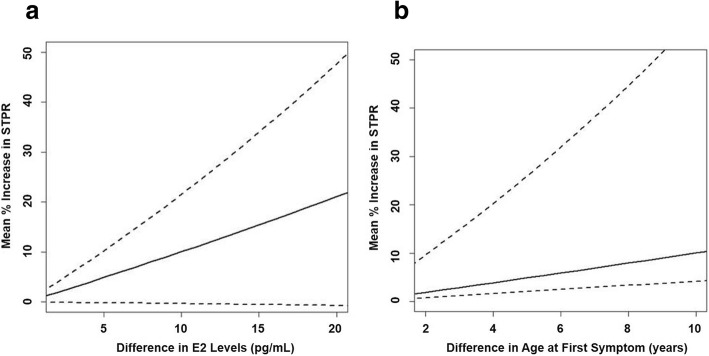
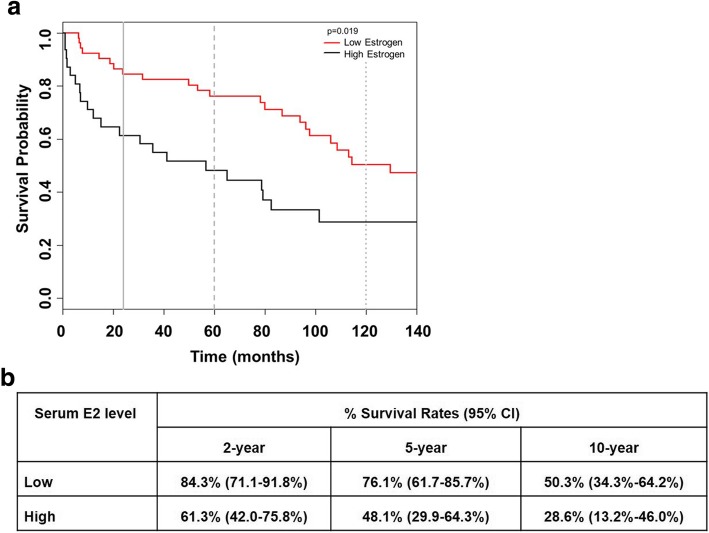
Male dcSSc patients had significantly higher serum E2 levels compared to healthy males and similar aged dcSSc post-menopausal women. Male dcSSc patients with high serum E2 had significantly more heart involvement, a trend for higher skin thickness progression rate, and worse survival. Using Cox regression modeling, increased serum E2 levels in anti-Scl-70 antibody-positive dcSSc males were associated with an increased risk of death.
dcSSc males > 50 years old have higher levels of serum E2 compared to healthy controls and dcSSc post-menopausal women. Elevated serum E2 levels in dcSSc males are associated with heart involvement, trend to progression of dermal fibrosis, and, if anti-Scl-70 antibody positive, worse survival. Our study expands on previous work implicating E2 in dermal fibrosis in SSc and associates E2 levels with internal organ involvement and survival. These data suggest a role for estrogen imbalance in dcSSc.
系统性硬化症(SSc)是一种以女性为主的疾病,其特征是细胞外基质(ECM)过度沉积,伴有皮肤和内脏器官纤维化。鉴于疾病发病率的性别差异,具有促纤维化作用的雌激素形式雌二醇(E2)可能在 SSc 中发挥作用。我们曾报道,弥漫性皮肤型(dc)SSc 的绝经后女性血清 E2 水平高于同龄健康对照者。由于 SSc 男性的疾病往往更严重,因此我们检测了 dcSSc 男性的血清 E2 与疾病特征和生存的关系。
我们检测了来自匹兹堡大学硬皮病中心的 83 名年龄>50 岁的 dcSSc 男性患者和同龄健康对照者的血清 E2。我们采用统计学模型,研究了血清 E2 与内脏器官受累、自身抗体谱和生存之间的关系。
与健康男性和同龄 dcSSc 绝经后女性相比,dcSSc 男性患者的血清 E2 水平显著升高。血清 E2 水平较高的男性 dcSSc 患者心脏受累更明显,皮肤厚度进展率升高,生存更差。使用 Cox 回归模型,抗 Scl-70 抗体阳性的 dcSSc 男性血清 E2 水平升高与死亡风险增加相关。
年龄>50 岁的 dcSSc 男性患者的血清 E2 水平高于健康对照者和 dcSSc 绝经后女性。dcSSc 男性患者血清 E2 水平升高与心脏受累、皮肤纤维化进展趋势有关,如果抗 Scl-70 抗体阳性,则生存更差。本研究扩展了之前的研究结果,表明 E2 参与了 SSc 中的皮肤纤维化,并将 E2 水平与内脏器官受累和生存相关联。这些数据提示雌激素失衡在 dcSSc 中发挥作用。