Department of Molecular and Cell Biology, University of Leicester, Leicester, U.K.
Essays Biochem. 2019 Apr 23;63(1):97-107. doi: 10.1042/EBC20180061.
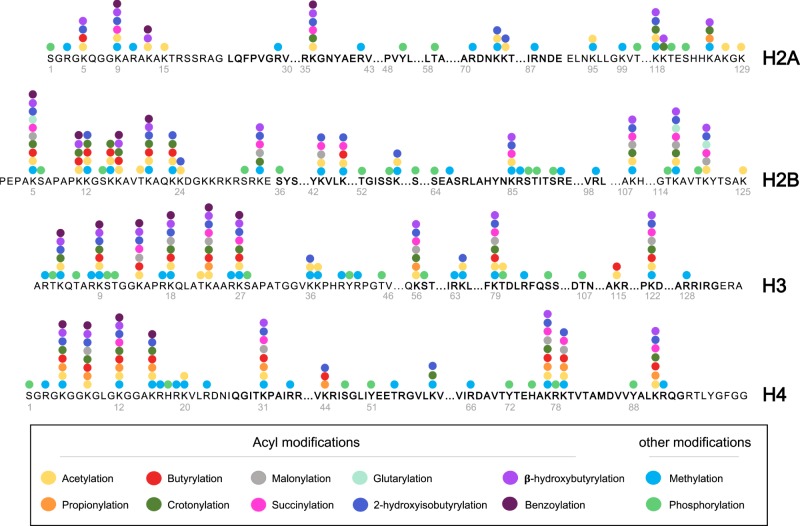
Packaging the long and fragile genomes of eukaryotic species into nucleosomes is all well and good, but how do cells gain access to the DNA again after it has been bundled away? The solution, in every species from yeast to man, is to post-translationally modify histones, altering their chemical properties to either relax the chromatin, label it for remodelling or make it more compact still. Histones are subject to a myriad of modifications: acetylation, methylation, phosphorylation, ubiquitination etc. This review focuses on histone acylations, a diverse group of modifications which occur on the ε-amino group of Lysine residues and includes the well-characterised Lysine acetylation. Over the last 50 years, histone acetylation has been extensively characterised, with the discovery of histone acetyltransferases (HATs) and histone deacetylases (HDACs), and global mapping experiments, revealing an association of hyperacetylated histones with accessible, transcriptionally active chromatin. More recently, there has been an explosion in the number of unique short chain 'acylations' identified by MS, including: propionylation, butyrylation, crotonylation, succinylation, malonylation and 2-hydroxyisobutyrylation. These novel modifications add a range of chemical environments to histones, and similar to acetylation, appear to accumulate at transcriptional start sites and correlate with gene activity.
将真核物种的长而脆弱的基因组包装到核小体中是很好的,但是细胞在将 DNA 捆绑起来后如何再次获得访问权限呢?在从酵母到人等所有物种中,解决方案都是对组蛋白进行翻译后修饰,改变其化学性质,要么使染色质松弛,对其进行重塑,要么使其更加紧凑。组蛋白会受到多种修饰:乙酰化、甲基化、磷酸化、泛素化等。这篇综述重点介绍了组蛋白酰化,这是一组多样化的修饰,发生在赖氨酸残基的ε-氨基上,包括特征明确的赖氨酸乙酰化。在过去的 50 年中,组蛋白乙酰化已得到广泛研究,发现了组蛋白乙酰转移酶 (HATs) 和组蛋白去乙酰化酶 (HDACs),以及全局作图实验,揭示了高乙酰化组蛋白与可及的、转录活跃的染色质有关。最近,通过 MS 鉴定出了大量独特的短链“酰化”,包括:丙酰化、丁酰化、巴豆酰化、琥珀酰化、丙二酰化和 2-羟基异丁酰化。这些新的修饰为组蛋白添加了一系列化学环境,并且与乙酰化相似,似乎在转录起始位点积累,并与基因活性相关。