Department of Endocrinology, Peking University First Hospital, No. 8 Xishiku Avenue, Xicheng District, Beijing 100034, China.
Oxid Med Cell Longev. 2019 Mar 3;2019:4628962. doi: 10.1155/2019/4628962. eCollection 2019.
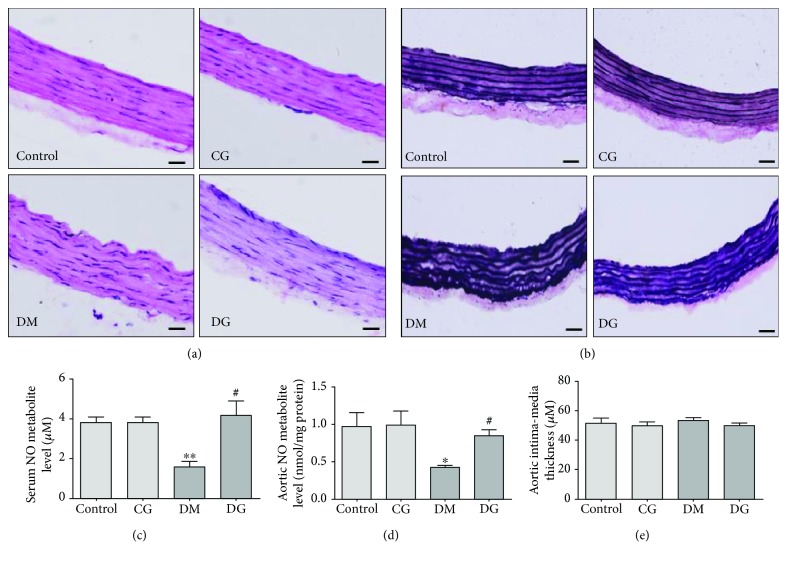
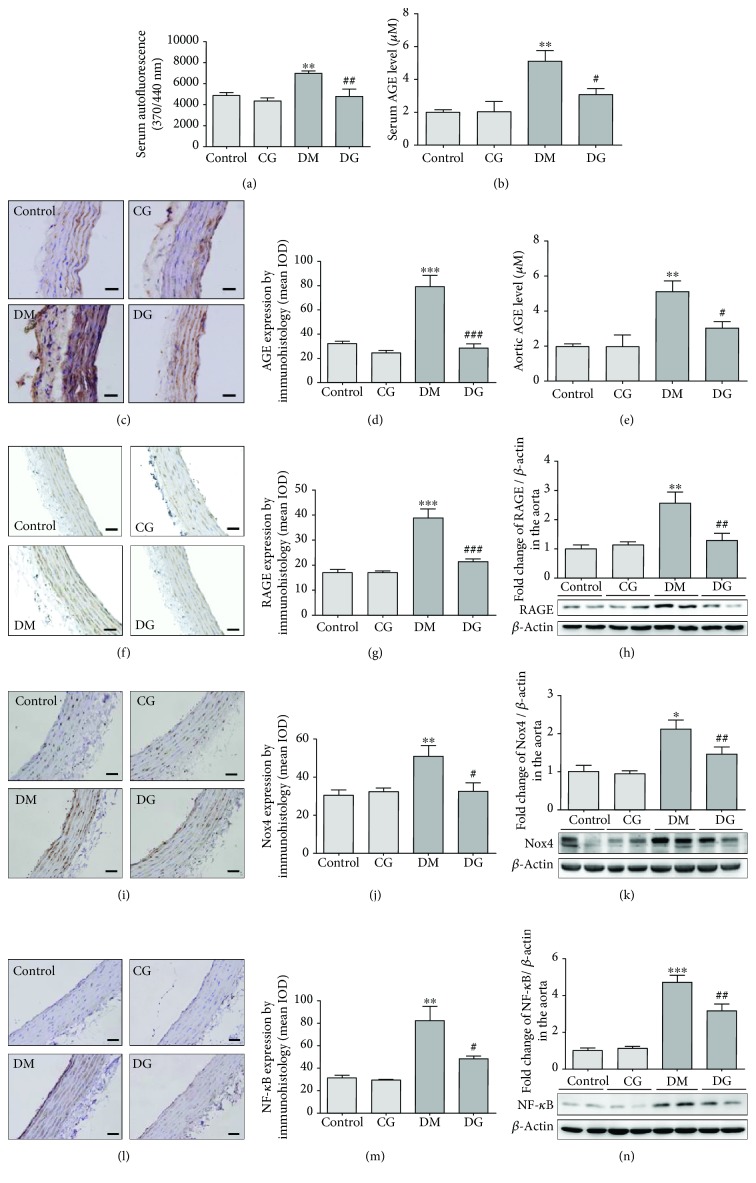
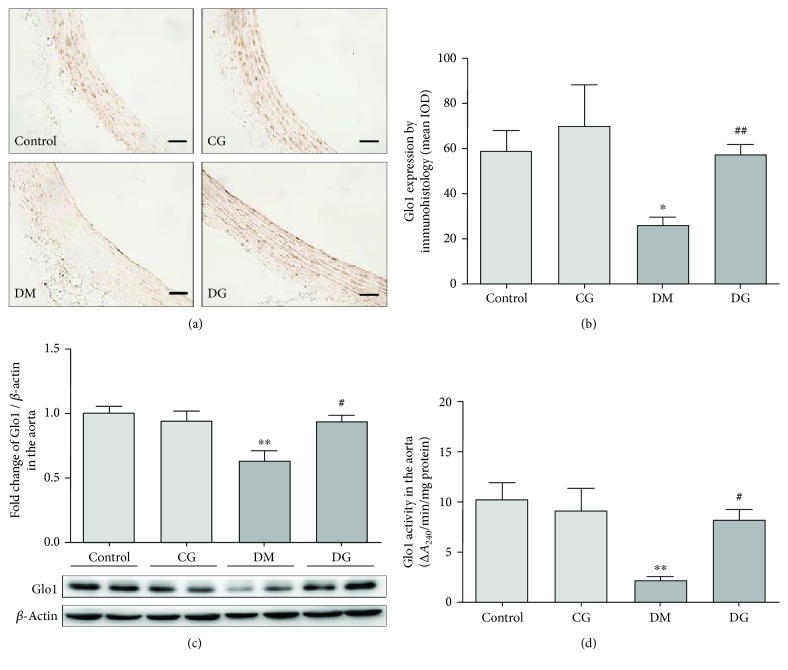
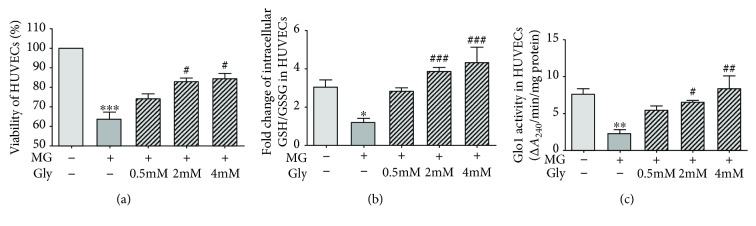
Oxidative stress plays a crucial role in the pathogenesis of diabetic vascular complications. It is known that the accumulation of advanced glycation end products (AGEs) and the activation of the receptor of AGEs (RAGE) induce sustained oxidative stress in the vascular tissue. Growing evidence indicates that glycine, the simplest amino acid, exerts antioxidant and antiglycation effects and also improves vascular function. However, the mechanism whereby glycine protects vascular tissue against oxidative stress in models with diabetes has not been investigated. In the present study, we evaluated whether glycine can attenuate oxidative stress by suppressing the AGE/RAGE signaling pathway in the aorta of streptozotocin-induced diabetic rats and in human umbilical vascular endothelial cells (HUVECs). Our results showed that oral glycine administration increased NO content and ameliorated oxidative stress in the serum and aorta of diabetic rats. The AGE/RAGE signaling pathway in the aorta of diabetic rats was significantly attenuated by glycine treatment as manifested by decreases in levels of AGEs, RAGE, Nox4, and NF-B p65. The suppressive effect of glycine on the formation of AGEs was associated with increased activity and expression of aortic glyoxalase-1 (Glo1), a crucial enzyme that degrades methylglyoxal (MG), the major precursor of AGEs. In MG-treated HUVECs, glycine restored the function of Glo1, suppressed the AGE/RAGE signaling pathway, and inhibited the generation of reactive oxygen species. In addition, the reduction in the formation of AGEs in HUVECs caused by glycine treatment was inhibited by Glo1 inhibition. Taken together, our study provides evidence that glycine might inhibit the AGE/RAGE pathway and subsequent oxidative stress by improving Glo1 function, thus protecting against diabetic macrovascular complications.
氧化应激在糖尿病血管并发症的发病机制中起着关键作用。已知糖基化终产物(AGEs)的积累和 AGEs 受体(RAGE)的激活会在血管组织中引起持续的氧化应激。越来越多的证据表明,最简单的氨基酸甘氨酸具有抗氧化和抗糖化作用,并且可以改善血管功能。然而,甘氨酸在糖尿病模型中保护血管组织免受氧化应激的机制尚未得到研究。在本研究中,我们评估了甘氨酸是否可以通过抑制链脲佐菌素诱导的糖尿病大鼠主动脉和人脐静脉内皮细胞(HUVEC)中的 AGE/RAGE 信号通路来减轻氧化应激。我们的结果表明,口服甘氨酸给药可增加 NO 含量并改善糖尿病大鼠血清和主动脉中的氧化应激。甘氨酸处理可显着减弱糖尿病大鼠主动脉中的 AGE/RAGE 信号通路,表现为 AGEs、RAGE、Nox4 和 NF-B p65 水平降低。甘氨酸对 AGE 形成的抑制作用与主动脉甘油醛-3-磷酸脱氢酶 1(Glo1)活性和表达的增加有关,Glo1 是降解甲基乙二醛(MG)的关键酶,MG 是 AGE 的主要前体。在 MG 处理的 HUVEC 中,甘氨酸恢复了 Glo1 的功能,抑制了 AGE/RAGE 信号通路,并抑制了活性氧的产生。此外,甘氨酸处理可减少 HUVEC 中 AGE 的形成,而 Glo1 抑制可抑制该作用。总之,我们的研究提供了证据表明,甘氨酸通过改善 Glo1 功能可能抑制 AGE/RAGE 途径和随后的氧化应激,从而防止糖尿病大血管并发症。