Department of Cardiology, Renmin Hospital of Wuhan University, Wuhan 430060, China.
Cardiovascular Research Institute, Wuhan University, Wuhan 430060, China.
Oxid Med Cell Longev. 2019 Feb 28;2019:9208949. doi: 10.1155/2019/9208949. eCollection 2019.
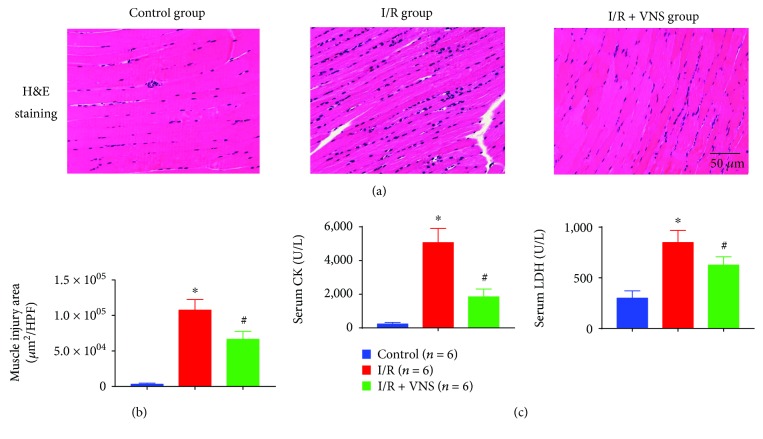
Vagus nerve stimulation (VNS) has been shown to attenuate ischemia-reperfusion (I/R) injury in multiple organs. The present study aimed at investigating whether VNS could exert protective effects against I/R injury in the skeletal muscle. Male Sprague-Dawley rats were randomly divided into 3 groups: the control, I/R, and I/R+VNS groups. The skeletal muscle I/R (SMI/R) model was induced by occlusion of the left femoral artery for 2.5 hours followed by reperfusion for 2 hours. The vagal nerve trunk was separated, and VNS was performed during the whole I/R process. The intensity of VNS was optimized in each rat to obtain a 10% reduction in the heart rate relative to the value before stimulation. After the experiment, the blood sample and left gastrocnemius muscle tissues were collected for histological examination, biochemical analysis, and molecular biological detection. During the I/R process, VNS significantly reduced cellular apoptosis, necrosis, and inflammatory cell infiltration compared to sham VNS. The VNS treatment also decreased the inflammatory response, alleviated oxidative stress, and improved vascular endothelial function ( < 0.05 for each). In contrast, the I/R group showed an opposite effect compared to the control group. The present study indicated that VNS could protect against SMI/R injury by suppressing excessive inflammation, alleviating oxidative stress, and preserving vascular endothelial function.
迷走神经刺激(VNS)已被证明可减轻多个器官的缺血再灌注(I/R)损伤。本研究旨在探讨 VNS 是否可以对骨骼肌的 I/R 损伤发挥保护作用。雄性 Sprague-Dawley 大鼠随机分为 3 组:对照组、I/R 组和 I/R+VNS 组。通过阻断左股动脉 2.5 小时,然后再灌注 2 小时来建立骨骼肌 I/R(SMI/R)模型。分离迷走神经干,并在整个 I/R 过程中进行 VNS。在每只大鼠中优化 VNS 的强度,以获得相对于刺激前心率降低 10%。实验结束后,采集血样和左腓肠肌组织进行组织学检查、生化分析和分子生物学检测。在 I/R 过程中,与假刺激 VNS 相比,VNS 可显著减少细胞凋亡、坏死和炎症细胞浸润。VNS 治疗还可减轻炎症反应、缓解氧化应激和改善血管内皮功能(每种情况均 < 0.05)。相比之下,I/R 组与对照组相比则表现出相反的效果。本研究表明,VNS 通过抑制过度炎症、缓解氧化应激和保护血管内皮功能来防止 SMI/R 损伤。