Haith Adrian M, Krakauer John W
Department of Neurology, Johns Hopkins University, Baltimore, MD, USA.
Department of Neuroscience, Johns Hopkins University, Baltimore, MD, USA.
Curr Opin Behav Sci. 2018 Apr;20:196-201. doi: 10.1016/j.cobeha.2018.01.015. Epub 2018 Mar 1.
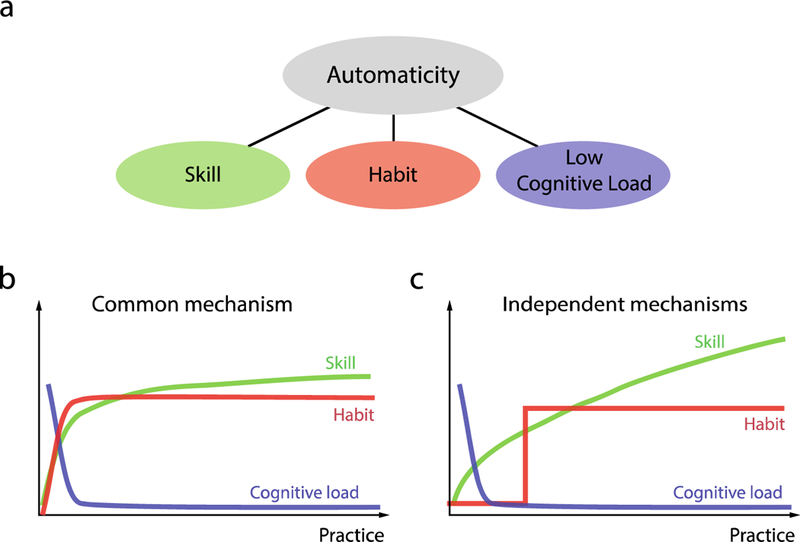
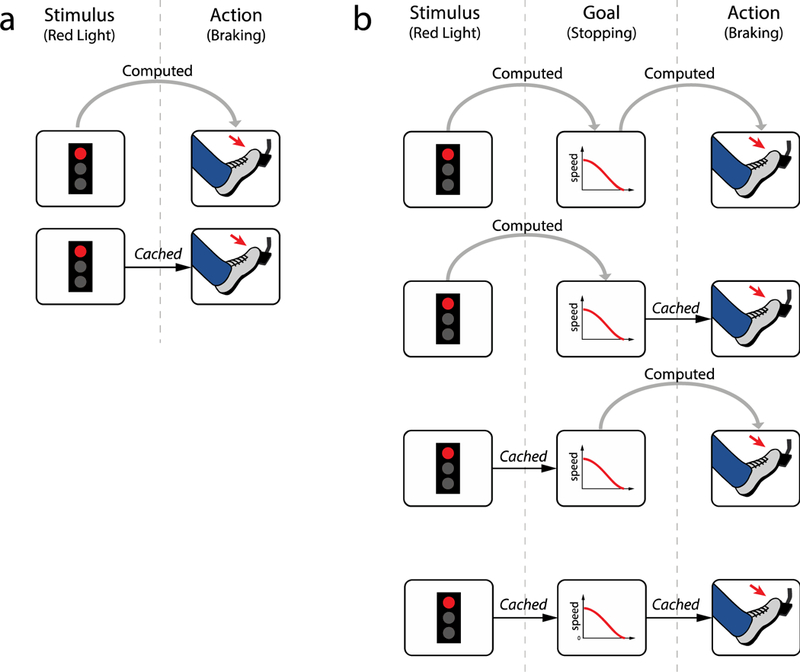
When learning a new skill, even if we have been instructed exactly what to do, it is often necessary to practice for hours or even weeks before we achieve proficient and fluid performance. Practice has a multitude of effects on behavior, including increasing the speed of performance, rendering the practiced behavior habitual and reducing the cognitive load required to perform the task. These effects are often collectively referred to as . Here, we argue that these effects can be explained as multiple consequences of a single principle: caching of the outcome of frequently occuring computations. We further argue that, in the context of more complex task representations, caching different intermediate computations can give rise to more nuanced behavioral signatures, including dissociation between skill, habit and cognitive load.
在学习一项新技能时,即便我们已被明确告知该做什么,但通常仍需练习数小时甚至数周,才能达到熟练流畅的表现。练习对行为有诸多影响,包括提高表现速度、使练习的行为成为习惯以及降低执行任务所需的认知负荷。这些影响通常被统称为 。在此,我们认为这些影响可被解释为单一原则的多种结果:对频繁出现的计算结果进行缓存。我们进一步认为,在更复杂的任务表征背景下,缓存不同的中间计算结果会产生更细微的行为特征,包括技能、习惯和认知负荷之间的分离。