Department of Psychiatry, Massachusetts General Hospital and Harvard Medical School, 149 13th St, Boston, MA, 02129, USA.
Picower Institute for Learning and Memory, Massachusetts Institute of Technology, 43 Vassar St, Cambridge, MA, 02139, USA.
Nat Commun. 2019 Apr 4;10(1):1536. doi: 10.1038/s41467-019-09557-4.
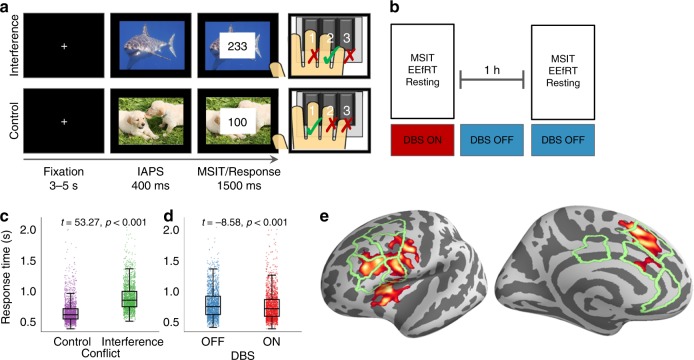
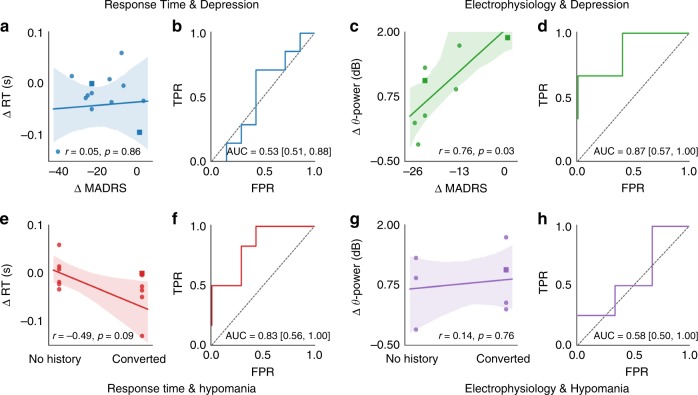
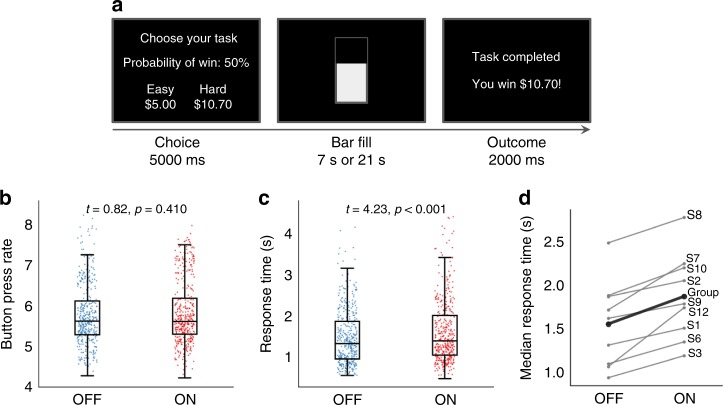
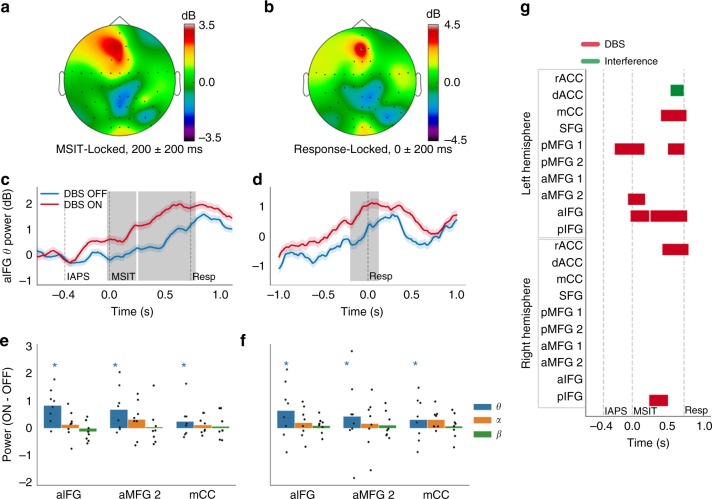
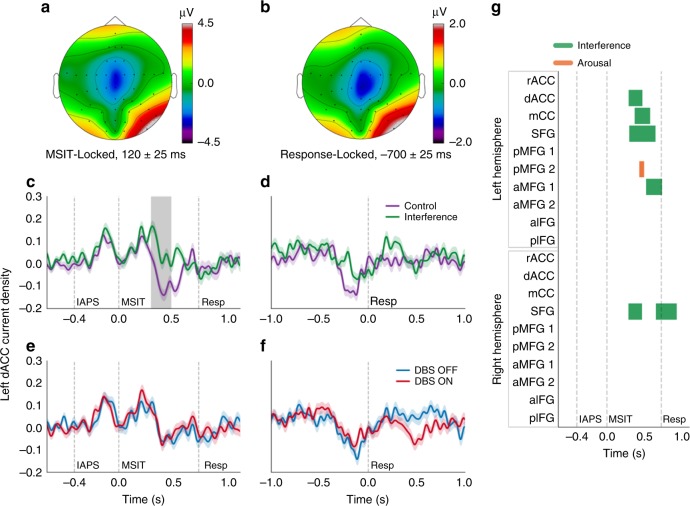
Deep brain stimulation (DBS) is a circuit-oriented treatment for mental disorders. Unfortunately, even well-conducted psychiatric DBS clinical trials have yielded inconsistent symptom relief, in part because DBS' mechanism(s) of action are unclear. One clue to those mechanisms may lie in the efficacy of ventral internal capsule/ventral striatum (VCVS) DBS in both major depression (MDD) and obsessive-compulsive disorder (OCD). MDD and OCD both involve deficits in cognitive control. Cognitive control depends on prefrontal cortex (PFC) regions that project into the VCVS. Here, we show that VCVS DBS' effect is explained in part by enhancement of PFC-driven cognitive control. DBS improves human subjects' performance on a cognitive control task and increases theta (5-8Hz) oscillations in both medial and lateral PFC. The theta increase predicts subjects' clinical outcomes. Our results suggest a possible mechanistic approach to DBS therapy, based on tuning stimulation to optimize these neurophysiologic phenomena.
脑深部刺激(DBS)是一种针对精神障碍的以回路为导向的治疗方法。不幸的是,即使是经过精心设计的精神科 DBS 临床试验也未能产生一致的症状缓解效果,部分原因是 DBS 的作用机制尚不清楚。这些机制的一个线索可能在于腹侧内囊/腹侧纹状体(VCVS)DBS 在重度抑郁症(MDD)和强迫症(OCD)中的疗效。MDD 和 OCD 都涉及认知控制缺陷。认知控制依赖于投射到 VCVS 的前额叶皮层(PFC)区域。在这里,我们表明,VCVS DBS 的作用部分是通过增强 PFC 驱动的认知控制来解释的。DBS 提高了人类受试者在认知控制任务上的表现,并增加了内侧和外侧 PFC 中的θ(5-8Hz)振荡。θ 增加预测了受试者的临床结果。我们的结果表明,基于调整刺激以优化这些神经生理现象,DBS 治疗可能有一个可行的机制方法。