Jeppesen Rose, Benros Michael Eriksen
Mental Health Centre Copenhagen, Gentofte Hospital, Copenhagen University Hospital, Hellerup, Denmark.
Front Psychiatry. 2019 Mar 20;10:131. doi: 10.3389/fpsyt.2019.00131. eCollection 2019.
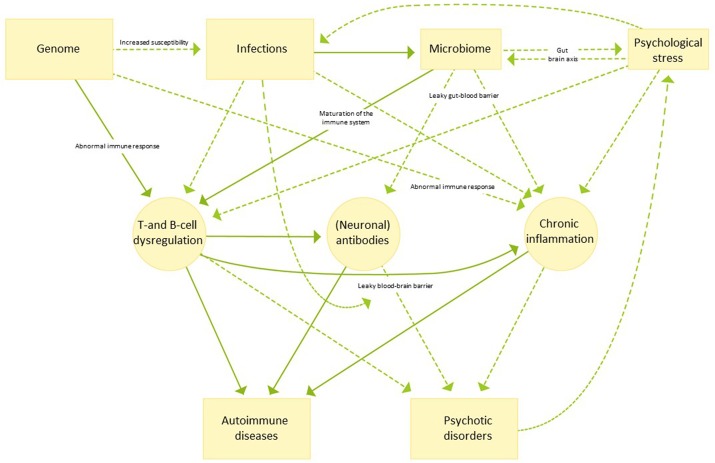
The notion of immunological pathways playing a role in the etiology of a subset of psychotic disorders has received increased interest in the last decades. One of the findings that has spiked interest herein, is an apparent link between autoimmune diseases and psychotic disorders. This is supported by genetic findings associating immune-related genetic markers with schizophrenia and clinical studies finding increased levels of inflammatory markers in patients with psychosis. Several large-scale epidemiologic studies have found positive associations between autoimmune diseases and psychosis. Particularly, autoimmune diseases as multiple sclerosis and lupus are known to have higher frequencies of neuropsychiatric symptoms, including psychosis, compared to healthy controls. Cross sectional studies have found higher prevalence of psychiatric diagnoses among those with autoimmune diseases, and longitudinal studies have shown bidirectional associations between several autoimmune diseases and increased risks associated with schizophrenia. Moreover, a family history of autoimmune diseases has been shown to be associated with an increased risk of psychotic disorders and vice versa. In this review we will summarize the epidemiologic evidence on associations between autoimmune diseases and psychosis. Possible mechanisms accountable for the association will be discussed, amongst others the probable role of shared genetic risk factors, the impact of infections on both autoimmunity and the development of psychotic disorders, and the potential role of the microbiome. We discuss the findings on and influence of autoantibodies and dysregulation of T- and B-cells in both disease categories, and why further research hereon is needed. In addition to the potential importance of autoimmunity in etiological mechanisms of psychotic disorders, the association also brings important attention to somatic comorbidity in patients with psychotic disorders.
在过去几十年中,免疫途径在一部分精神障碍病因中发挥作用的概念受到了越来越多的关注。其中一项引发人们兴趣的发现是自身免疫性疾病与精神障碍之间存在明显联系。这一观点得到了将免疫相关基因标记与精神分裂症相关联的遗传学研究结果,以及临床研究中发现精神病患者炎症标记物水平升高的支持。多项大规模流行病学研究发现自身免疫性疾病与精神病之间存在正相关。特别是,已知多发性硬化症和狼疮等自身免疫性疾病与健康对照相比,出现包括精神病在内的神经精神症状的频率更高。横断面研究发现自身免疫性疾病患者中精神科诊断的患病率更高,纵向研究表明几种自身免疫性疾病与精神分裂症相关风险增加之间存在双向关联。此外,自身免疫性疾病家族史已被证明与精神障碍风险增加有关,反之亦然。在本综述中,我们将总结关于自身免疫性疾病与精神病之间关联的流行病学证据。将讨论可能导致这种关联的机制,其中包括共享遗传风险因素的可能作用、感染对自身免疫和精神障碍发展的影响以及微生物群的潜在作用。我们将讨论这两种疾病类别中自身抗体以及T细胞和B细胞失调的研究结果及其影响,以及为何需要对此进行进一步研究。除了自身免疫在精神障碍病因机制中的潜在重要性外,这种关联还使人们高度关注精神病患者的躯体合并症。