Schmidt Jennifer, Martin Alexandra
Clinical Psychology and Psychotherapy, School of Human and Social Sciences, University of Wuppertal, Wuppertal, Germany.
Department of Psychology, HSD Hochschule Döpfer University of Applied Sciences, Cologne, Germany.
Front Psychol. 2019 Mar 20;10:579. doi: 10.3389/fpsyg.2019.00579. eCollection 2019.
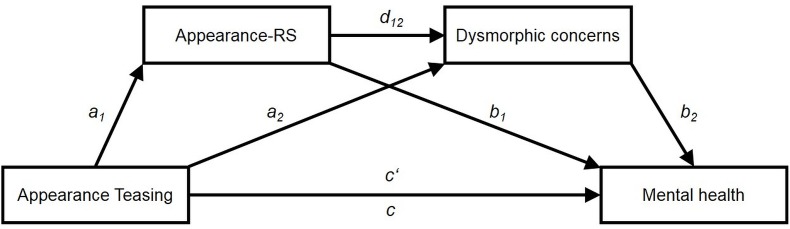
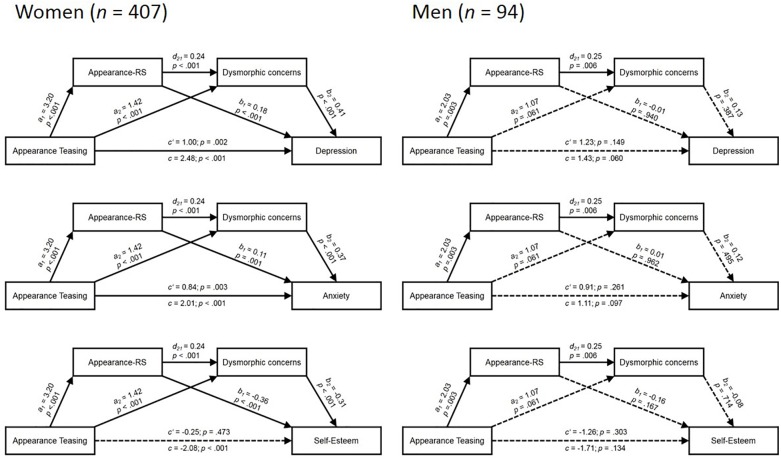
Appearance teasing is a common phenomenon in social interactions, especially in adolescence. Several studies have shown its negative impact on mental health as well as on body image. While these findings prove stable in various contexts, less evidence is available for possible gender differences in these relationships. In particular, the role of two important body image variables - appearance-based rejection sensitivity (ARS) and dysmorphic concerns - and their contribution to mental health impairments has not been assessed in gender-specific process models. In a cross-sectional survey-study ( = 501; 407 f, 94 m), we retrospectively assessed early appearance teasing experiences, as well as current ARS, dysmorphic concerns, depression, anxiety, and self-esteem. We analyzed gender differences in these variables and their interrelations. We then examined the mediating role of ARS and dysmorphic concerns in explaining mental health variables in adulthood due to early appearance teasing in gender-specific serial-mediation models. The results show high ratios of early teasing experiences, but no significant gender difference regarding the frequency of early appearance teasing. While teasing experiences were significantly related to body image variables in adulthood in both genders (s > 0.32; s < 0.010), we observed significant relations with mental health outcomes in women (s > 0.30; s < 0.001) but not in men (s < 0.20; s > 0.250). Serial mediation models show that ARS and dysmorphic concerns mediate the effects of appearance teasing on mental health in all outcomes in women (Δ > 0.17), but not in men (Δ < 0.03). Findings remained stable when controlling for Body-Mass-Index, age, and relationship-status. The findings show similar frequencies of appearance teasing and associated negative effects on body image in men and women. Specifically, in women, the effects of teasing on mental health were stronger and mediated by ARS and dysmorphic concerns. Overall, the results point to the relevance of ARS for etiological models of body image disorders and female mental health. However, men did not show the same relationships of teasing and mental health. Differential resilience factors regarding the negative effects of early appearance teasing could be an important target for future research.
外貌调侃是社交互动中的常见现象,在青少年时期尤为如此。多项研究表明,它对心理健康以及身体意象有负面影响。虽然这些发现在各种背景下都很稳定,但关于这些关系中可能存在的性别差异的证据较少。特别是,两个重要的身体意象变量——基于外貌的拒绝敏感性(ARS)和畸形担忧——的作用及其对心理健康损害的影响,尚未在特定性别的过程模型中得到评估。在一项横断面调查研究(n = 501;407名女性,94名男性)中,我们回顾性评估了早期的外貌调侃经历,以及当前的ARS、畸形担忧、抑郁、焦虑和自尊。我们分析了这些变量中的性别差异及其相互关系。然后,我们在特定性别的系列中介模型中,检验了ARS和畸形担忧在解释成年期心理健康变量(由于早期外貌调侃所致)方面的中介作用。结果显示早期调侃经历的比例很高,但在早期外貌调侃的频率方面没有显著的性别差异。虽然调侃经历在成年期与男女双方的身体意象变量都显著相关(rs > 0.32;ps < 0.010),但我们观察到它与女性的心理健康结果显著相关(rs > 0.30;ps < 0.001),而与男性无关(rs < 0.20;ps > 0.250)。系列中介模型表明,ARS和畸形担忧在女性的所有结果中都介导了外貌调侃对心理健康的影响(Δ > 0.17),但在男性中并非如此(Δ < 0.03)。在控制了体重指数、年龄和恋爱状况后,研究结果依然稳定。研究结果表明,男性和女性的外貌调侃频率及其对身体意象的相关负面影响相似。具体而言,在女性中,调侃对心理健康的影响更强,且由ARS和畸形担忧介导。总体而言,研究结果表明ARS在身体意象障碍和女性心理健康的病因模型中具有相关性。然而,男性并未表现出调侃与心理健康之间的相同关系。关于早期外貌调侃负面影响的不同恢复力因素可能是未来研究的一个重要目标。